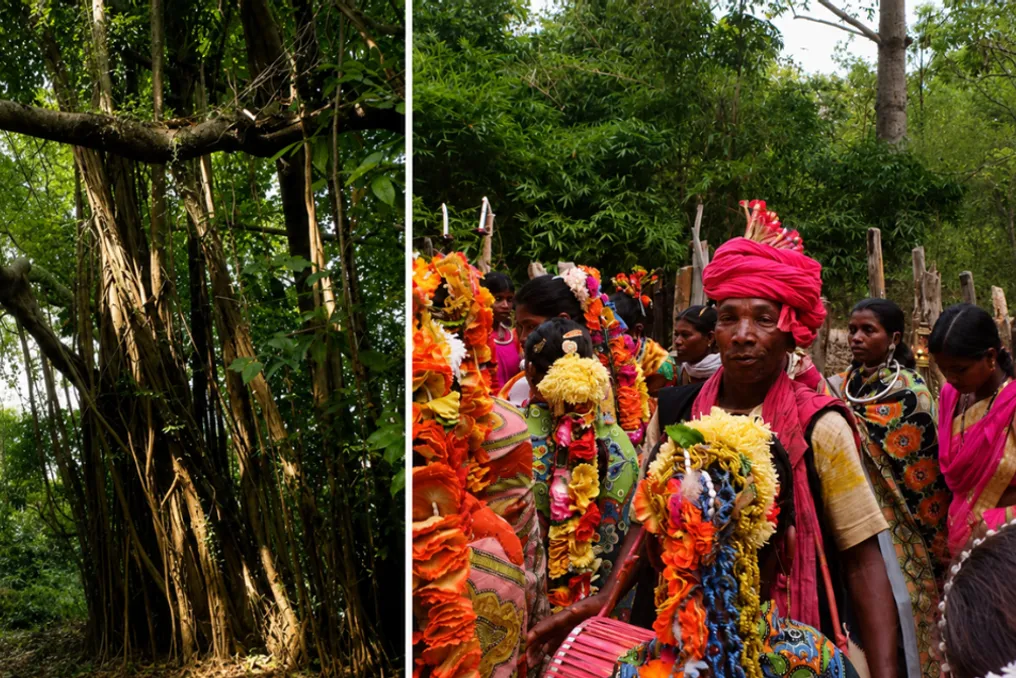
In many regions of India, entering the forest traditionally meant visiting a deity's abode. This also implied stepping onto land where cutting down trees, hunting animals, or even taking fallen timber was forbidden in some places. These rules were rarely documented in writing; instead, they were passed down through generations via stories, rituals, festivals, and warnings.
Today, scientists use terms like 'biodiversity refugia,' 'carbon sinks,' 'watershed basins,' and 'ecological corridors.' However, India has its own, older vocabulary.
There are names such as Devarakadu in Karnataka, Kavu in Kerala, Oran in Rajasthan, Sarna or Jaherthan in Jharkhand, Low Kyintang in Meghalaya, Umang Lai in Manipur, and Dev Van in Himachal Pradesh. Despite differences in landscapes and communities, they share one idea: some forests are not intended for free use.
As forests become increasingly fragmented due to road construction, infrastructure, and other forms of development, this old concept is gaining new relevance.
A Forest with a Boundary You Cannot Always See
Sacred groves are patches of natural vegetation that communities protect due to their religious, cultural, or spiritual significance. They can range from a small number of trees to forest masses spanning several hectares.
The rules vary depending on the location. In some groves, cutting trees and hunting are completely prohibited. In others, communities may collect honey, medicinal plants, or fallen wood according to customs. Since these places are often less disturbed than the surrounding landscapes, they contribute to the conservation of local flora and fauna that have disappeared elsewhere. Furthermore, their canopy helps reduce soil erosion, retain moisture, and support groundwater replenishment.
In arid regions, sacred community lands can provide pastures, fodder, and water for communities. In other words, an age-old cultural practice can simultaneously protect an ecosystem, which in turn continues to support that community.
Nevertheless, the scale of this tradition is difficult to assess. The Centre for Environmental Education (CEE) has documented thousands of sacred groves across India. Its records include 13,270 groves, although earlier estimates suggest the actual number could be significantly higher. CEE itself notes that its documentation is not a final count, and it continues to work on their preservation and restoration.
This uncertainty matters. Sacred groves are not always clearly demarcated areas on government maps. Many of them are community-protected landscapes whose boundaries and rules exist primarily within customary knowledge.
One Idea, Many Names
Traveling from the Western Ghats to the Thar, the name changes depending on the landscape. However, the underlying idea remains strikingly similar.
In Karnataka It Is Devarakadu
In the Malnad region of Karnataka, Devara Kadu is considered more than just a forest. Any activity involving felling, pruning, or clearing trees, as well as weeding, is traditionally prohibited. Five natural elements are revered as part of nature. Nevertheless, these groves are shrinking. A survey showed that their area decreased from approximately 15,000 acres to less than 9,000 acres by 2018. The New Indian Express linked the incursions to factors such as migration and the pursuit of economic gain.
In Kerala They Are Called Kavus
Especially common in Kannur and Kasaragod, the Kavus of Kerala have preserved a significant portion of their original forest character and are home to local species. The Kerala State Biodiversity Board launched a pilot restoration program covering five Kavus. Over 100 local and endangered plant species were identified, and the planting of nearly 3,000 saplings is planned.
Low Kyintang and Umang Lai in the Northeast
In Meghalaya, the Khasi community protects sacred groves known as Law Kyintang or Law Lyngdoh through customary traditions. Researchers from the Assam Royal Global University found that the Ryngkeu Sver Law Kyintang sacred grove accumulates over 100 megagrams of carbon per hectare, with the densest sections reaching 200 Mg/ha. In Manipur, sacred forests associated with deities are known as Umang Lai. About 365 such groves are registered across the state, although recent studies indicate growing pressure from urban expansion.
In Jharkhand Sarna or Jaherthan
In Jharkhand, areas of sacred forests are called Sarna or Jaherthan and are central to tribal worship. Last year, hundreds of Adivasis in traditional attire formed a human chain in Ranchi, waving red-and-white flags of Sarna faith and protesting against the recently constructed ramp of the Siram Toli-Mekkon flyover. Their concern was that the ramp ended just a few feet from Kendriya Sarna Stal, a central sacred grove that attracts hundreds of thousands of visitors annually. Sal (Shorea robusta) is sacred in many such groves, though other species are also found. In East Singhbhum, Santhal and Bhumij communities call these sacred places Jaherthan, where Sal and Mahua (Madhuca longifolia) are found among the trees.
The Thar Has Orans
Nowhere is the ecological value of sacred landscapes as evident as in Rajasthan. The Orans of the Thar can look very different from the dense forests of Kerala or Meghalaya. Nevertheless, they perform many of the same functions. A Supreme Court ruling from December 2024 noted that there are about 25,000 Orans in Rajasthan, covering approximately six lakh hectares, of which about 5.37 lakh hectares are in the western Thar. These landscapes provide pasture, forest produce, medicinal plants, and water. They also help protect springs, ponds, and groundwater systems. Today, they face a new question: how can land needed for India's transition to clean energy coexist with community-protected ecosystems?
This question became particularly apparent around solar and wind energy projects in western Rajasthan, where pastoral communities depend on grasslands and common lands. Conservationist and camel herder Sumer Singh Bati, whom The Better India recently spoke with, highlighted the communities' concerns that large-scale solar energy development could damage grasslands and local grasses like Sevan and Dhaman, upon which livestock depends. Thus, the issue is not simply a conflict between development and conservation. It is also related to recognizing what already exists on the ground—including its ecological functions and community rights.
A Court Draws the Line
This is where the Supreme Court's ruling of December 18, 2024, becomes significant. Considering a case concerning sacred groves in Rajasthan, the Court directed the state to conduct ground and satellite mapping of sacred groves, including Orans, Dev Vans, and Rundhis, and complete their survey and notification in all districts. Crucially, it ruled that their classification should not depend on size. Their cultural and ecological significance is what matters.
The Court also ordered the groves to be classified as forests according to the recommendations of the Central Advisory Committee and proposed protection under the Wildlife Protection Act's community reserve structure. This was an important recognition of what communities had understood for generations: a forest gains value not only when it is large enough to be mapped.
For centuries, these communities protected natural areas not through formal conservation plans, but through faith, customs, and collective responsibility. Names may change from one region to another, as may rituals and rules. But the fundamental principle remains unchanged: some parts of nature deserve protection simply because they sustain life—and because they do not belong to us to destroy.