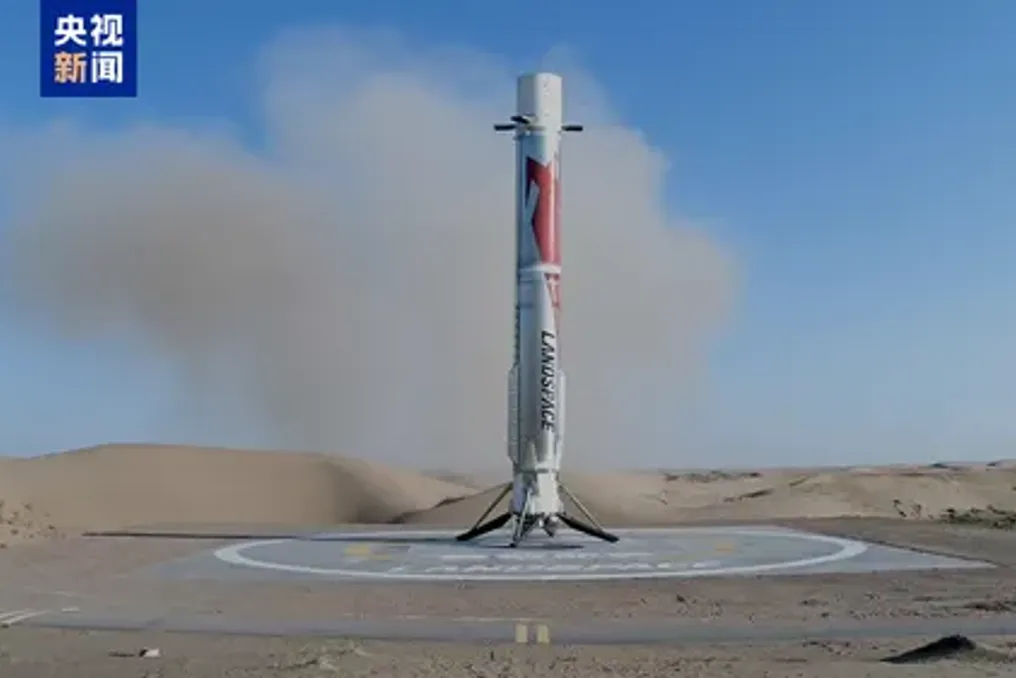
The ground landing of the first stage of the reusable Zhuque-3 rocket was successfully completed according to plan. This event confirmed the success of the entire mission, which took place on August 19, 2026, at the Zhuque-3 landing site in Minqin County, Gansu Province, northwestern China.
The Zhuque-3 Y-2 rocket launched from the Dunfeng Commercial Space Innovation Pilot Zone in northwestern China on Wednesday morning. It successfully placed the Honghu-03 satellite into the designated orbit. According to the rocket developer LandSpace, the sequence of the first stage ground landing proceeded as planned, making the test flight and recovery mission completely successful.
After the separation of the first and second stages, the first stage began the planned return phase. During this phase, it performed several critical maneuvers, including attitude correction at high altitude, controlled deceleration during atmospheric entry, aerodynamic gliding control, engine braking before landing, as well as the deployment and cushioning of landing legs.
Ultimately, the first stage landed stably at the designated area using its landing legs. This allowed for a comprehensive check of the entire process of returning the vehicle from high-speed flight to the ground landing site in Minqin County, Gansu Province, northwestern China.
This mission marked the first successful flight test of the ground landing of a reusable booster's first stage for China, as well as the country's first successful test of landing using deployable landing gear.
The development team made several targeted improvements to key technologies for reusable flights based on data from previous tests and accumulated engineering experience. The landing engine system was optimized by reducing the number of engines used for braking, which simplified the system design. Furthermore, the onboard autonomous safety system received a new function for monitoring the safety of the predicted landing point, and the return control strategies were improved to enhance safety and autonomous control during the recovery flight.
In response to the complex aerodynamic and thermal environment encountered by the rocket during atmospheric entry, the team also increased the rocket's ability to withstand extreme aerodynamic and thermal loads by reinforcing the protective structure.
Due to the specific nature of the satellite delivery mission, the team made adaptive improvements to the satellite separation system and related interfaces, and tested a specially designed device for stacking and compressing satellites.
Zhuque-3 is a new generation liquid oxygen-methane booster independently developed by LandSpace. This company has created a technological system focused on reusable boosters, covering the overall vehicle structure, propulsion systems, return control, stainless steel fuselage manufacturing, and ground support.
According to LandSpace, this mission laid a solid foundation for subsequent inspection and maintenance of the recovered stage, conducting repeat flights, and the commercial application of reusable launch vehicles.