Even India's most powerful artificial intelligence lags behind 171 models while remaining the cheapest. Users can ask bank chatbots about payment failure reasons or ask homework apps to explain photosynthesis to an eighth grader, receiving answers in seconds. However, the origin of these AI systems is a question.
In most cases, the answers are generated by models developed in the US or China, not in India. According to OpenRouter data, from January to July, 94 percent of tasks performed by Indian developers using AI models were implemented by models created in America and China. OpenRouter is a platform that provides access to hundreds of different AI models simultaneously.
The AI benchmarking firm Artificial Analysis tests major global AI models across nine standard tests. 610 models have been tracked, with 257 currently available. This list includes only two models from India, both developed by Sarvam from Bangalore.
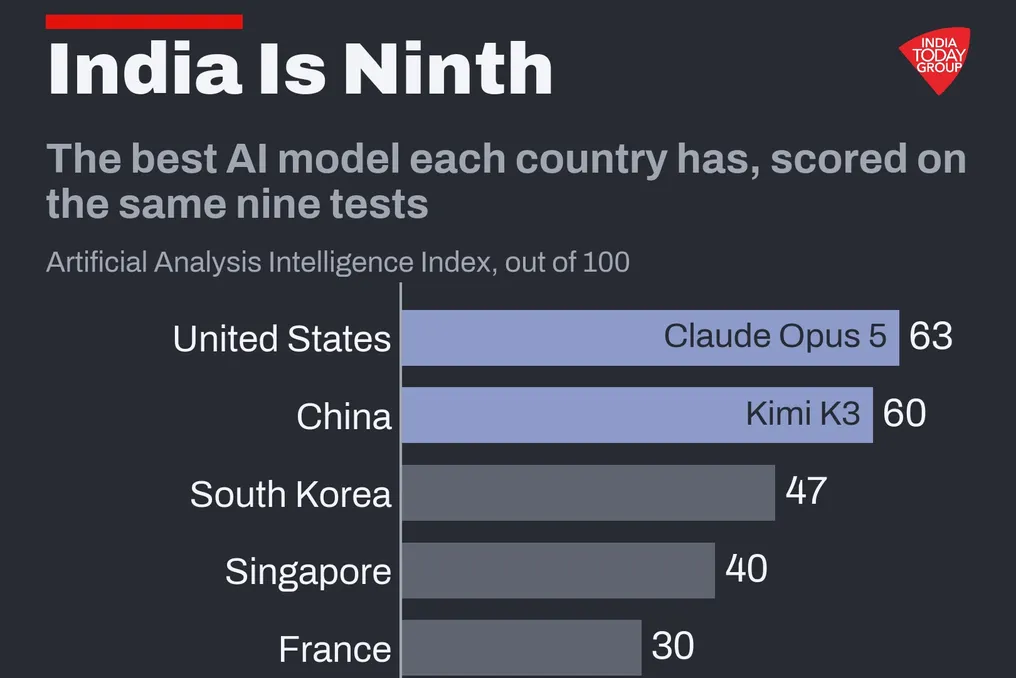
India's most powerful AI model is called Sarvam 105B. According to recent data from Artificial Analysis, its score is only 11.9 out of 100 points. For comparison, the world's most powerful model, Anthropic's Claude Opus 5, has a score of 63.1, and China's most powerful model, Kimi K3, scores 59.7. When looking at countries based on their best AI models, India ranks ninth out of 11 countries. Countries ahead of India include South Korea, Singapore, France, Canada, Spain, and the United Arab Emirates.
It should be noted that Artificial Analysis indicated that the scores for both Sarvam models are preliminary because they have not undergone full testing. Nevertheless, this does not change India's position in the ranking.
Viewing the picture through the lens of time makes it clearer. The first AI model in the world to score over 11.9 points was OpenAI's o1-preview, launched on September 12, 2024. This means that India's best AI model is at the level that the world's best AI model had about two years ago.
Out of the 257 AI models available to developers, 171 models score higher than Sarvam 105B. In January, America released 113 new AI models, and China released 91 new models, while India released only two models.
The problem is not limited to the most powerful and expensive models. For example, OpenAI GPT-OSS-120B is a model that anyone can download and run on their own hardware. Its score of 24.1 is double the score of Sarvam 105B.
One of the significant advantages of Indian AI is its low cost. Sarvam 105B is among the cheapest AI models. According to the report, if performing the same task with Claude Opus 5 costs $10, it will cost approximately 7 cents with Sarvam 105B, representing a price difference of about 135 times. Sarvam also allows users to download and run its models. In contrast, OpenAI and Anthropic do not offer this option for their most powerful models. Chinese companies have also focused on cheap and open AI models, which is reflected in the use of OpenRouter.
In June, Chinese AI models surpassed American models on OpenRouter. Last month, over 60 percent of work on OpenRouter was done by Chinese models. However, the situation in India is different: in India, 94 out of every 100 tasks are performed by foreign AIs. Despite India being one of the large countries using AI, most of this work is done by foreign models.
From January to July, 9 trillion tokens were used via OpenRouter. A token can be represented as a word or part of a word read and written by AI. Based on this usage, India is the tenth largest AI market in the world. Furthermore, 51 percent of this work was done by American models, and 43 percent by Chinese models. Thus, approximately 94 out of every 100 tasks are performed by AIs from America and China, and the remaining 6 percent is distributed among all other countries, including the two Indian models.
There is no exact data on what percentage of AI work in India is performed by Indian models, but existing data clearly shows that most of the AI used in India is not domestically developed.
There is another significant drawback in this ranking. The nine tests conducted by Artificial Analysis check coding, solving scientific problems, general knowledge, and the AI's ability to work independently. However, none of these tests include Indian languages. These tests do not show whether the AI can understand a complaint written in Bollywood language, read a land document in Marathi, or correctly answer a pension question in Tamil. Companies like Sarvam develop AI considering such needs, so a low score in the global ranking does not necessarily mean weakness in the model regarding Indian languages and needs.