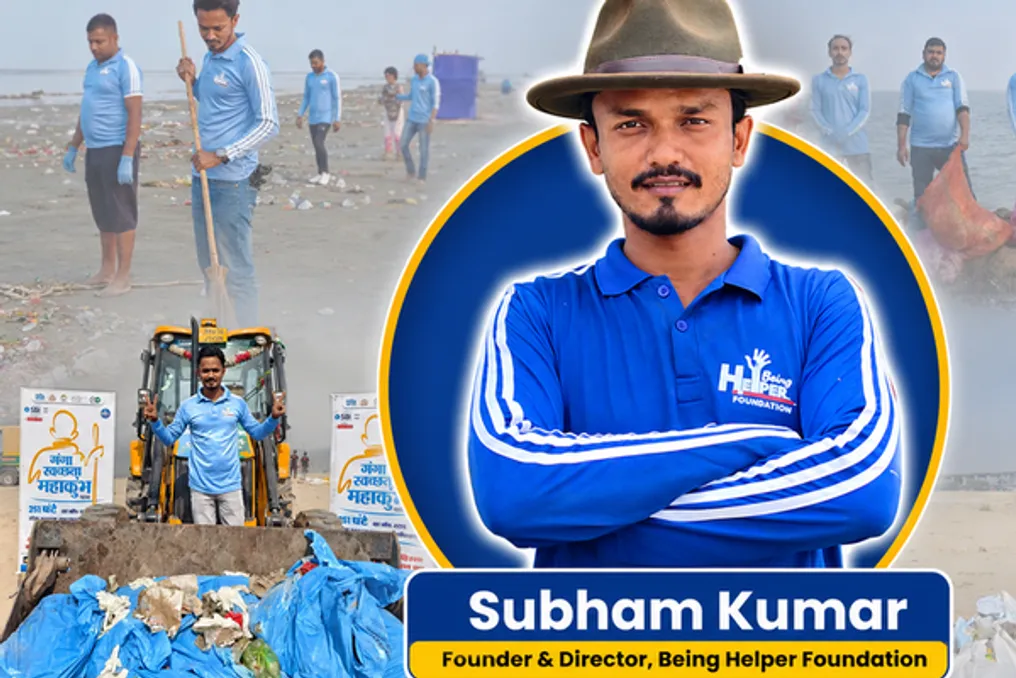
People often feel regret when seeing trash, plastic bottles, and dirt on the ghats of the Ganges River in Patna. However, Shubham Kumar from Bihar decided to turn this feeling into active action. As a civil engineer by profession, Shubham left his job in 2018 and began cleaning the Digha Ganga Ghat in Patna. Initially, he did not have a large team, but today his initiative has attracted over 1100 volunteers.
Through the Being Helper Foundation, Shubham Kumar is involved not only in maintaining cleanliness but also in managing plastic waste, planting trees, developing civic responsibility, and engaging local communities. Furthermore, he is an ambassador for Namami Gange and BUIDCo Bihar. His story demonstrates a new image of Bihar, where youth do not just discuss problems but create solutions at the local level.
Having grown up in Bihar, Shubham was connected to rivers, public spaces, and local residents from an early age. He received an engineering education and worked as a civil engineer. He then moved to Bengaluru, where he worked for a private company. His career was progressing well: he had a job, his future was secure, and life was going smoothly. Nevertheless, a question slowly began to arise within him:
Is professional success determined solely by a good job and a better position? Or does it also include what we can change for other people and places?
He partially found the answer to this question during a trip to Varanasi. Observing the Ganga Aarti at Dashashwamedh Ghat, he saw that the river is closely linked to culture, faith, tourism, and the local economy. From boatmen to flower sellers and small stalls—the livelihoods of many people depended on this river.
In an interview with YourStory, Shubham Kumar, founder and director of the Being Helper Foundation, stated: 'After watching the Ganga Aarti in Varanasi, I realized that the river is not just a flow of water. It is connected to the culture, tourism, and livelihoods of thousands of people. I thought that if the Ganges remains clean and healthy, the benefit will not only be for the environment. It can also create better economic opportunities for communities dependent on the river. When I returned to Patna and saw the condition of the ghats, I felt I could no longer remain just a spectator.'
Upon returning from Varanasi, the state of the Patna ghats worried Shubham. Piles of plastic and other garbage were visible in many places, and dead animals could be seen in some areas. He felt that instead of just talking about the problem, it was more important for someone to take the first step.
In 2018, he started cleaning the Digha Ganga Ghat. On the first day, he had no large team, no sufficient funds, and no support from any organization. He came there alone to collect trash.
For Shubham, the real problem was not collecting trash. The difficulty lay in how people would perceive this work. Some questioned his actions, some even mocked him. Even close relatives could not understand why a civil engineer decided to abandon his career for the sake of cleaning the ghats.
But he kept working. Gradually, friends joined him, and then local residents. Thanks to social media and conversations among people, the initiative continued to grow.
Shubham noted: 'Initially, the biggest problem was not the trash, but people's mindset. Many asked how one person could ultimately change anything. I realized that trust is not asked for; it is earned. So, we kept working, unconcerned about people's reactions. Whether five people or fifty came, we kept heading to the ghats. Gradually, people began to see the difference, and those who criticized us later stood by us.'
Over time, Shubham realized that simply removing trash would not solve the problem. If the same trash returned to the ghats the next day, the effect of the cleanup would be very limited. Therefore, the scope of the initiative was expanded. Work began on waste sorting, plastic collection, recycling, tree planting, and raising civic awareness.
During this process, the Being Helper Foundation grew stronger. Today, the organization is associated with over 1100 volunteers. According to the organization, more than 2.47 lakh kilograms of waste have been removed under its initiative. Over 3 lakh plastic bottles have been collected and sent for recycling. About 1.40 lakh PET bottles have been reused for various environmental purposes.
More than 45 Bottle Banks have been created in Patna. Through these, over 11,000 plastic bottles are collected weekly. The organization has also built women's changing rooms on several ghats. Shubham reported that such facilities are currently available on 12 Ganga ghats.
Shubham emphasized: 'For us, impact does not just mean the amount of waste removed. Real change is visible when people change their behavior. We saw that if the same plastic returns to the ghats the next day, the cleanup is incomplete. Therefore, we started involving people. Bottle Banks, waste segregation systems, and awareness—all of this is part of our thinking. Our goal is to make cleanliness not a one-time event, but a daily responsibility.'
There is another feature of Shubham's initiative. He views waste not just as a problem. Upon discovering a large number of PET bottles during the cleanup, the team began to think about how some of them could be reused locally.
Based on this idea, experiments were conducted related to using plastic bottles to protect trees and support plantings. Work was also done on drip irrigation systems for more efficient water use. Additionally, special containers were installed for the separate collection of worship items and other waste that would otherwise end up in the river.
The construction of women's changing rooms was also dictated by this on-site experience. Working on the ghats, the team noticed that women did not have a safe and dignified place to change clothes. Shubham viewed this not just as a matter of convenience, but as a need related to dignity.
Shubham believes: 'We believe that waste does not always have to be seen as trash and thrown away. Often, there is potential for new use in it. But the goal of any solution should not be showmanship. We need to develop simple, inexpensive things that work at the local level. Only if an idea solves a real problem of a ghat, school, village, or neighborhood, is it a true innovation for me.'
The activities of the Being Helper Foundation are no longer limited to Patna. The organization's events have also covered Bhagalpur, Katihar, Darbhanga, Sitamarhi, Jehanabad, and other districts. Shubham is now looking at a wider stretch of the Ganges. In the coming years, he intends to create a network of local volunteers at major Ganges ghats in Uttarakhand, Uttar Pradesh, Bihar, Jharkhand, and West Bengal.
Furthermore, through the Mission Civic Sense, emphasis is placed on developing an understanding of civic responsibility in schools and communities. Shubham believes that people should not constantly need cleanliness campaigns; it should become part of their habits.
His approach also links the environment with employment. He is convinced that clean and organized riverbanks can promote tourism. This can create new local opportunities for boatmen, vendors, artisans, women, and youth. By 2030, he aims to contribute to creating one hundred thousand or more decent jobs related to environmental protection and sustainable development.
Shubham Kumar says: 'My dream is not just to see a clean Ganges. I want jobs to be created for the local population alongside the preservation of the river. A clean riverbank can promote tourism and small businesses. In the coming years, we want to build a strong network of local teams and volunteers at the major Ganges ghats. My wish is that from Gaumukha to Gangasagar, people become protectors of their river and make environmental responsibility a part of their lives.'
In 2018, when Shubham stood alone at Digha Ghat, his resources were limited. But he made a decision. Today, this decision is associated with over 1100 volunteers. What started as a cleanup effort is now becoming part of a broader discussion on civic responsibility, the environment, and local livelihoods.
Perhaps the most important part of Shubham's story is that he did not wait for big changes. He started doing his small part. Then people began to join him.
For him, the definition of change also lies in this. One person can start, but lasting change only comes when society considers this work its shared responsibility. Ultimately, this story of cleaning the Ganges becomes more a story of human responsibility than of the river itself.