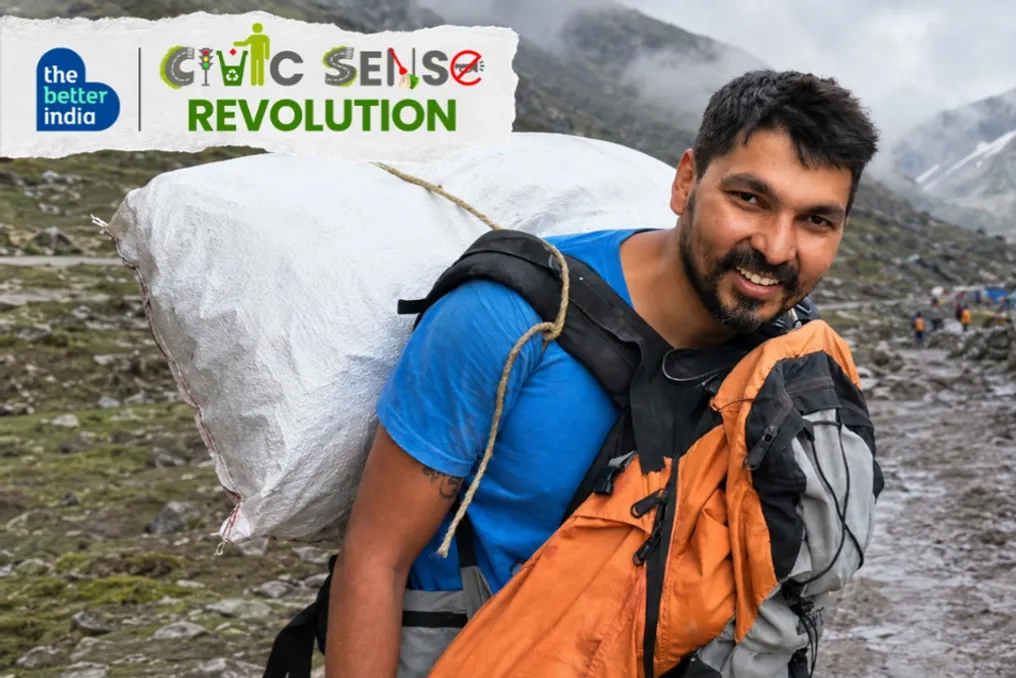
Every year, millions of people undertake the arduous climb to Kedarnath. This year, environmental activist Pradip Sangwan is urging pilgrims to carry away something more than memories—a kilogram of trash.
The founder of the non-profit organization Healing Himalayas, which has spent years cleaning trekking routes in the Indian Himalayas, believes that a simple change in behavior can transform one of India's busiest pilgrimage corridors.
As part of a campaign called #CarryMeBack, Sangwan appeals to all pilgrims heading to Kedarnath, asking them to collect and bring back at least one kilogram of waste on their return journey.
The Math Behind the Idea
If one hundred thousand pilgrims carry away one kilogram each, this will amount to 100 tons of waste removed from the mountains. Sangwan shared this vision on social media, noting that ten million visitors have been registered in Kedarnath after forty days of pilgrimage, exceeding all previous records. He emphasized that the campaign's goal is to collect one kilogram of waste per yatri, equivalent to 100 tons.
The campaign is tracked digitally, allowing volunteers to record participation and measure impact in real time. This initiative has resonated in the region, where waste management remains one of the most serious problems of mass tourism.
When Pilgrimage Leaves a Mark
As the number of visitors grows, the volume of discarded plastic bottles, food packaging, raincoats, glass containers, and other waste generated along the route increases annually. Photographs from this pilgrimage corridor in past years showed accumulations of trash near campsites and rest areas, indicating stress on the ecologically sensitive landscape.
Sangwan personally observed this problem for over ten years. He told Outlook Traveller in an interview that his visits to the region were filled with irritation and sadness due to dumps spoiling famous trekking spots. Instead of waiting for a solution, he started picking up trash himself. Friends and family joined him in cleanups.
What began as a personal effort gradually turned into a movement. In 2016, he founded the Healing Himalayas Foundation, which today conducts cleanup drives, waste audits, awareness campaigns, and waste management initiatives in mountainous areas. However, despite years of collecting trash, Sangwan realized that cleanups alone are not enough to solve the problem; he believes the solution lies in participation.
Turning Pilgrims into Partners
The campaign turns every traveler into part of the solution. Sangwan has repeatedly stressed that participants do not need to carry large volumes of waste; even a few hundred grams can make a difference when multiplied by hundreds of thousands of visitors. He explained online that the campaign aims to collect between 250 grams and 5 kg from yatris and pilgrims.
This idea transforms passive concern into practical action. A plastic bottle picked up during a hike may seem insignificant, but when thousands of people do the same, the cumulative effect becomes substantial. Just ten days after the campaign gained momentum, hundreds of travelers reportedly helped remove over 1000 kilograms of waste from the Kedarnath route. These early results provided insight into what collective action can achieve during a pilgrimage season with a massive influx of people.
Nevertheless, for Sangwan, carrying away trash is only part of a broader conversation. Recently, he highlighted the presence of nearly a ton of discarded glass bottles in Kedarnath and questioned how such material ends up in high-altitude areas. He urged people to 'carry it back if it is consumed,' adding that his team is auditing brands to better understand waste flows in the area.
He has also repeatedly called for greater attention to waste minimization at the source, segregation systems, infrastructure, and scientific disposal. Sangwan noted: 'We do post-mortem analysis by collecting it. But the question is how do we control it before the foothills?' In his view, effective waste management in the mountains relies on four pillars: minimization, source segregation and infrastructure, public participation, and reverse supply chains that ensure responsible transport and recycling of waste. The Carry Me Back campaign fits into this broader framework by addressing the issue of lack of participation.
Healing Himalayas' waste audits show the scale of material already being extracted and recycled. In Kedarnath alone, the organization recently reported recycling 25 tons of sorted and packaged material at its materials recovery facility. The waste included multi-layered plastics, PET bottles, cardboard, fabric, raffia bags, high-density polyethylene, paper plates, raincoats, and other discarded items.
Furthermore, Sangwan noted that over 5.5 tons of this material came specifically through the Carry Me Back initiative. It is important to note that the significance of the campaign goes beyond numbers, as it redefines pilgrimage as an act of care.