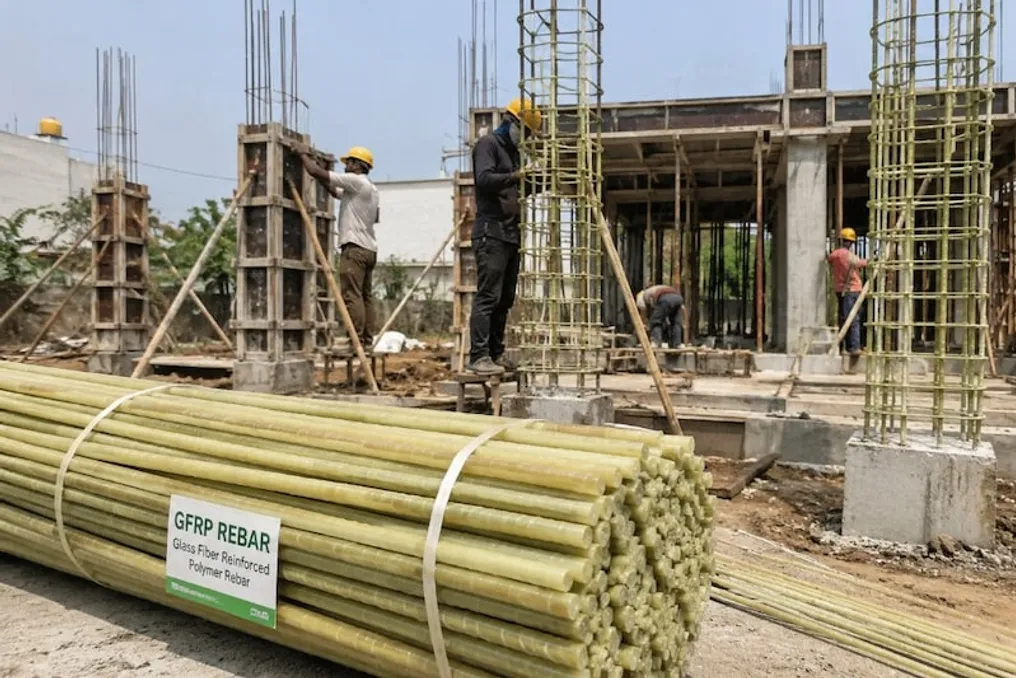
Before starting house construction, people always conduct a thorough check of building materials because no one wants to compromise on the strength of their home. At the same time, attention is also paid to the budget. In such conditions, the choice of durable, strong, and economical building materials is crucial, and GFRP reinforcement is an example of such a material, which explains the growing trend of using it instead of TMT reinforcement.
Currently, an alternative to steel reinforcement bars, known as GFRP reinforcement, is actively used in construction. It is considered stronger and more durable than steel TMT reinforcement. In fact, GFRP reinforcement is a fiber reinforcement made of plastic that is widely used in construction work. The question arises: can plastic rods be stronger than iron ones?
The question of why plastic rods, i.e., glass fiber reinforced plastic (GFRP), are considered so strong lies in its manufacturing process and material composition. This plastic reinforcement is created by mixing strong glass fibers and resin, which gives it high strength. This is why its use in construction is rapidly increasing. Furthermore, GFRP reinforcement has many other advantages.
In many aspects, it surpasses steel TMT bars. The first advantage is that it is not susceptible to corrosion. The second is that it is significantly lighter, which simplifies transportation and use. Its strength is twice that of steel. When it comes to durability and reliability, it lasts longer than iron.
The main advantage of GFRP reinforcement that allows it to last longer than TMT reinforcement is its resistance to rust. Because of this, fewer cracks appear in the concrete. Even when in contact with moisture, it can reliably last from 80 to 100 years. It is now clear why the use of GFRP reinforcement is gaining popularity over steel TMT bars.
GFRP reinforcement is not only used as a replacement for steel TMT bars; it is also transforming the future of construction due to its properties, which add new dimensions to the field of construction work.