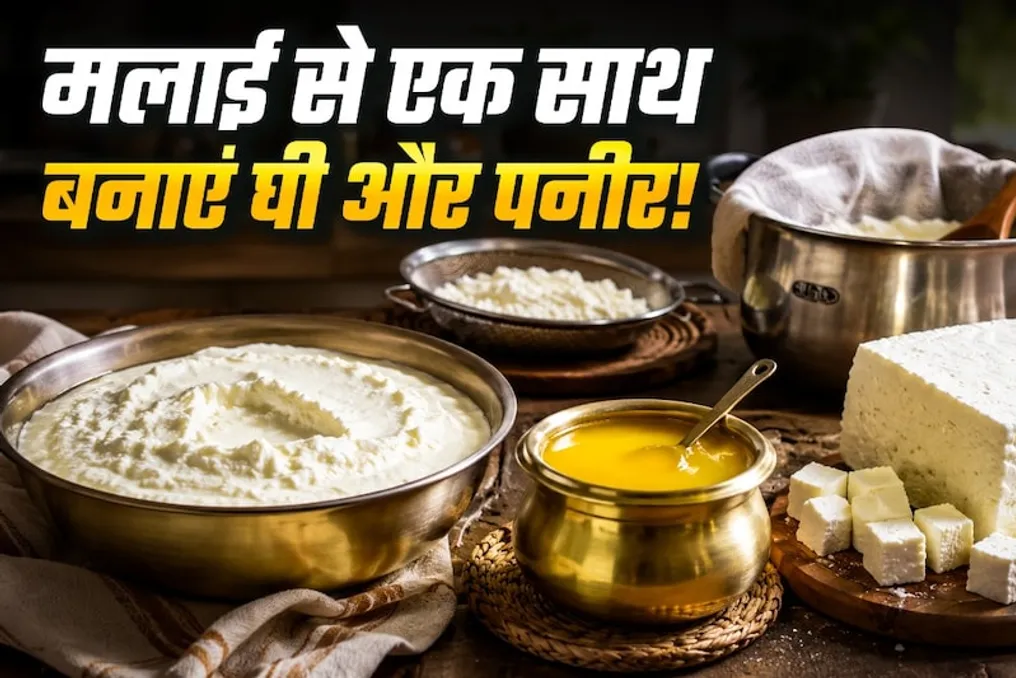
Every day, milk yields cream in every household. Most people store this cream, while some use it to prepare homemade ghee. However, many others throw away the cream, fearing the lengthy process of extracting the butter. If you are one of those people, you shouldn't do that in the future. Today, we will tell you about a simple method of obtaining butter from cream that eliminates the need for preliminary whipping of the cream to separate the butter.
Thanks to this simple trick, you can get butter directly from the cream, bypassing the stage of separating the butter. A special feature of this method is that besides butter, cheese is also produced. Thus, from one batch of cream, you can obtain pure clarified butter and cheese simultaneously.
Method for extracting butter and cheese from cream
To obtain pure clarified butter and cheese, you need about a week's worth of old cream collected from milk. If the cream was stored in the freezer, it should be taken out a few hours before starting the preparation so that it becomes soft enough.
Then, it is placed in a thick-bottomed saucepan, a little water is added, and it is cooked over low or medium heat, stirring constantly so that the cream does not burn to the bottom. When the cream has completely melted and taken on the appearance of milk, the heat is turned off.
After this, a glass filled with water is placed in the center of this melted cream. The glass is left in the center of the saucepan, and the saucepan is placed in the refrigerator overnight. By morning, the cream will set well. Then, the glass is removed. Where the glass stood, a depression forms. Cold water is poured into it and this water is drained into another container. Repeating this process one or two times will help separate excess liquid from the cream.
This liquid does not need to be thrown away; it can be drunk with a little salt added, or used in dishes like curry.
The solidified cream is placed back in the saucepan and cooked over low or medium heat. It is important to monitor so that the cream does not cook for too long if you want cheese along with the butter.
When the cream has completely melted and taken on a light yellow hue, the gas is turned off. Then, it is strained. The solid part remaining after straining is wrapped in a clean cloth and placed under something heavy for some time. This is how your fresh homemade cheese is made, which can be used in vegetable dishes as well as in paratha.
After separating the cheese, the remaining liquid cream is added back to the saucepan and cooked over low heat. Gradually, butter will begin to separate from it. When clear butter appears on top and a solid sediment collects at the bottom, the gas is turned off. Let it cool down a bit, then strain and pour into clean, dry, and airtight jars.
The delicious residue left in the saucepan does not necessarily have to be thrown away. It can be turned into small pedis by mixing it with powdered sugar.
Thus, in this method, almost all the cream is used: both butter and cheese are obtained, and finally, a small treat from the sweet residue.
What is special about this method?
The traditional method of making butter from cream requires long whipping to separate the butter. This method allows skipping this step. This is why this method may seem simpler for those who want to make butter at home but avoid the long whipping process.