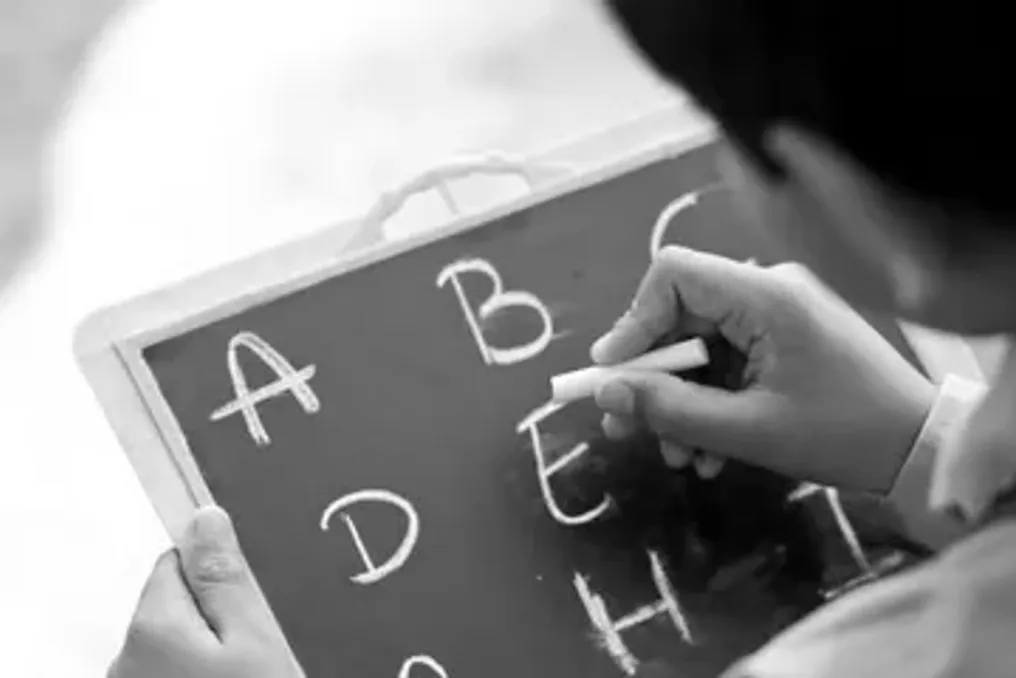
Some decades ago, inkboards were widely used in primary schools. The author argues that a complete transition to using keyboards may lead to future memory loss, reminiscent of Alzheimer's disease, various forms of dementia, and cognitive decline after Parkinson's disease.
The act of handwriting is not just nostalgia, but a discipline that maintains the activity of brain circuits. This ritual of combining thought and movement cannot be fully replicated when typing. Abandoning it threatens the weakening of connections that unite memory, attention, and the ability to learn.
Neuroscientists note that the movement of a pen across paper activates many areas of the brain, accelerates the recall process, and contributes to strengthening long-term mental health.
The older generation might recall how, in the past, the main tool for small hands in class was not a tablet or a notebook, but a flat blackboard. The author shares personal experiences, remembering Tamil language lessons where he initially used an inkboard. He remembers the pencil scratching faint traces on the cool surface, forming alphabetic characters.
Traditionally, every trace had to be erased with a damp cloth to keep the surface immaculate. However, when the first letters of the Tamil alphabet turned out messy, the author resorted to the 'spitting and rubbing method.' Today, inkboards are museum exhibits, but the author believes they were more than just teaching aids; they served as cultural artifacts, symbolizing modesty and self-discipline, embodying values beyond literacy.
These tools reflected the principle of repetition: practicing writing and erasing until knowledge became muscle memory, similar to rhythmically reciting the multiplication table or the smell of chalk dust during breaks.
There is something deeply human about the sound of a pen gliding across paper, a sound that echoes through centuries of clay tablets, parchment scrolls, inkboards, and school notebooks. Writing is not just a way of recording information; it is a way of remembering it.
Writing has always been not only a skill but also a subject of study. Generations of children underwent intensive calligraphy training comparable to arithmetic, where letters were measured against the edge of a ruler. The author himself went through the entire cycle of writing lessons, which lasted four years, and is grateful for this discipline because his handwriting possessed an elegance unattainable through typing.
The journey began with a thick graphite stick, clumsy in small hands but forgiving due to its thickness. This was followed by a fine pencil, requiring greater precision and control. Next came a dip pen with a G-nib, dipped into an inkwell—a ritual that taught patience, as one careless stroke could ruin a page. After that came elegant and modern fountain pens, and then the ballpoint pen, which made writing accessible through convenience, speed, and portability.
Each instrument carried not just ink, but memory, shaping the ways different generations learned, remembered, and expressed themselves. Writing tools were not neutral; they were formative. The thick pencil taught boldness, the pen taught restraint, the fountain pen taught elegance, and the ballpoint pen taught efficiency.
The tactile sensations of each stage became part of the memory itself: the smell of ink mixed by the supervisor at school, the smudge of graphite when the lead broke, the click of a BIC ballpoint pen—all these sensory signals enhanced the learning process.
In different cultures, writing has always been linked to the preservation of memory. In Hindu rituals, the inscription of mantras sanctifies memory and devotion. On the day dedicated to Goddess Saraswati, the Goddess of Knowledge, an elder family member or temple priest chants the sacred syllable 'Om' in the student's language, invoking blessings of wisdom and pure knowledge.
In medieval Europe, monks copied manuscripts not only to preserve texts but also to internalize them. In South African settlement schools, generations of children learned by copying excerpts into notebooks, which shaped both literacy and memory.
Even in professional life, handwritten notes during meetings often ensure clearer retention than text minutes, because the writing process itself acts as a filter, highlighting the main points.
Of course, handwriting has its limitations: it is slower, less searchable, and harder to share. Typing surpasses it in speed and organization, making it indispensable in modern workflows. However, when the goal is memorization, not just data storage, handwriting prevails. Handwritten text aids memory because it is more than a mechanical action; it is a ritual of attention. To write is to pause, to weigh words, to give them form. In this pause, memory finds support.
The author cites the example of his father, who never typed but wrote by hand until his last breath at the age of 91, and whose memory was as impeccable as his handwriting.
Reflecting on letters written to loved ones, youthful diary entries, hastily made school notes, and information recorded during journalistic interviews, the author realizes that these records exist not only in drawers or on shelves but also in his consciousness, vivid because his hand created them.
When we write, we are not just storing information; we are inscribing ourselves into the narrative of our own lives. The act of writing becomes a rehearsal of who we are and who we want to become. This is why diaries feel so intimate, why letters carry emotional weight, and why recipes passed down through generations taste better than any digital file.
Writing is visible memory, and memory is a stable identity. The pen, humble and ordinary, is actually a vessel of continuity, carrying thought through time. Neglecting it for the sake of speed risks losing the depth of memories.
The author personally feels the power of memory that writing provides. When he manually makes a shopping list, he can remember much more when he gets to the store—bananas, bread, and even cookies. When he enters this list into his phone, he only remembers the battery percentage. It seems the pen has a longer memory than the human thumb.
The main conclusion is simple: if you need to remember something, write it down! To improve memory with age, bring back the pen as a daily discipline. Write a poem, a diary entry, or a prayer by hand. In the ink you leave, you are not just recording words—you are training memory itself to withstand the test of time.