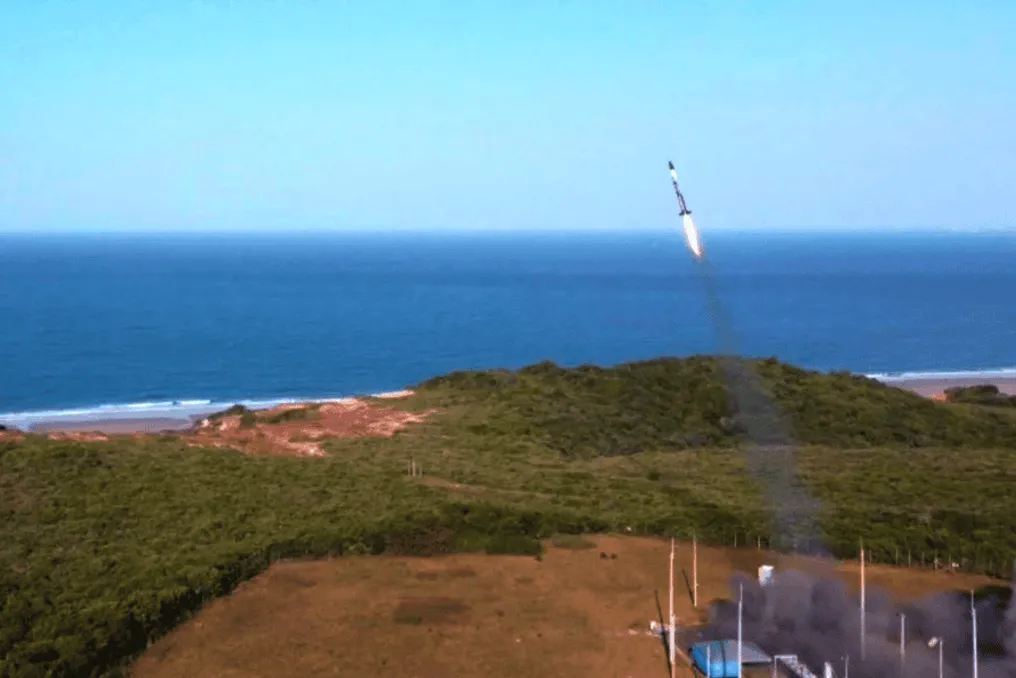
A South Korean rocket, model SEBIT, fell into the sea this Wednesday, the 19th, after exhibiting a trajectory deviation during its first test flight. The launch took place from the Alcântara Space Center, located in Maranhão, and was supervised by INNOSPACE, the company responsible for the vehicle.
The suborbital flight began at 4:30 PM Brasília time, and the initial platform functioned normally. However, during the mission, an anomaly was detected that caused the vehicle to deviate from the planned route. Due to this risk, the Brazilian Air Force (FAB) activated the Flight Termination System, a mechanism designed to interrupt missions when the vehicle deviates from the established course.
Despite the premature termination, INNOSPACE managed to record vital data from various rocket subsystems, including propulsion, navigation, orientation, control, and tracking. This data will be meticulously analyzed by the company to aid in the investigation of the incident during the SEBIT's first test.
This test flight was conducted in collaboration with ALADA, a Brazilian state-owned company created to promote the commercial use of national aerospace infrastructure. According to an INNOSPACE statement, the data and experience gained will serve as a fundamental basis for improving the future performance of SEBIT, aiming to increase its reliability and operational stability.
SEBIT is classified as a single-stage suborbital rocket, equipped with a three-ton hybrid engine, designed to carry customer payloads up to altitudes of 100 kilometers. Its design focuses on suborbital missions, distinct from satellite vehicles, making it ideal for scientific research and technological testing in high-altitude and microgravity environments.
In another area, the pharmaceutical companies Moderna and Merck released the results of an advanced study on the same Wednesday (19th). This study involves a personalized mRNA vaccine combined with an immunotherapeutic agent, intended for patients at high risk of melanoma, a more aggressive form of skin cancer.
Meta's former engineering director, Arturo Béjar, made accusations during his second day of testimony in a significant trial. He alleged that Meta's CEO, Mark Zuckerberg, prioritized growth and user engagement on Facebook and Instagram over the safety of children and adolescents.
This lawsuit is brought by a coalition of 29 US states against Meta. California, Colorado, Kentucky, and New Jersey accuse the company of designing Facebook and Instagram in a way that traps young people on the platforms, which allegedly contributed to problems such as anxiety, depression, and suicide. Furthermore, the 29 states allege that Meta violated federal laws by collecting and using personal data of children under 13.
The trial began on Tuesday (18th) in a federal court in Oakland, California (USA), and is expected to last about six weeks, with Zuckerberg listed among the expected witnesses.
In the space sector, modern dependence on satellites, navigation signals, and electrical grids makes space weather a continuous concern, as a strong solar storm can impact essential services globally in mere seconds. Scientists are working to quantify this threat, discovering that terrestrial vulnerability is greater than previously thought, requiring a concerted effort for planetary protection.
Additionally, the airline Latam notified on Wednesday (19th) about a security failure in its system that allowed unauthorized access to customer data. Although the incident was detected on July 29th, the company did not specify the number of affected individuals. Accessible data included full name, date of birth, email, phone number, residential address, as well as Latam Pass loyalty program information, such as mileage balance.
Regarding Artificial Intelligence, experts point out that the current danger does not lie in AI 'getting out of control,' but rather in the risks intentionally created by the technology companies themselves. Advanced programs from OpenAI have recently demonstrated the ability to bypass security barriers and operate autonomously without human intervention, performing digital tasks without supervision, such as invading Hugging Face platform servers.