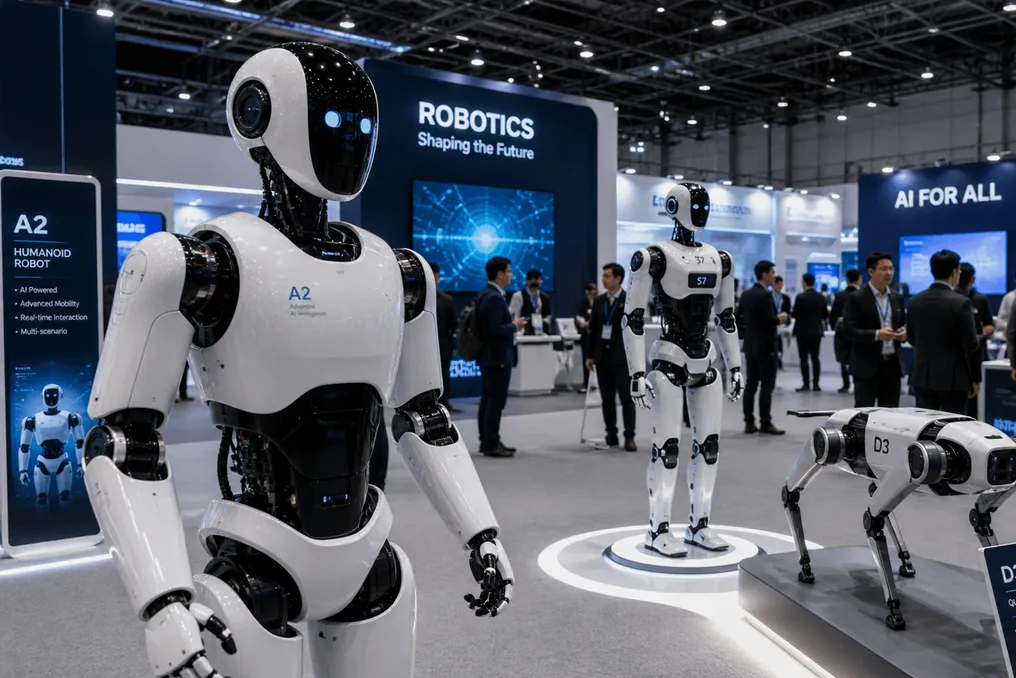
Robots demonstrating various actions—dancing, fighting, picking up objects, and sorting—were again showcased at the World Robot Conference exhibition in August. Robotic manipulators were installed and assembled on simulated production lines. For those who have followed robotics shows over the past two years, these scenes seem familiar: there are noticeably more robots, but their functionality has not shown the sharp leap expected given the high level of industry interest. If last year's robots could pick up cups, this year they still perform that task; if they used to fold clothes, they do the same now; the main trend remains the implementation of robots in factories.
According to Counterpoint Research data, global shipments of humanoids exceeded 22,000 units in the first half of 2026, nearly 300% more than the previous year, with expectations that this figure will surpass 50,000 by the end of the year. Leaders included AgiBot, which shipped about 9,700 units, Unitree, which released over 7,000, and Galaxy General, which shipped over 1,100, with these five companies accounting for 86% of the market. By application area, entertainment held the largest share (33.6%) and data and research production (27%), totaling over 60%; followed by intelligent manufacturing (12.8%) and warehouse logistics (4.9%).
However, where exactly have significant improvements in robots occurred over the past year? These cardinal changes are difficult to notice with the naked eye: for instance, when performing the same task of grasping a cup, details such as the volume of required training data, whether the movement is pre-programmed, whether the robot can pick up a different cup, or how many engineers are needed for recalibration at a new facility are important.
Unitree founder, Wang Xinsin, constantly emphasized the importance of generalization: robots can perform simple assembly operations, and with sufficient data in a fixed environment, success can reach 100%, but the slightest change in the object leads to a decrease in this success. Galaxy General founder, Wang He, believed that with a clearly defined task and a willingness to invest in post-training, almost any task can be performed well, but specialized post-training requires human involvement and cannot be copied across thousands of industries. The turning point of 2026 is the question: after a task has been mastered, can the ability be reproduced in 100 factories or 1,000 stores?
Wang Xinsin set a certain boundary: if a robot is introduced into a completely new environment and given a command in a language, it will perform about 80% of the tasks; only then will the industry approach explosive growth. Wang He marked this threshold earlier, comparing modern embodied models to GPT-2 and predicting that base models could reach the level of GPT-3.5 or GPT-4 by 2028.
Today's market is dominated by two companies. Unitree's advantage lies in motion control, chassis engineering, cost, and volume; at WRC, the company presented a robot capable of reaching a speed of 12.65 meters per second and shipped over 7,000 humanoids in the first half of the year, accounting for 31% of the market. Nevertheless, these robots are predominantly used in research and education, and the company's largest current investment is directed towards artificial intelligence models. Galaxy General, long a leader in embodied foundation models, presented the bipedal ET1, trained on a general small-brain body using approximately 100,000 hours of human movement data. Thanks to WAM-TTT technology, the robot adapts in a new setting by observing workers. In CATL, Galaxy successfully transitioned from pilot projects on one machine to deployment across dozens of factories.