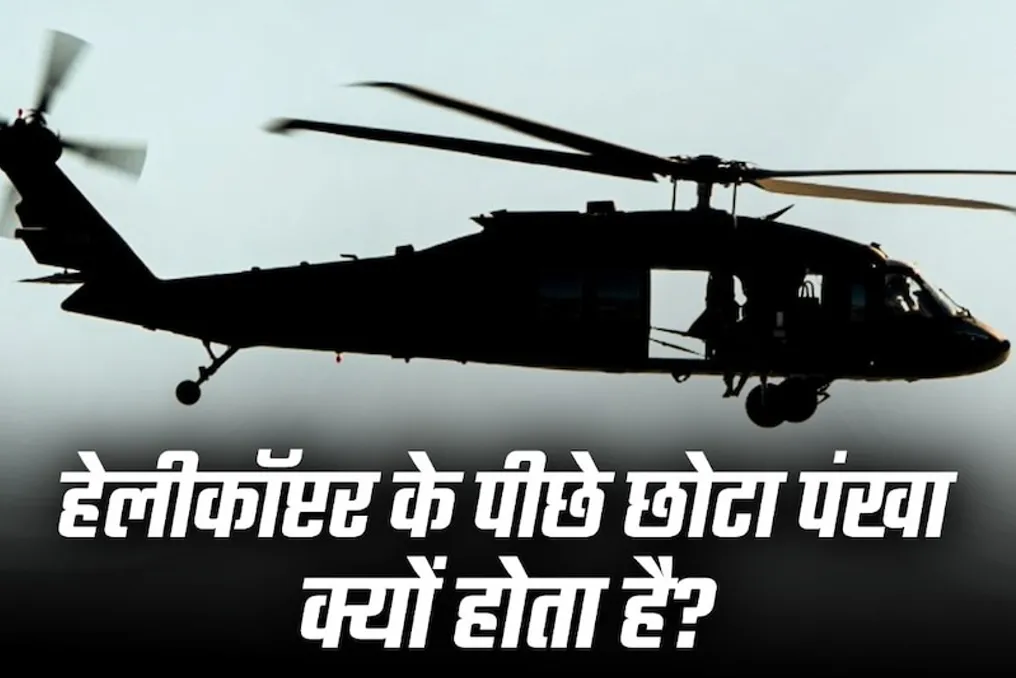
When looking at a helicopter flying in the sky, a question often arises: if there is a large rotor installed on top, why is a small one placed at the back? Does this rear rotor actually perform the flight function? In reality, this small rotor, called the tail rotor, is critically important for the safe flight of the helicopter. Its main task is to prevent the helicopter from spinning in the air and to help control its direction.
The large rotor on top is called the main rotor. It spins very fast, directing air downwards, which allows the helicopter to take off. However, the rotation of this large rotor creates a rotational force on the helicopter's body. If this force is not balanced, the helicopter will start to spin in a certain direction instead of just taking off.
This can be explained with a simple example. When something rotates quickly, it affects surrounding objects. When a helicopter's main rotor spins rapidly, it creates a counter-rotational force on the helicopter's body. This force is called torque. If there is no mechanism to compensate for this torque, the main body and tail of the helicopter may begin to rotate around their axis. In this case, it would be extremely difficult for the pilot to control the helicopter.
This is where the most important work of the tail rotor begins. The small rotor at the back directs air in a specific direction. This creates a force on the helicopter's tail that compensates for the torque created by the main rotor. Simply put, the large upper rotor helps the helicopter fly, while the small rear rotor prevents it from spinning unnecessarily. Without a tail rotor, stabilizing a standard design helicopter would be very difficult.
The tail rotor also helps change the direction of the helicopter's flight. When the pilot increases or decreases the thrust of the tail rotor, the helicopter's tail can turn right or left. This, in turn, changes the direction of movement of the front part of the helicopter. Thus, the pilot can turn the helicopter as needed. This is why helicopters hovering in place can also change their direction.
The tail rotor is a very important part of the helicopter. If it fails, it can affect the helicopter's ability to rotate and control its direction. Therefore, before flight, important helicopter components, including the tail rotor, its blades, engine, and related parts, are checked. Although this does not mean the helicopter will immediately crash if the tail rotor fails, the pilot may have a number of different emergency response measures depending on the condition of the helicopter, its altitude, and the nature of the problem.
If you have seen different types of helicopters, you may have noticed that not all of them have such an exposed rotor at the back. The reason is that not all helicopters are manufactured using the same technology. Some helicopters use a technology called fenestron, where the tail rotor is placed inside a circular housing in the tail. Because of this, the rotor blades are not visible from the outside. This design may be used for noise reduction and increased safety.
Some helicopters do not need a tail rotor at all. They use other technologies for stabilization. For example, some helicopters are equipped with two main rotors that rotate in opposite directions. The torque created by one rotor is compensated by the torque of the other rotor. Therefore, such helicopters do not require a traditional tail rotor.
Although the small rotor on the tail of a helicopter may seem small, its function is huge. It prevents unwanted rotation of the helicopter and helps the pilot control its direction. So, the next time you see a helicopter in the sky with a small rotor on its tail, understand that it is not an extra or decorative detail. It is an extremely important part of the balance and control of the helicopter. The large upper rotor lifts it into the air, and the small rear tail rotor helps maintain the correct direction and balance.