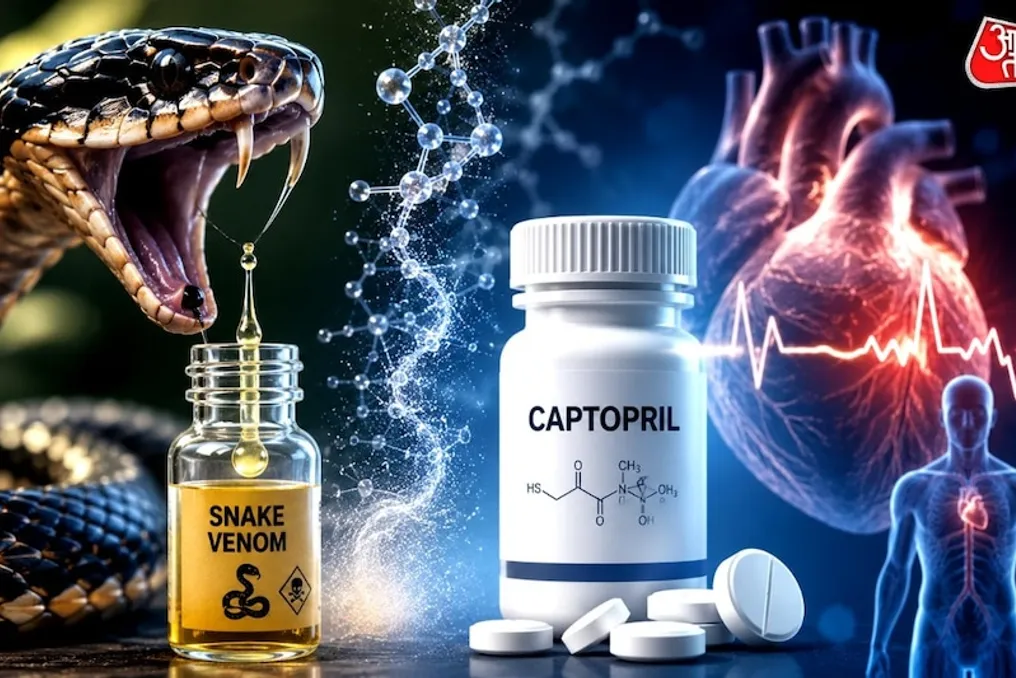
During the rainy season, an increase in snakebite cases is recorded in various regions of the country, some of which lead to death. Although snake venom poses a life threat, it also served as a source of inspiration for creating a vital medicine. The drug Captopril, designed to lower blood pressure, was developed based on a protein found in the venom of a poisonous snake known as the pit viper from Brazil.
Interestingly, the development process for the drug Captopril began not in a laboratory, but in the forests of Brazil. In the 1950s, scientists studied the venom of a poisonous pit viper called Bothrops jararaca. During these studies, it was discovered that the venom contained substances capable of affecting high blood pressure. Analyses showed that certain proteins in the snake venom could weaken the effect of high blood pressure on the body.
After this, scientist Sergio Ferreira and his team studied bradykinin-potentiating factors (BPF) in snake venom. They discovered that BPF in snake venom suppress and reduce the activity of the important enzyme ACE in the human body, which regulates blood pressure. Reducing the activity of this enzyme leads to a decrease in high blood pressure. This proved that BPF contained in snake venom can be useful in treating hypertension.
However, the scientists faced a serious problem: since the venom is deadly, how to conduct research to assess the effect without endangering the subjects? The scientists found a solution to this dilemma.
Dr. Rohit Kapur, a hematologist from Max Hospital in Ghaziabad, stated that for the drug's development, scientists did not use snake venom directly because it would be dangerous. Instead, they focused on understanding which specific proteins in the venom could control blood pressure. It was established that bradykinin-potentiating peptides (BPP) exist. Then, using medical chemistry, artificial BPPs capable of controlling blood pressure were synthesized, which led to the creation of Captopril.
In the laboratory, scientists reproduced the natural component, creating a safe and effective drug that entered the market in 1981 under the name Captopril. This became the first drug in the world capable of controlling high blood pressure and was recognized as a major achievement in hypertension treatment. The drug proved useful not only for high blood pressure but also for heart failure and gradually began to be used worldwide.
Dr. Rohit emphasizes that it is more accurate to say that Captopril is not a drug made from snake venom, but a synthetic drug developed based on scientific data obtained from snake venom. He clarifies that snake venom is not used in modern Captopril tablets; instead, scientists synthesized its imitation in the laboratory. Moreover, even in early versions of the drug, the venom was not administered directly, but the idea for creating the drug came to the scientists thanks to the snake venom.