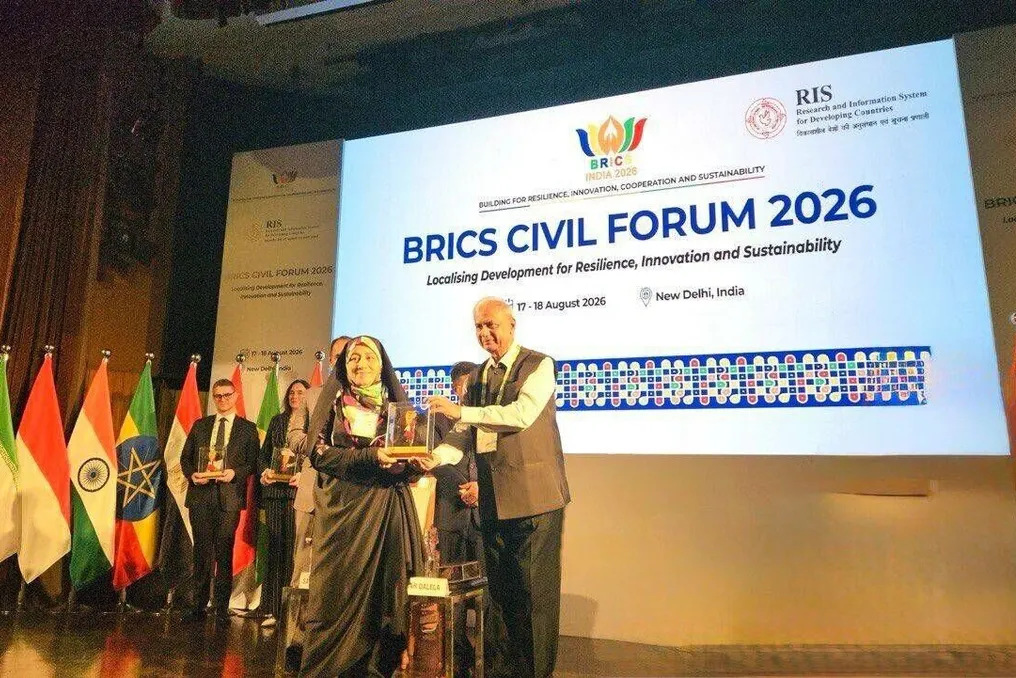
The Iranian Red Crescent Society (IRCS) has proposed the establishment of a network of public health centers within the framework of BRICS. According to IRNA, this network should serve as a platform for experience exchange, joint learning, conducting research, and implementing practical projects.
On Tuesday, Razieh Alishvandi, head of IRCS for international affairs, spoke at the BRICS Civil Forum in New Delhi, India. She emphasized that the experiences from pandemics, natural disasters, climate change, conflicts, and humanitarian crises demonstrate that the resilience of healthcare systems is practically unattainable without genuine public participation.
Alishvandi highlighted the key role of civil society in enhancing the resilience of medical systems. She also noted the necessity of expanding ties between BRICS member states in areas such as primary healthcare, non-communicable diseases, mental health, traditional medicine and local knowledge, staff training, and public health.
Topics discussed included joint search and rescue drills, disaster medicine, first aid, and psychosocial support. Furthermore, the official representative put forward the idea of creating a joint BRICS platform for documenting successful experiences and early warning of health risks, aiming to transform civil society cooperation within BRICS from a stage of dialogue to one of practical action and joint projects.
In light of the mention of medical personnel, aid workers, and rescuers killed during humanitarian missions amid US and Israeli attacks on the country, Alishvandi stressed the importance of protecting healthcare workers, aid staff, patients, as well as medical and humanitarian facilities in accordance with international humanitarian law.
She detailed the capabilities of IRCS, including a network of six million rescuers, young volunteers, and crescent homes, noting that resilience goes far beyond simply increasing the number of hospitals and equipment. Instead, it requires an informed, trained, and organized society that supports social trust.
Razieh Alishvandi also announced IRCS's readiness to share expertise and strengthen scientific cooperation with BRICS member countries in disaster medicine, search and rescue, public education, psychosocial support, volunteer management, and mass gatherings.
The BRICS Civil Forum 2026 was held under the theme 'Building Resilience, Innovation, Cooperation and Sustainable Development,' placing special emphasis on a human-centered approach focusing on the practical impact of political decisions on society and expanding opportunities for inclusive development. The forum covered eight main areas: education, health, culture, environment, finance, information security, new technologies, and entrepreneurship and social welfare.
The program included thematic round tables and working groups on core areas of activity, as well as panel discussions featuring NGO leaders, experts, and government representatives. Participants also presented examples of successful practices developed in BRICS countries.
In July, the Secretary-General of the International Federation of Red Cross and Red Crescent Societies (IFRC), Jagan Chapagain, highly praised IRCS's efforts during the 40-day US and Israeli war against Iran in a letter to Pirhossein Kolivand, head of IRCS. He noted that the aid and medical operations, as well as the search and rescue work and dedication of IRCS volunteers, demonstrate the outstanding capabilities of a strong national society in crisis management.
Highlighting the immense operational, logistical, and humanitarian difficulties, Chapagain stated that 'the Iranian Red Crescent Society demonstrated resolute and effective leadership, acting as the country's primary humanitarian actor.' The IRIB letter stated: 'On behalf of the International Federation of Red Cross and Red Crescent Societies, I wish to express our gratitude and respect for the exceptional humanitarian response led by the Iranian Red Crescent Society in the context of the current conflict situation in the Islamic Republic of Iran.'
The letter further indicated: 'Your rapid mobilization of volunteers and personnel, the scale and effectiveness of life-saving assistance, and the unwavering commitment to our fundamental principles ensured that those in need received timely and dignified support. The coordination of emergency medical services, round-the-clock aid operations, psychosocial support, and community engagement, along with bold and highly professional search and rescue operations, reflect not only technical excellence but also deeply rooted trust within communities. Such trust is the cornerstone of effective humanitarian action and underscores the unique auxiliary role of IRCS and its presence across the vast territory of Iran.'
We are deeply saddened by the loss of four dedicated IRCS volunteers who tragically died while performing their duties. Their selfless commitment to saving lives serves as a powerful testament to our values. On behalf of IFRC, I wish to express our sincere solidarity with IRCS, as well as our deepest condolences to the families, friends, and colleagues of these selfless individuals. Their sacrifice will not be forgotten. Your response serves as a powerful example of what a strong National Society can provide in times of crisis—saving lives, alleviating suffering, and preserving human dignity. IFRC remains fully committed to supporting IRCS in its current endeavors and in addressing evolving humanitarian needs. We stand with you, your dedicated staff, and your extensive network of volunteers whose heroism and dedication continue to inspire the entire IFRC network.'