Indian players replaced handshakes with greetings after winning against Pakistan in hockey match
Read more
Aaj Tak
www.aajtak.in

Indian players replaced handshakes with greetings after winning against Pakistan in hockey match

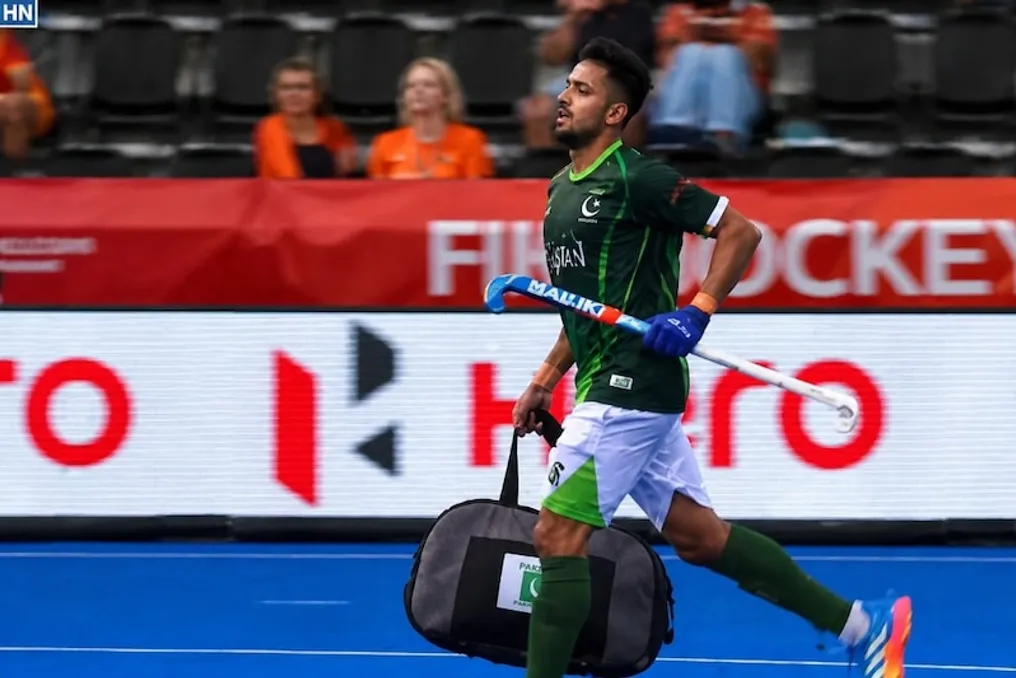
The Indian men's hockey team demonstrated a different approach to sportsmanship following an impressive victory over Pakistan. In the World Cup match held in Amstelveen (Netherlands), India defeated Pakistan with a score of 5:3. Although the Indian athletes did not exchange the traditional handshake with the opposing players, they showed sportsmanship by exchanging greetings (high-fives).

This moment occurred at a time when there was a differing stance between the Indian and Pakistani players regarding handshakes, which is linked to the Pulwama attacks. In cricket, the Indian team has recently adhered to a policy of refusing handshakes with Pakistani players. Now, in hockey, a greeting was observed instead of a handshake.

A similar scene was previously observed on June 23, 2026, during a Pro League match between the Indian and Pakistani hockey teams, which took place in London. Greetings were also recorded between players of both teams in that match.

Nevertheless, the situation concerning the Indian hockey team differs from the situation in cricket. Indian hockey has not established any official restrictions on shaking hands with Pakistani players.

Change in Situation After Pulwama Attacks

The situation regarding handshakes between Indian and Pakistani players changed after the Pulwama attack on April 22, 2025. Following this, Indian players began avoiding traditional handshakes both before and after matches in cricket. This policy of no handshakes in the Indian men's cricket team was evident during last year's Asian Cup. The team, under the leadership of Suryakumar Yadav, did not shake hands with Pakistan's captain Salman Ali Agha, making the topic of handshakes a constant subject of discussion in Indo-Pakistani cricket matches.

The women's cricket team adopted a similar stance. During the Women's T20 World Cup, held from June 12 to July 5, 2026, players from the Indian and Pakistani women's teams did not exchange handshakes. Although India's captain Harmanpreet Kaur and Pakistan's captain Fatima Sana met during the draw, a traditional handshake during the match did not take place.

Now, attention has been drawn to the use of greetings instead of handshakes in the men's hockey team match.

India's Victory Over Pakistan, Qualification for Top 8

Prior to this, the Indian team delivered a decisive blow to Pakistan on the field. At the Wagner Hockey Stadium in Amstelveen (Netherlands), India defeated Pakistan 5:3. Thanks to this victory, the Indian team managed to secure a spot in the top 8 of the World Cup, while Pakistan's journey in the tournament ended.

India's captain Harmanpreet Singh scored 2 goals, and Abhishek also scored two goals, contributing significantly to India's victory, while Hardik Singh scored one goal. From Pakistan's side, Hannan Shahid scored 2 goals, and Sufian Khan also scored one goal; however, the Pakistani team could not withstand the aggressive hockey of the Indian team.

Similar stories

India and Pakistan match in the Hockey World Cup to take place; tickets sold out
Read more
www.aajtak.in

India and Pakistan match in the Hockey World Cup to take place; tickets sold out

The anticipated match between India and Pakistan in the Hockey World Cup is scheduled for Wednesday, generating huge excitement among fans. The Wagner stadium, with a capacity of 10,000 spectators, is completely full for this major match. All tickets for this high-profile group stage match between India and Pakistan have been sold.

Significant interest in the game is observed among Indian and Pakistani fans residing in the Netherlands. Tickets for the match became available for online sale back in September 2025. Tamara Bouwman, Communications Director of the Royal Dutch Hockey Association (KNHB), informed PTI that ticket sales were conducted in phases.

She specified that tickets began selling online in September, with the first phase taking place in September, and the next phase starting in March of this year.

The ticketing platform offered numerous categories for spectators. The starting price for a ticket in the South Stand for matches not involving the Netherlands was 35 euros (approximately 4 thousand rupees), while a day ticket for the covered main stand cost up to 57 euros (about 6 thousand rupees). Additionally, away tickets were offered at a price of 251.34 euros (approximately 28 thousand rupees).

KNHB also informed that if all tickets for the group stage day are sold out, half-day passes are provided through the ticketing platform. These passes allow spectators to watch all matches scheduled for that day, but they do not include the Netherlands team's game.

The contest between India and Pakistan has become a special focal point for people of Indian descent living in the Netherlands. Local Indian families showed great interest in attending the match at the stadium. Previously, the Wagner stadium was also completely full during this tournament. All tickets for the matches of the Netherlands team, which is a co-organizer, were also sold out.

This actual meeting between India and Pakistan has once again heightened the atmosphere at this arena. The 10,000-capacity stadium is fully prepared for this high-profile group stage match. The attention of Indian and Pakistani fans, as well as hockey enthusiasts residing in the Netherlands, is focused on the upcoming confrontation.

Pakistan national team lost to England in Hockey World Cup due to forgotten equipment
Read more
www.aajtak.in

Pakistan national team lost to England in Hockey World Cup due to forgotten equipment

Pakistan's return to the Hockey World Cup was extremely disappointing. In the match against England, the Pakistan team lost with a score of 1:4. However, during the game, a serious oversight by the team drew attention.

In the first half of the match, the Pakistan team left behind defensive equipment necessary for penalty corners in the locker room. This incident occurred around the 17th minute when England was leading 1:0. Due to the lack of equipment, the Pakistan team had to delay before executing the penalty corner.

As a result of this delay, Pakistan's captain, Abu Bakar Mahmud, was shown a yellow card. Former Pakistan captain Salman Akbar expressed his dissatisfaction with this incident on the social media platform X, raising questions about the team's preparation, discipline, and organization.

Since Pakistan is returning to the Hockey World Cup after a long time, such negligence in the very first match of the tournament raised serious doubts about the team's level of preparation. Although England won against Pakistan with a score of 4:1 on the field, the mere fact of the forgotten equipment became a source of shame for Pakistani hockey.

Indian referees to be absent from World Hockey Championships in Netherlands and Belgium for the first time in 28 years
Read more
www.aajtak.in

Indian referees to be absent from World Hockey Championships in Netherlands and Belgium for the first time in 28 years

The World Hockey Championship will begin in the Netherlands and Belgium on August 15, and the Indian team will once again compete with the goal of winning a medal. Although millions of Indians will pray for the players' victory, there will be a certain silence felt at this World Championship, which perhaps no one will notice.

For the first time in 28 years, there will be no Indian referee or technical specialist at the World Championship. This is not just a story about the absence of one name; it is a narrative about the loss of a legacy that Indian referees built through decades of hard work.

There was a time when decisions in major global matches were made under the whistle of Indian referees. Names such as Amarjit Singh Bawa, Tarloq Singh Bhullar, Satinder Sharma, and Arvi Ragu Prasad were highly respected in world hockey. They achieved a distinguished position due to their impartiality and competence amidst the dominance of European countries.

However, the 2026 World Championship brought a bitter reality to Indian officiating. While India is moving towards the status of a global power in hockey through its players, its representation in officiating has completely disappeared.

Former international referee Arvi Ragu Prasad notes that selection for major tournaments depends not only on reputation. One must constantly perform at a high level in the Pro League and other international competitions. The question arises: how many opportunities are given to Indian referees to establish themselves?

Satinder Sharma recalls how he and his predecessors gained recognition among Europeans. Although the Indian team failed to qualify for the Beijing Olympics in 2008, he was present there as the only Indian official. Today, the situation has changed: the team participates in the World Cup, but the name India is absent from the officiating panel.

It is surprising that hundreds of referees and technical specialists are registered with Hockey India in both men's and women's divisions. Nevertheless, the number of Indians reaching the FIH panel is extremely small. This points to a problem not in quantity, but in quality, visibility, and long-term planning.

Former referees believe there is a huge difference between whistling in domestic competitions and making decisions at the world level. If Indian referees do not gain experience in the Pro League and major international tournaments, how can they meet FIH selection standards?

But the story doesn't end here. Another side of this profession is even more complex. Players receive government jobs, awards, and financial stability after brilliant performances. Referees, however, often remain with only enthusiasm.

Amarjit Singh Bawa, who started with a daily wage of only 20 rupees, recounts that they had to fight a long battle for referee recognition. There was a time when they were not even awarded medals or commemorative badges.

Ragu Prasad's words are particularly painful. Despite officiating in approximately 200 international matches, he had to seek private employment after retirement. His question is very clear: 'Under these conditions, why would parents want to make their child a referee?' Perhaps this is the biggest problem facing Indian hockey.

If there is no respect, economic security, and clear career path in this profession, why will a new generation come? And when a new generation does not appear, how will the whistle of India be heard in venues like the World Championship?

India dreams of hosting the 2036 Olympics and speaks of becoming a sporting superpower. However, the true strength of sports lies not only in the players. Good coaches, technical staff, and world referees are also part of the sporting culture.

This time, India may score a goal and win, but there will be one voice that remains unheard—the voice of the Indian whistle.

Popular