Modern sensors generate volumes of data that exceed the capacity of the platform on which they are installed. For instance, a drone equipped with a hyperspectral camera or a satellite with a radar payload produces data faster than its communication channels can transmit, and faster than onboard storage can accept, a gap that widens with every sensor improvement.
Traditional solutions to this problem are often insufficient. Storing data for later offloading results in information becoming outdated. Discarding most of the data risks losing critically important information. While compression is easy to apply to a photograph, it is a complex task for scientific data, where the smallest detail is often the essence.
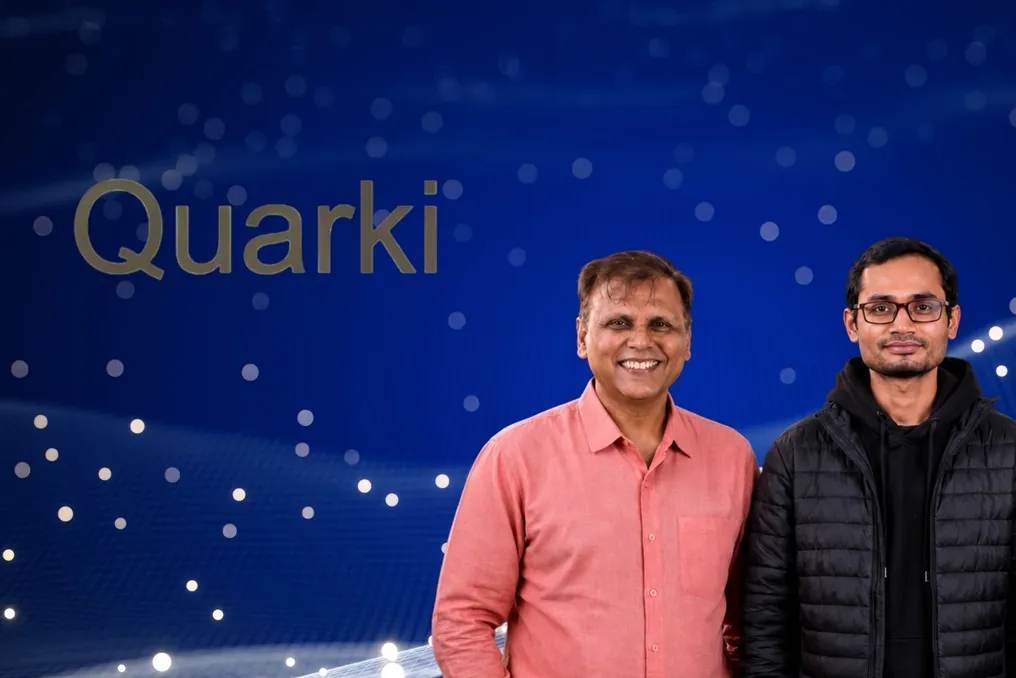
Quarkitech has solved this problem by creating software that reduces the volume of sensor data directly at the source, before it is stored, processed, or sent anywhere. Founded in January 2025 and based in the IIT Madras Research Park, the company has founders Rajesh Narayanan, Sanyam Parashar, and Shashikant Singh Kunwar, with Vishnu P.K. participating as a founder leading work on quantum algorithms.
The company defines its broader scope as simulation and algorithmic solvers for large-scale optimization, applicable to problems arising in the financial sector, scientific computing, and sensor systems.
The company's approach came from an unexpected direction. Sanyam Parashar, CEO, noted that their algorithms use a mathematical basis applied in the physics of many-body quantum nature—a field concerned with describing systems with a huge number of interacting particles.
This connection is not so strange. Physicists working with such systems have been developing methods to represent something vast in a compact form without losing essential information for decades, since a complete description is computationally impossible. The same mathematics applies to data streams.
Quarkitech claims that its algorithms can compress sensor data by 10 to 100 times, depending on the sensor type. In laboratory tests with drone imagery, the company reported a 26-fold reduction in data volume while retaining 98% of the information it classifies as mission-critical. This classification belongs to the company, and the result was obtained during laboratory testing.
An important practical point is that the software runs on standard processors and graphics chips, not specialized hardware. This allows it to be used on already flying computers instead of requiring new hardware to be built for it.
In August 2026, the company raised 2 crore rupees in seed funding from Artha Access, the Artha Venture Fund II program, and also from Finvolve. Additionally, it received a grant of 1.5 crore rupees from the Samgnya Technologies IITM-CDOT Foundation under the National Quantum Mission—a government program approved in 2023 that covers quantum computing, communication, sensors, and materials.
This grant does not require dilution of equity, and the total amount will be directed towards developing the core compression library, hiring engineers, and testing the technology outside the lab. This testing is the main work ahead. The company still needs to determine if the results hold up when operating on a moving platform, under heat and vibration, with limited power, and with intermittent connectivity.
The applications mentioned by the company include unmanned aerial vehicles, Earth observation from satellites, video surveillance, and mapping using radar and LiDAR. In all these cases, sensors produce more data than the system can process.
Currently, no data on clients, contracts, or revenue is publicly disclosed, and the company is nineteen months old. It currently possesses a laboratory result, secured funding runway, and a problem that does not appear to get any smaller.