Almost all solar panels in the world are made from silicon, but silicon is approaching the limits of its capabilities. Perovskite has long attracted the industry's attention because it converts light more efficiently, can be processed at low temperatures, and can be applied to glass or flexible film, unlike rigid crystal.
The main problem with perovskite cells has never been efficiency; they have repeatedly set record figures in laboratory conditions. However, these cells are prone to degradation over several months under the influence of heat, moisture, and ultraviolet radiation—conditions under which a solar panel operates. Most developers have failed to translate this technology from laboratory achievements into a durable product.
P3C is attempting to solve this problem. It was founded in 2019 by Suraj Kumar and others who began working on this material while students at IIT BHU. The company has a research and production facility in Gurugram and is located in the FITT incubator, a technology transfer unit of IIT Delhi.
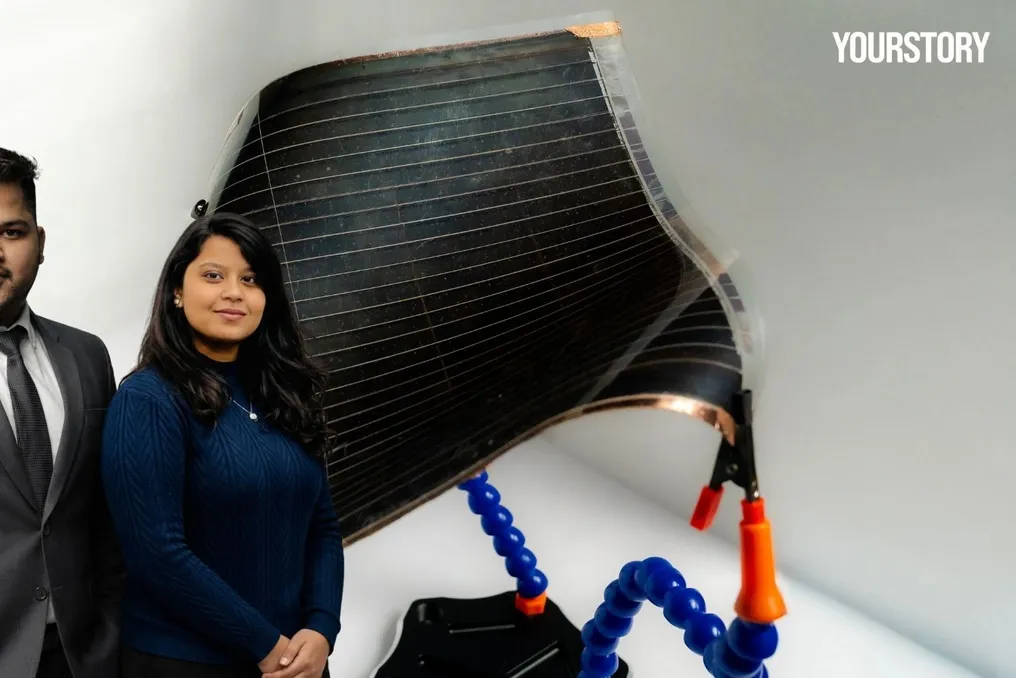
P3C Technology releases two types of products. MySUN Glass modules are attached to glass, mimicking the structure of a traditional panel. MySUN Flex modules are placed on flexible substrates, which most clearly demonstrates the material's advantage over silicon, as the flexible panel can be installed on a surface inaccessible to a rigid structure.
The company's certified performance is 19.3% cell efficiency, confirmed by the National Institute of Solar Energy (NISE), an autonomous body under the Ministry of New and Renewable Energy. Modules that are larger and always tested lower than individual cells showed about 15% efficiency. Research semi-transparent cells reach approximately 20%.
Production is carried out on its own assembly line, with a capacity of about 100 kilowatts of small-format modules, with plans to reach one megawatt. The company sends modules for durability testing to NISE and plans to send them to the US National Renewable Energy Laboratory for verification.
In March 2026, the company launched the P3SKY platform, designed for manufacturers to test and validate perovskite modules in real-world conditions before deciding on full-scale production. Kumar explains that the obstacle for the industry is not so much the record efficiency as the reliability data, which is an unusual position for a company selling this technology.
The markets targeted by the company are very broad: commercial installations in open areas, building roofs, vehicles, aerospace, defense industry, railways, and agriculture. Furthermore, the company is working on perovskite-silicon tandem modules with one of India's largest silicon producers, without naming the partner, and is also developing anti-fouling and anti-glare coatings.
The company's funding came first as a grant from FITT at IIT Delhi, and then as a seed round of $250,000 from Oberoi Thermit, an industrial equipment manufacturer in Uttar Pradesh, announced in June 2023. Additionally, an extra $3 million was allocated conditional on successful testing. Investment from an industrial manufacturer differs from investment from a venture fund and suits a business whose task is to build a production line, rather than attracting end-users.
The company positions itself as the first producer of perovskite-based solar cells in India and aims to achieve gigawatt capacity by 2027. This is a very significant step compared to the current production line measured in hundreds of kilowatts. At the same time, the company has not disclosed data on customers, orders, or revenue; institutional buyers received modules for initial testing, which precedes actual purchase agreements.