When Sean Fitzpatrick, an All Blacks legend, first arrived in Johannesburg, a South African boy handed him a warning that reflected the entire tension of the rivalry between the Springboks and the All Blacks.
The All Blacks captain sat in the front of the team bus after arriving at Johannesburg International Airport during the 1992 tour, when a small child approached the window and showed a sign. It bore a simple message: 'Uli is going to kill you.'
Fitzpatrick recalled this incident in Johannesburg on Wednesday with a laugh, but the name on the sign—Springboks legend Uli Schmidt—was no laughing matter for the All Blacks player. This moment served as the perfect introduction to the rivalry, which Fitzpatrick considered the ultimate test in world rugby.
'Growing up in New Zealand playing against the Springboks was undoubtedly our greatest challenge,' he stated. 'Perhaps my first memory is related to the 1976 tour, when the All Blacks took to the scorched fields in knee pads to avoid burns from the grass. Even then, it was the greatest rivalry.'
Subsequently, Fitzpatrick became a central figure in this confrontation, leading the All Blacks to their first series victory in South Africa after nearly a century of attempts. He returned to South Africa in 1996, a year after the Springboks crushed the hopes of the New Zealanders by winning the World Cup final in Johannesburg, and this time he left with a historic trophy.
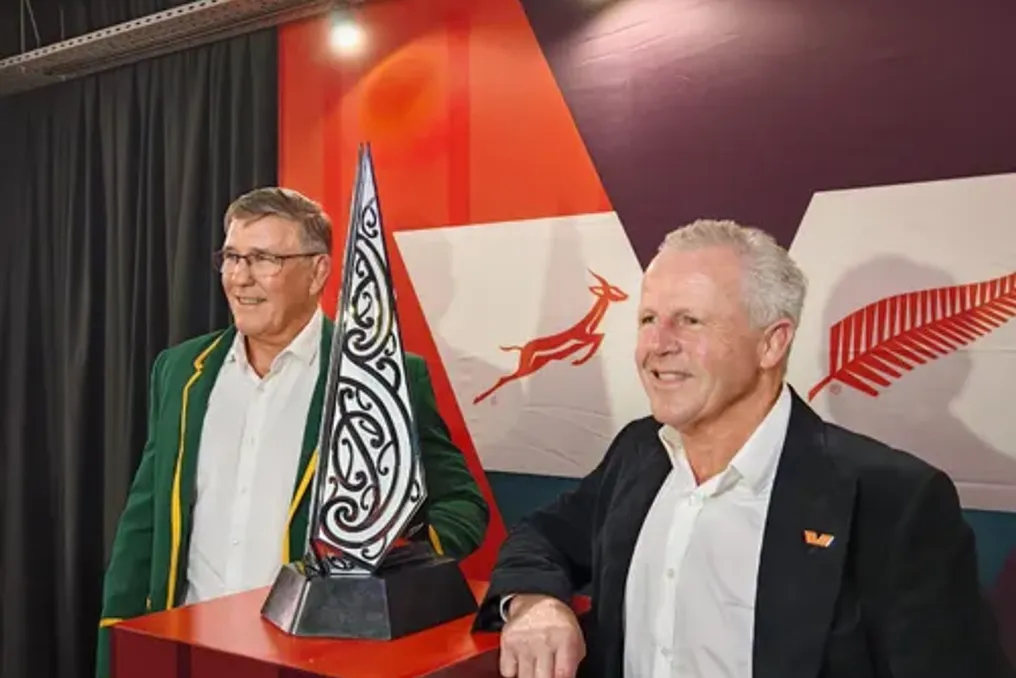
When the All Blacks won the series at Loftus Versfeld Stadium, an iconic scene was captured: Fitzpatrick, kneeling, beating the ground in joy, while South African spectators watched in bewilderment. Nearly thirty years later, Fitzpatrick is back in South Africa as part of the 'Rugby's Greatest Rivalry' tour. On Wednesday, he presented the trophy, which will be contested in a four-match series, alongside his colleague from the 1996 Springboks team, Gary Teichmann.
However, for Fitzpatrick, this rivalry runs much deeper than the trophy before him. 'I never thought I would come to South Africa as an All Blacks player, as an All Blacks captain, and come here in 1992 to play at Ellis Park Stadium. It felt like a dream come true,' he said. 'We played against some of our greatest heroes, such as Dan Herbert. And there was the legend Uli Schmidt, who was a player I wanted to become.'
The 1996 series was the moment Fitzpatrick and his generation finally achieved success where many previous All Blacks teams had failed. 'In ninety-six, we knew we had a good chance to win the series,' he noted. 'Although the team had several senior players who knew the history, there were also younger members, such as Christian Cullen, whom we needed to teach and tell about their legacy and how important it is to prepare both on and off the field.'
Fitzpatrick emphasized that the pressure extends far beyond the field. 'It's a 24/7 challenge. Off the field, it's ridiculous,' he added. 'Gary would say the same thing when the Boks come to New Zealand. Everyone has something to say—the old lady in the square telling you that you hit too hard or did this, did that. That's life when we come here. You have people who say, 'We'll kill you. And we'll crush you.' And all these things, it's just wonderful! I like it. I like coming back here, to the great rugby country.'