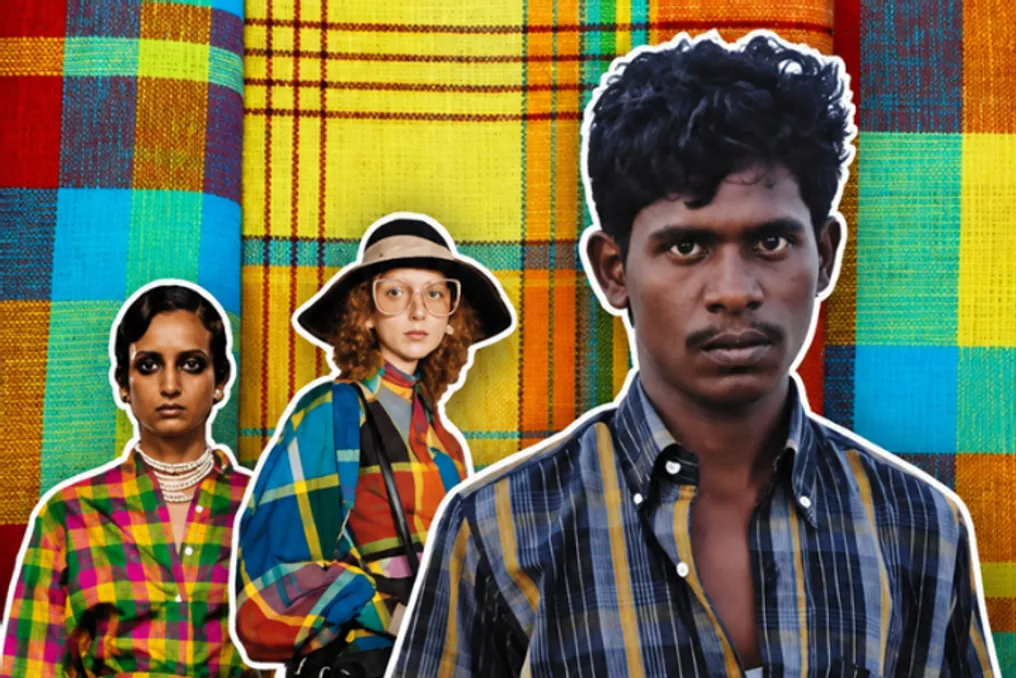
Fishermen's lungis from Tamil Nadu have become a global fashion icon
Read more
The Better India
thebetterindia.com

Fishermen's lungis from Tamil Nadu have become a global fashion icon

According to an ancient craft tradition, fishermen and rice farmers from Tamil Nadu wore hand-woven, plant-dyed checkered cloth as everyday lungis long before it was noticed by European traders.

Artisans would roll the thin muslin into 36-inch squares, carefully dye them with plant dyes, and then tightly wrap them around the waist—a technique passed down through generations among coastal masters.

Dutch traders established a textile base in Pulicat in 1610, and by 1639, Francis Day set up land for the establishment of Fort St. George, turning Madras into a global center for textile production.

Portuguese and British traders brought this fabric to Nigeria in West Africa starting in the 1500s, where the Kalabari people renamed it Indjiri, meaning 'real India,' and used it at births, weddings, and funerals.

Nigerian traders named it George cloth after Fort St. George in Madras, wrapping eight-yard checkered pieces around the hips like skirts and tying smaller pieces into handkerchiefs and turbans.

British exporters deliberately labeled the fabric as 'Real Madras Handkerchief,' because handkerchiefs were subject to significantly lower export duties, even though each square was almost a meter, which was much larger than any real handkerchief.

In 1958, American importer William Jacobson visited India and contacted Krishnan Nair from Chennai, whose factory, Leela Scottish Lace, sold him thousands of yards of this bright checkered fabric.

Because the plant dyes faded in washing machines, advertisers renamed this flaw 'Bleeding Madras,' and the magazine Seventeen published a multi-page feature calling it a miracle of Indian handmade fabric.

By the 1960s, 'Bleeding Madras' became an essential summer uniform for students of the Ivy League and American vacationers, proudly worn every season as shirts, shorts, and blazers on university campuses.

The Madras checkered pattern started as a fisherman's lungi and ended up on Manhattan runways and in Nigerian shrines. What other everyday fabric worn by workers could become the next global fashion icon?

Similar stories

Kumar Vishas' Daughter Agrata Showcases Royal Look in Denim Kurta and Farasi Salwar at Holi Teej
Read more
www.aajtak.in

Kumar Vishas' Daughter Agrata Showcases Royal Look in Denim Kurta and Farasi Salwar at Holi Teej

Agrata Sharma, the daughter of the renowned poet Kumar Vishas, frequently attracts public attention, and people closely follow her every news update. Recently, Agrata shared photos on Instagram where she celebrated Holi Teej with Nitu Bisht's mother-in-law and other individuals. Instead of traditional attire, she opted for a stylish Indo-Western look that received high praise.

Agrata Sharma's Look at Holi Teej

For the Holi Teej festival, Agrata Sharma moved away from classic sarees and lehengas, preferring denim for her festive ensemble. This modern twist on traditional fashion made a strong impression on viewers. She wore the 'Sakhi Denim Kurta with Farasi Salwar' set. The blue denim kurta is adorned with rich embroidery on the hem and neckline, while pink pompoms give the look a youthful and stylish vibe.

To complete her natural look, she used glossy lipstick, soft blush, and a small bindi on her forehead. Her open wavy hairstyle added elegance to her festive appearance. The denim kurta was paired with a similar denim Farasi salwar, lending the entire outfit a beautiful ethnic feel. Despite the modern material, the Farasi silhouette retained its traditional accent.

With the blue denim kurta and salwar, Agrata added an olive-green dupatta with embroidery, which served as a vibrant complement to her look. This dupatta, embellished with heavy Gota Patti and zari work, gave her appearance a royal touch. To add more glamour, Agrata chose a bright pink handbag, whose color harmonized with the pink pompoms on the kurta, creating a cohesive look.

This 'Sakhi Denim Kurta with Farasi Salwar' set, which has become a topic of discussion among fashion enthusiasts, retails for 15,950 Indian Rupees. The design of this outfit might appeal to those looking to try something new in festive wear. The pictures also capture Agrata Sharma and YouTuber Nitu Bisht Sandipika Sharma sitting on swings; it was Sandipika's first Teej, which she marked in a special style.

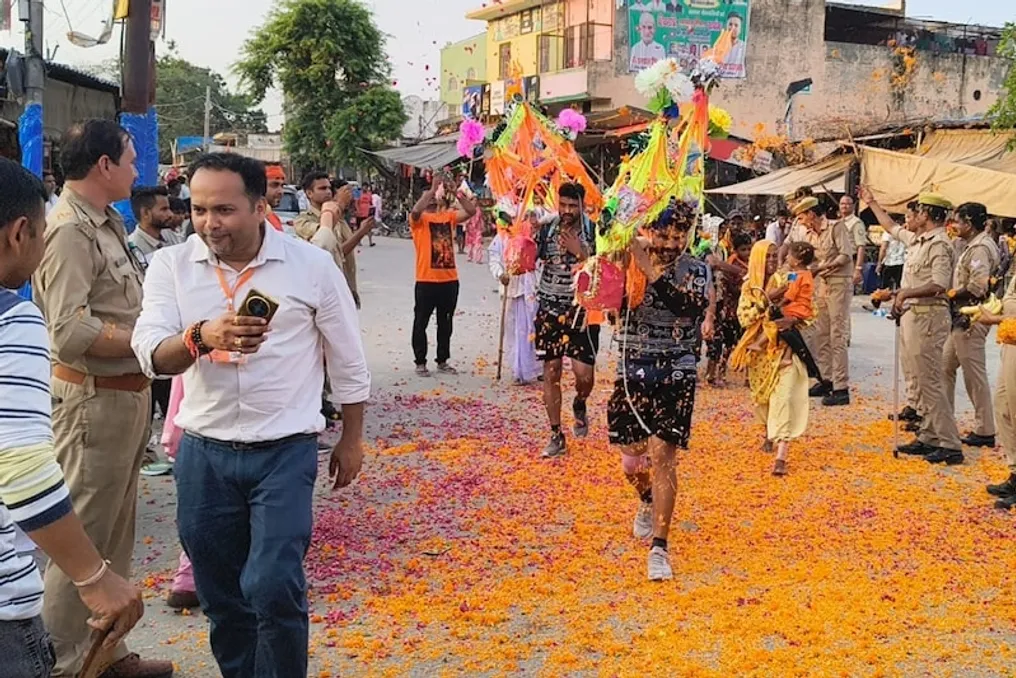
Police welcome Kavand pilgrims with flowers during pilgrimage in Bagpat
Read more
www.aajtak.in

Police welcome Kavand pilgrims with flowers during pilgrimage in Bagpat

During the Kavand pilgrimage in Bagpat, Uttar Pradesh, a scene of public interest unfolded, featuring a combination of blue-yellow and saffron colors. Police officers lined the road to greet the pilgrims who were heading to temples, carrying water from the Ganges from Haridwar.

As the procession of pilgrims passed along Binouli road, police personnel began showering them with flowers. Some of these officers also adorned the pilgrims with floral garlands, honoring them. This unexpected reception evoked strong emotions among the pilgrims, and the entire atmosphere was filled with chants in honor of Bollenath, demonstrating a sense of service and reverence.

In honor of the pilgrims, the Binouli police undertook a special initiative. Police officers lined the road and began showering flowers as the devotees passed by. Some approached closer to place garlands on the pilgrims and support their enthusiasm. At this moment, an atmosphere of warmth and closeness developed between the police and the pilgrims. The red Kavands, decorated with flowers, and the radiant faces full of devotion to Bollenath made this picture special.

Photos published by the Binouli police show both uniformed officers showering flowers on the devotees and soldiers greeting the pilgrims with floral garlands. These pictures attracted public attention on social media and at the local level.

The Kavand pilgrimage is viewed not only as a religious journey but also as an event associated with service, cooperation, and brotherhood. The reception organized by the police officers in Bagpat highlighted precisely this spirit. When the blue-yellow uniform responsible for security showed such sincerity in respecting the pilgrims, the atmosphere became even more special.

This gesture of respect and closeness to the pilgrims, performed by the police officers in Binouli, was encouraging for the devotees undertaking the long journey with water from the Ganges from Haridwar, going beyond the scope of official duties.

These photos from Binouli do not look like an official event, but rather a spontaneous and emotional reception of the pilgrims. Police shower flowers on the devotees and put garlands on them, while the pilgrims accept this respect with hands folded in prayer. Every year, a large number of pilgrims pass through Bagpat to Puri Mahadev. In such conditions, besides ensuring safety, a feeling of support and respect for the devotees becomes extremely important. This initiative by the Binouli police reflects exactly this sentiment.

Popular