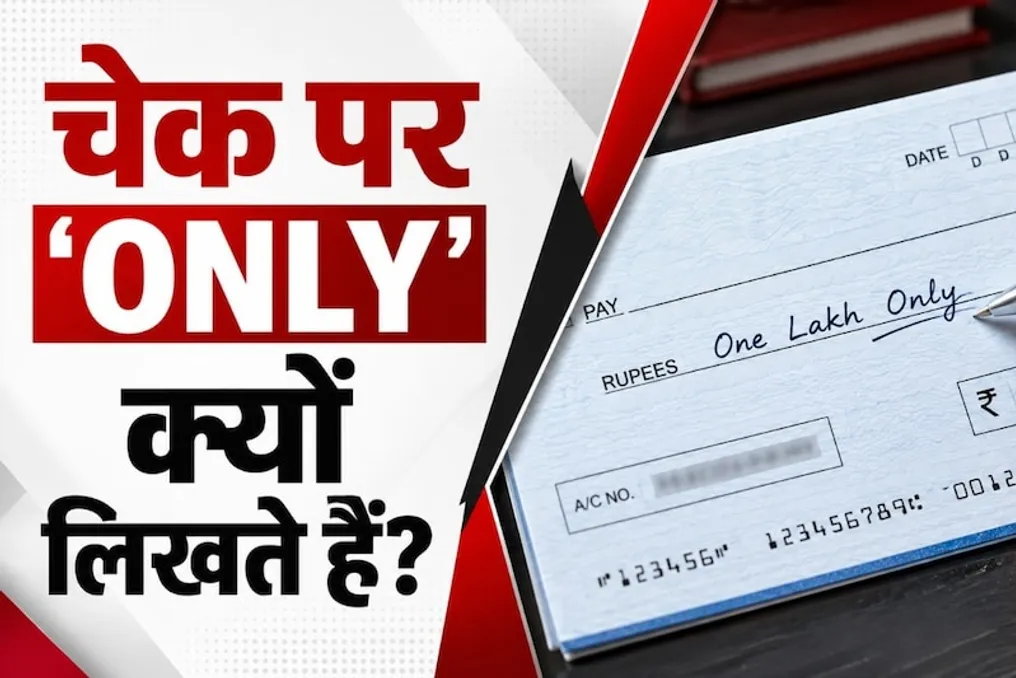
Nowadays, people increasingly use digital methods such as UPI and internet banking to send money. Nevertheless, checks are still used for large sums. When filling out a check, you have probably noticed that after writing the amount in words, the word 'Only' or 'Matra' (only) is placed at the end.
Many also place '/-' next to this sign. However, have you ever wondered why this is done?
The main reason for writing 'Only' after the amount on a check is related to ensuring security. The purpose of this action is to prevent the addition of any extra words to the written amount, thereby reducing the probability of fraud and manipulation of the check.
Suppose you write the amount in words as 'Twenty Five Thousand'. If there is a lot of empty space left after this, someone might try to add other words there. But if you write 'Twenty Five Thousand Only', the end of the amount becomes obvious.
Similar caution should be observed when writing the amount in figures. For example, if you write ₹25,000/-, the slash and dash placed after the amount are also used to reduce the possibility of adding extra digits or symbols.
It is important to know that writing 'Only' is not a mandatory requirement from the bank. That is, the check itself will not become invalid just because you did not write 'Only'. Nevertheless, for your own safety, it is considered a reasonable measure to write 'Only' after the amount written in words.
When filling out a check, you should try to state the amount clearly and correctly. You should also not leave too much blank space after writing the amount, as this makes it easier for another person to add something else.
You may have seen two parallel lines on some checks on the left. This is called a cross-check. If 'A/C Payee' is written between these lines, it means that the check amount must be credited to the bank account of the corresponding person. This increases the security of the check and makes the payment more secure.
When filling out a check, you must carefully specify the date, the name of the payment recipient, and the amount. The amount must be the same in both figures and words. After writing the amount in words, it is better to add 'Only'. In case of writing in figures, you can use the '/-' sign. The signature on the check must also correspond to the data in the bank records. If an error occurs on the check, it is safer to fill out a new check than to correct and use a damaged one.
Although digital payments are gaining popularity today, checks are still used in many large transactions. Therefore, it is important to understand the small details of working with checks. The habit of writing 'Only' is part of this security system.