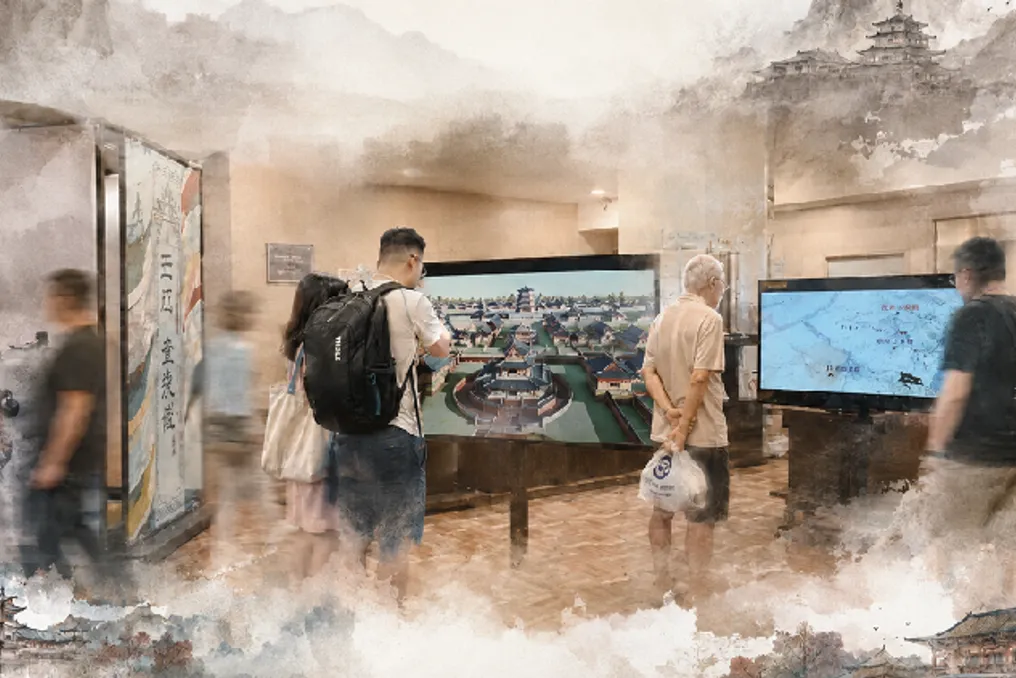
The China Crafted exhibition is currently running at the Chinatown Library in Singapore this month, offering visitors an immersion into the ancient history and material culture of China. Films and animations are displayed on screens, covering items such as ritual bronzes, jade, lacquer, silk, gold, silver, and exquisite pottery from the Song Dynasty.
Informational panels with QR codes are placed nearby, allowing viewers to delve deeper into the histories, objects, and themes presented within the complete digital exhibition. This monthly presentation features the CGTN Art Series titled China Crafted and takes place at the public library from August 1st to August 31st.
For the Singapore version of the digital exhibition, CGTN collaborated with a collection of books selected by the National Library Board (NLB). This provides visitors with multiple ways to engage with the theme: they can watch a film, scan a QR code for online research, or consult the bookshelves for a more detailed study of the materials, objects, and traditions shown on screen.
This exhibition is the latest stop for China Crafted in Singapore, following its launch at ART SG in January and programs at the Museum of Asian Civilizations in June.
Integration of the Digital Exhibition into the Library Environment
In the Chinatown Library, China Crafted was adapted to the rhythm of the everyday public space. Films and animations are continuously broadcast on a large television screen. Some visitors stop only briefly, while others watch several videos consecutively. The nearby China Crafted panel is directly linked to the online exhibition via a QR code, allowing the experience to continue beyond the screen.
The physical environment adds another layer of perception. Instead of encountering China Crafted only through a website or an art fair, visitors can experience it by reading, borrowing books, or moving around the library. This setting is particularly relevant for the Chinatown Library, which focuses on Chinese art and culture.
The NLB's contribution extends the experience beyond the screen, offering visitors the opportunity to follow the themes presented in the CGTN digital exhibition through the library's own collection. The featured books cover Chinese painting, calligraphy, jade, architecture, and traditional furniture, placing the themes of China Crafted within the broader context of Chinese art and craftsmanship. They also include topics adjacent to the four dynastic periods, giving visitors a wider view of how materials, artistic practices, and design traditions evolved across different eras.
What Visitors See on Screen
The content displayed in the library is based on four chapters of China Crafted, covering the Shang, Han, Tang, and Song Dynasties. The films utilize historical figures, artifacts, animation, and expert commentary to present the material culture of each period. The Shang chapter explores jade and bronze; the Han section focuses on lacquered goods, silk, and Mawangdui finds; the Tang chapter examines gold and silver in cosmopolitan Chang'an; and the Song chapter investigates porcelain, tea, and the culture of literati.
Shorter animations provide a quick overview of people and themes, while longer pieces dedicate more time to individual objects, techniques, and historical context. Viewers who wish to learn more can scan the QR code and explore the full digital exhibition at their own pace.
How Visitors React to the Stories
Visitors of various ages were observed near the display, sometimes staying to watch several videos. The animations appear to be a particular magnet. Recreated buildings, historical characters, and detailed objects provide viewers with a visual journey into periods that might otherwise seem distant. Long, over 70, who has always been interested in Chinese history and material culture, noted that the sense of immersion was one of the exhibition's strengths. He stated that the films helped transport viewers to different eras of Chinese history, bringing distant places, objects, and lifestyles closer through visual storytelling.
Long found the exhibition unique and educational, especially because many of the historical sites and artifacts presented are difficult to see in person. He felt that the combination of animation, historical detail, and material objects helped bridge this distance, giving viewers a deeper understanding of the people and societies behind them. He mentioned that he plans to return with his daughter to spend more time with the exhibition.
Other visitors came with much less prior knowledge. One man said he knew very little about Chinese dynasties before encountering China Crafted, but the stories on screen sparked his interest. After watching the video, he scanned the QR code and expressed his intention to read more about the periods and objects presented. His reaction demonstrated how the exhibition can work on different levels: deepening existing interest in Chinese history for some, and awakening curiosity in those encountering these stories for the first time.
A similar reaction was reflected in the visitor feedback book, where another guest wrote that they learned a lot from the exhibition and thanked the organizers. Through the combination of CGTN's digital storytelling and the NLB's library collections, the Chinatown exhibition offers visitors several paths to the same theme. A film can lead to a QR code, a digital exhibition, or a book on the shelf, allowing a brief visit to the library to become a starting point for further discovery. The exhibition runs until August 31st.