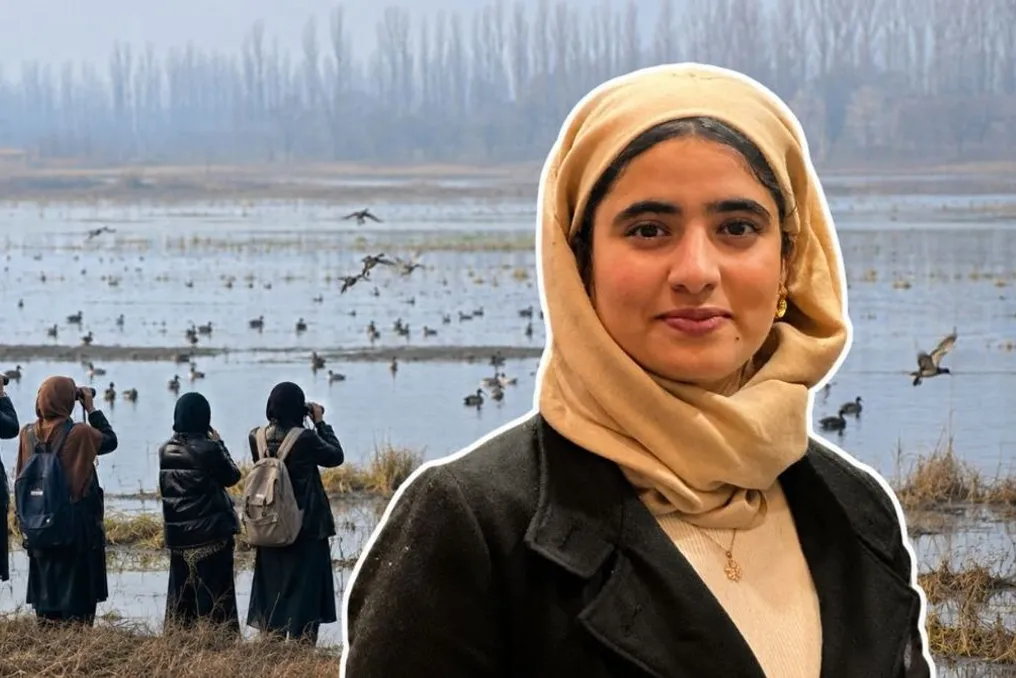
On a quiet spring day on the outskirts of Srinagar, along the banks of the Hooker Sar wetland, a group consisting exclusively of women and girls was reviewing achievements from the past month. Among them was 13-year-old Alima Hamid, surrounded by more than a dozen members of the Salim Ali Bird Watchers Network (SABN).
Armed with notebooks and binoculars, the group members assessed the progress, which included cleaning the wetlands, creating leaflets, and conducting school excursions. Seerat-ul-Nisar, one of the founders of the bird lovers' club, meticulously recorded all suggestions and comments made by the group members.
During the discussion, attention focused on Alima's book, which she is preparing for schoolchildren, containing information about the wetlands and migratory birds. Seerat advised Alima to complete the book as soon as possible so that it could reach educational institutions, which drew approving nods from the other participants.
Alima's book, titled 'Birds of Paradise,' includes information on over 50 species of migratory birds, as well as detailed descriptions of their habitats and significance. Like Alima, each participant has individual tasks in addition to the general weekly campaigns to clean the wetlands in South and Central Kashmir.
This group of 15 people represents the first women-led bird lovers' network in Jammu and Kashmir—SABN. It was launched in January 2025 after a group of women and girls who had been working individually decided to unite on a single platform for the preservation of Kashmir's fragile ecology.
Just before National Bird Day, January 4, 2025, the Wildlife Conservation Foundation (WCF), in collaboration with the Kashmir Bird Club (KBC) and The Nature Academy – YPJK, launched SABN in the Chatlam wetland reserve in Pampore. This initiative was conceived to expand the opportunities for women and girls in ornithology, ethical bird watching, and biodiversity conservation, while strengthening community-led conservation efforts across Jammu and Kashmir.
The network initially comprised 13 women and girls, including schoolgirls and college students, who pledged together to work towards the preservation of Kashmir's wetlands. Previously, many of them participated in environmental protection programs and events alone. Some young members were affiliated with The Nature School, founded in 2017 by ecologist and lawyer Nadim Qadri, which is designed as an educational space for children, integrating traditional knowledge with modern education.
Seerat, one of the founders, notes that the idea of creating a dedicated platform for women ecologists developed over time. She says the thought of establishing a women's ecological network arose last year due to a perceived need for female representation as eco-activists. Kashmiri women have always led environmental conservation, but their efforts often went unnoticed by the government and the public due to a lack of organizational support.
These women were already connected through environmental programs, bird watching events, and awareness initiatives. With the support of WCF, KBC, and The Nature Academy, they united to form a structured network. WCF played a crucial role in consolidating the group and assisting in defining its mission and approach.
Qadri, Executive Director of WCF, stated: 'We really wanted women to step forward and join the initiative to conserve our wetlands. Since all these women volunteer, they need to act under a single banner to strengthen their mission. We just guided them; otherwise, they are excellent at what they do.'
Seerat reports that the group is now open to a larger number of women and girls wishing to contribute to nature conservation. Interested parties can contact SABN through its social media platforms, including Facebook, X, and WhatsApp, to participate in cleanup drives and awareness programs.
Every year, hundreds of thousands of migratory birds arrive in Kashmir from countries and regions such as China, Russia, Siberia, and Eastern Europe. However, many of these seasonal visitors face threats from poaching, habitat degradation, and pollution. Numerous birds are illegally shot every year, posing a constant problem for the government and wildlife specialists.
This year, several instances of poaching attempts were registered in Kashmir's wetlands. On March 14, a double-barreled shotgun, 32 live cartridges, and two wooden boats were seized in the Narkara wetlands. In the Rampur wetlands, in the Chattabal area, poaching equipment was discovered after patrol teams prevented an attempt to catch birds. On March 24, three alleged poachers were arrested during a patrol in the Narkara wetlands, and three rifles were confiscated from them.
For SABN, combating this issue means going beyond simple bird documentation. Members regularly visit villages around the wetlands to speak with residents about the importance of protecting migratory birds and their habitats. They conduct door-to-door awareness campaigns, organize meetings with village communities, and discuss the threats facing the wetlands with panchayat representatives.
The group also visits schools and colleges to convey the conservation message to a younger audience. Hurain Gulzar, the club founder, notes: 'We have conducted many programs, and people are joining our mission and voluntarily cleaning the wetlands with us.'
The network's efforts come at a time when Kashmir's wetlands are facing increasing pressure from land grabbing. Recent data provided by the Forest Department, Kashmir Wetlands Division, in response to an RTI request, showed that over 7600 channels (385.7 hectares) of marshland had been lost due to encroachment. The Wetlands Division reported that the Hooker Sar wetland reserve, one of Kashmir's key wetlands, accounts for the largest proportion, with 3784 channels reported as encroached.
The Comptroller and Auditor General of India (CAG) also pointed to the encroachment of over 2500 channels and the ecological degradation of the Hooker Sar wetland, warning that its 'pristine glory' is under threat. These concerns prompted several organizations in the valley to intensify their conservation efforts. The Centre for Environmental Law, a research center in environmental law in Srinagar, is one of the organizations working through legal and official channels to protect the wetlands. Inspired and supported by such organizations, SABN was created to give women and girls a collective voice in the efforts to protect wildlife reservoirs, wetlands, rivers, and lakes.
Since its inception, the network has placed great emphasis on wetland cleanup and restoration. A significant portion of the Chatlam wetland in Pampore has already been cleaned. Simultaneously, the club conducted a similar cleanup campaign in Hooker Sar, one of Kashmir's largest and most important wetlands. Every Sunday, members gather with plastic bags, sticks, and trash bins to remove debris from parts of the wetlands.
According to the group, the effect is beginning to show. Seerat notes that there has been a noticeable increase in migratory birds in Chatlam this year. According to her estimates, over one hundred thousand birds visited the wetland during the season, compared to less than 50 thousand in previous years. Although the group acknowledges that bird numbers can depend on several factors, Seerat believes that the cleanup and restoration work has helped make the wetland more favorable for migratory birds.
The transformation has also made Chatlam more accessible to nature lovers, who can now observe its flora and fauna in a cleaner environment. Seerat states: 'We are still cleaning the Chatlam wetland. Then it will be Hooker Sar, and then the northern wetlands where hundreds of thousands of migratory birds reside.'
For a group that is barely a year old, ambitions extend far beyond cleaning isolated patches of marsh. The club plans a series of workshops, awareness campaigns, and public programs in collaboration with NGOs, conservation organizations, and government agencies. Seerat says they plan to hold workshops in different areas with open invitations for the public interested in contributing to nature conservation.
The club also goes into villages surrounding the wetlands, where members inform residents about the necessity of protecting water bodies and forests. From door-to-door awareness campaigns to informal discussions with panchayat members—young environmental defenders raise issues such as wetland land grabbing and poaching.
The female character of SABN is significant in a region where environmental protection has traditionally had a strong male presence. However, there is a growing number of women holding leadership positions in various sectors in Kashmir, including business, media, government, and art. Nature conservation is no exception. For instance, Aalia Mir has become one of the valley's prominent wildlife rescuers and an example of how women can lead wildlife protection.
SABN leverages this momentum by creating a platform led predominantly by young women and girls. Its members feel that their age and gender help them communicate more easily with a younger audience. Through school visits, workshops, and interactive awareness programs, they hope to encourage more students to view environmental protection as something they can actively participate in.
Their cleanup drives have also brought together volunteers of different age groups. Youth, local residents, and even elderly community members have joined the women in cleaning the wetlands. For Alima and other students, the message is simple: nature conservation cannot be left to a handful of experts or organizations. It must be a collective community effort.
Alima's book is one example of how the network is trying to take nature conservation beyond the wetlands. It works with schools to present 'Birds of Paradise' as supplementary educational material. The book combines illustrations, sketches, and stories to introduce students to over 50 species of migratory birds, their habitats, and the wetlands they depend on. Alima says: 'This book will be presented as a supplement by institutions. It contains beautiful pictures and sketches of these birds, and everything will be presented in the form of a story.'
The book launch is planned in parallel with the network's broader awareness activities. Meanwhile, members like Hurain have taken on specific roles within the group. Due to her public speaking skills and ability to motivate people, she has been tasked with preparing speeches and conducting environmental protection information sessions. Each participant brings a unique strength—be it birdwatching, writing, public speaking, art, research, or community outreach. Together, they transform these individual efforts...
2