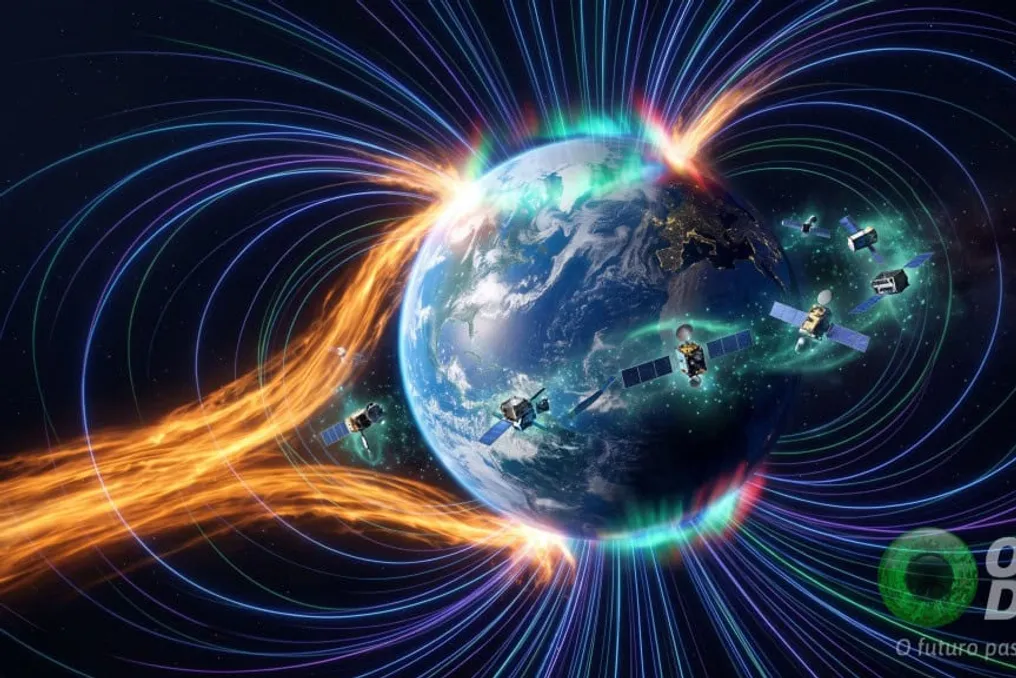
The growing dependence of modern society on electrical grids, satellites, and navigation systems has made space weather a matter of great concern. A powerful solar storm has the potential to affect vital global services in mere seconds.
To prevent major power outages and communication failures, the scientific community is working to reevaluate the true magnitude of this threat. Recent discoveries indicate that Earth is more vulnerable than previously thought, requiring a collaborative effort to protect the planet.
Recent research shows that the true scale of the risk has been underestimated for several decades. A study conducted by NASA and published in the journal Nature revealed that inaccuracies in measuring solar wind generated a false belief that Earth had a maximum limit for magnetic response. By correcting these interpretation errors, scientists concluded that the atmosphere's reaction to storms is continuous and linear.
Paulo Simões, a researcher and professor at the Mackenzie Center for Radio Astronomy and Astrophysics (CRAAM), explained to Olhar Digital how the data revision changed the perception of risk. He stated that the study suggests that, due to the way uncertainties in solar wind measurements are handled, a geomagnetic disturbance indicator in the Earth's poles could be up to double the currently recorded value.
The professor added that the study's authors propose adjustments to data interpretation and warn that extreme events can generate consequences greater than previously predicted.
The scientific concern extends beyond rare and catastrophic events. According to the researcher, intense but relatively frequent solar storms already cause problems in radio communications, instabilities in geolocation systems, electronic failures in satellites, and flight path deviations in civil aviation in polar regions. Thus, the study and monitoring of space weather have become a global necessity.
In this context, safeguarding terrestrial infrastructure depends on the integration of various observation technologies, not on a single solution. To ensure safe monitoring, it is necessary to combine information from ground telescopes, orbiting satellites, and new digital models.
Simões emphasizes that no isolated tool or technique excels, as solar activity is extremely complex, just like its effects on space weather and consequently on our technology. He concludes by saying that monitoring conducted by telescopes, whether old or new, on the ground or in space, are complementary, providing different types of data on solar magnetism, eruptions, solar wind, and the conditions of the near-Earth space environment.