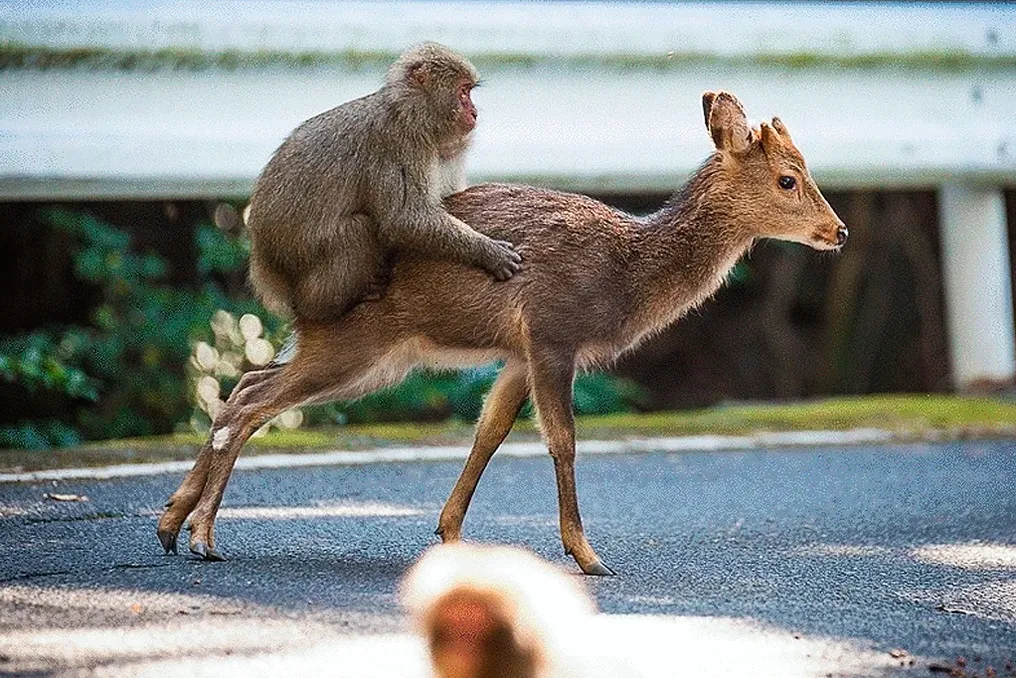
Research indicates that primates, such as simians and monkeys, are not the only beings who enjoy the company of pets, as they demonstrate caring, nurturing affectionate bonds, and even adopting individuals of other species.
Although in nature interaction between species usually has a clear objective, such as defense against predators or assistance in hunting food, the scenarios observed by scientists deviate from these established norms.
The collected evidence points to interactions between primates and various animals, including lizards, birds, deer, squirrels, dogs, and cats. The most frequent forms of interaction were surprisingly limited to play and mutual grooming, although in certain instances, the relationship resembled an adoption process.
According to the authors, this behavior directly reflects the social dynamic that primates themselves maintain within their own species. It was observed that young individuals had a greater tendency to interact with animals of other species, while adult females frequently nursed the adopted animals. In contrast, adult males were the only ones to show indifference, occasionally even exhibiting violence.
The researchers speculate that the motivation for monkeys and simians to adopt companions lies in loneliness. Like humans, these primates seek the company of other individuals, whether to participate in daily hygiene activities or to cuddle together.
Notable examples include Koko the gorilla, known for having a cat companion. Furthermore, there are reports of a friendship between an elephant and a dog, a crow that took in a cat, and a goose that lives with a turtle.
Historically, the oldest records of humans with pets date back 14,000 years in Germany, where a couple was found buried next to their dog. However, it is likely that this bond originated before this period, with the domestication of wolves, which occurred more than 15 thousand years ago and gave rise to dogs. With the advancement of domestication, this connection tends to shift from a purely utilitarian function to a bond more laden with affection.
The idea of investigating primates with affectionate bonds with other animals arose when Cyril Grueter, a biological anthropologist and primatologist from the University of Oxford, visited the Shanghai Zoo in China. On that day, he witnessed a gibbon female holding and stroking a small mouse in her hands.
The researcher had other encounters with this behavior. In a reserve in Africa, in Uganda, Ishe and Dembe, two young Eastern chimpanzees, were jumping between the forest branches when Grueter approached. What followed surprised the scholar: the pair of chimpanzees approached a neighboring red-tailed monkey, not with hostility, as is usual among chimpanzees, but with gestures of affection, starting to groom the other's tail.
To go beyond isolated cases, Grueter and his team reviewed scientific literature and consulted primatology specialists for similar reports. The final article consolidated 427 records involving 88 species of primates. The data confirmed that all primates, regardless of species, exhibited some behavior that could be associated with pet keeping.
The authors emphasize that, for the animals, there is no exact parallel to the human concept of 'having a pet'; the most appropriate term would be to describe the exchange of affection between animals belonging to different species.