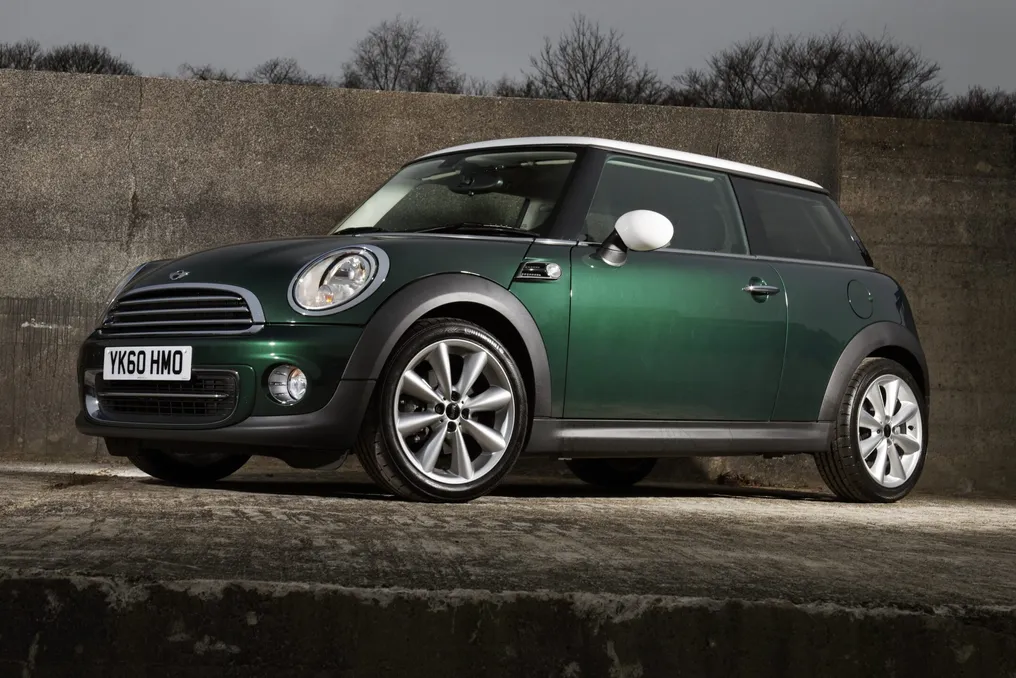
Although many enthusiasts appreciate various types of vehicles, each has distinct preferences. The guide's author shows a preference for compact, light, and enjoyable-to-drive hatchbacks, without placing great importance on rear-wheel drive supremacy when the focus is on dynamics and driving experience.
In this context, the R56 generation Mini Hatch stands out as a notable model. Some criticize the increase in size and weight of cars after BMW took over the Mini brand, but this view only holds up when compared to the original Mini by Alec Issigonis, conceived nearly seven decades ago as an accessible vehicle for the masses in the United Kingdom.
This initial project was so successful that the sporty Mini Cooper won the Monte Carlo Rally in 1964, 1965, and 1967, beating more powerful competitors in tight corners with almost no mechanical modifications.
However, with the arrival of the 21st century, all automobiles, in various categories, have become larger and heavier due to factors such as stricter safety regulations, the inclusion of modern comfort equipment, and the demand for greater interior space and sound insulation.
Even adapting to current requirements, the Mini Hatch managed to maintain the essence of its original concept: controlled dimensions, moderate weight, short wheelbases with wheels in all four corners, and fundamentally, the legendary kart dynamics—characterized by being direct, firm, and highly communicative. It is by preserving this formula, almost extinct in the current market, that this guide focuses on the naturally aspirated versions of the R56 generation Mini Cooper.
Why Consider a Naturally Aspirated Mini Cooper?
Among the various modern phases under BMW management, the second generation, identified by the R56 code and produced between 2006 and 2013, is considered one of the most interesting. It improved the finish and usability compared to the first modern generation (R50/R53) while maintaining the analog appeal and lightness.
In the Brazilian market, while the turbocharged Cooper S and higher models often attract more attention, the versions equipped with the 1.6 16V naturally aspirated engine from the Prince family represent a very practical and fun entry option for the brand's universe. This engine was developed in collaboration between BMW and the former PSA Group (Peugeot and Citroën), sharing many peripheral components, sensors, pumps, and seals with a wide range of Peugeot and Citroën vehicles (such as 208, 308, Citroën C4, and similar), which theoretically allows avoiding the known 'BMW tax' on wear parts and preventive maintenance.
However, for enthusiasts, the real motivations for wanting a naturally aspirated Mini Cooper R56 go beyond the practical, being more dynamic and emotional. Firstly, the dynamics: the Mini Cooper 1.6 generates about 120 hp to move just over 1,100 kg, which already favors a more pleasant drive. Although it is not a car made to impress in linear acceleration, it compensates with very astute behavior, rewarding those who master gear changes, keep the engine in the ideal RPM, and manage to carry speed into the curves. It has a short wheelbase (2.47 meters), low center of gravity, good mass distribution, and a naturally stiffer suspension setup.
Additionally, unlike the Cooper S (especially the early ones with the N14 turbo engine), which requires constant vigilance and faces chronic issues with direct injection, carbon buildup on valves, and expensive high-pressure pumps, the naturally aspirated engine (both N12 and its evolution, N16) is significantly simpler and more tolerant. With a naturally aspirated Cooper, the driver obtains the same torsional rigidity, the same precise suspension, and the same agile and communicative steering, but with a much lower chance of workshop surprises.
What Versions Are Available in the Market?
Launched in 2006, the R56 generation officially arrived in Brazil in 2009. Later, at the end of 2010 (as the 2011 line), the brand implemented a mid-life restyling (Life Cycle Impulse, or LCI).
This update included slightly renewed bumpers and LED taillights, replacing the silver buttons on the console—which tended to peel—with better-finished black controls, and swapped the N12 engine (120 hp) for the revised N16 (122 hp).
Mini segmented the naturally aspirated Cooper packages into three trim levels, which currently range between R$ 48,000 and R$ 75,000 in the used market, depending on the condition, year, and options:
- Salt (between R$ 48,000 and R$ 55,000): Basic Cooper package, already including 16-inch alloy wheels, manual air conditioning, halogen headlights, and a simpler interior. Ideal for those seeking the 120/122 hp mechanics while spending the minimum possible on purchase.
- Pepper (between R$ 52,000 and R$ 65,000): Maintained 16-inch wheels but added automatic digital air conditioning, leather multifunction steering wheel, fog lights, rain sensor, and automatic headlight activation.
- Chili (between R$ 60,000 and R$ 75,000): Featured 17-inch wheels, Xenon headlights with washers, leather sports seats, and could be equipped with the desired panoramic double sunroof as an extra—an item that pushes the price of post-2011 LCI units to the top of the market.
Regardless of the package chosen, the naturally aspirated Cooper could be equipped with the six-speed manual Getrag transmission—a rare and highly valued item by enthusiasts—or the reliable six-speed Aisin automatic transmission with sequential shifts.
The Alternative: Mini One
In the used segment, the Mini One appeared in Brazil starting in 2011 (in the LCI phase), with current values between R$ 45,000 and R$ 52,000. It used the same 1.6 Prince family engine but with a smoother electronic calibration, delivering 98 hp, along with 15-inch wheels and simple fabric interior trim, without luxuries like digital air conditioning or a sunroof.
Those familiar with the model know that the One version offers inferior performance compared to the others. However, for those who prioritize chassis dynamics above all else with the lowest acquisition cost, it offers a positive point: a considerable portion of the few units sold in the country came with the six-speed manual gearbox, providing the engaging drive and the same suspension tuning as the more expensive versions at a more accessible price. Despite this, its modest performance and simplified finish reduce its overall appeal. The information in this Buying Guide also applies to it.
Points to Note When Buying
It is crucial to recognize that despite the relatively accessible cost, which places the Mini Cooper R56 in the same price range as a semi-new domestic hatchback, it remains a premium brand vehicle. Consequently, maintenance and spare parts costs reflect this positioning; therefore, one should not expect the maintenance cost to be the same as that of an HB20 or Onix.
An essential starting point is not to rely exclusively on the dealership network. By law, manufacturers must provide parts for ten years after the model's production ends. Since the R56 has been discontinued for some time, the official network often refuses requests for specific body and trim components, forcing the owner to seek independent workshops for repairs using original parts or look for imported parts, which may have long delivery times and be more expensive.
The positive aspect is that, besides sharing several components with PSA cars sold in Brazil, the R56 has good quality spare parts support in the parallel market and benefits from specialized workshops that master all its details. An example cited is Alma 27 Garage, in Barueri/SP, which services both Minis and BMW models. Its co-owner, Yahn Amaral, was the mechanic who provided information for this guide.
Engine
Initially, since the 1.6 Prince engine was used in numerous Peugeot and Citroën vehicles, items such as sensors, seals, pumps, and internal engine components are easily found in large auto parts stores for a fraction of the price charged by the Mini logo box. Basic service parts, such as filters (oil, air, and fuel), spark plugs, brake pads, and discs, are widely available in the national market, manufactured by OEM suppliers.
It is recommended to improve the cooling system. The original plastic connections and hoses of this system dry out with the intense heat of the engine bay and are expensive at dealerships. The solution adopted by specialized workshops is the installation of imported silicone hose kits—Yahn states that these parts can be ordered through platforms like AliExpress or Mercado Livre. Even considering import taxes, the final cost is usually more advantageous. Furthermore, silicone components offer superior durability and practically eliminate the risk of future drying out.
Transmission
Manual Transmission: The six-speed Getrag is recognized for its extreme robustness and uncomplicated maintenance. When replacing the clutch kit, assembly line suppliers such as LUK, Sachs, and Valeo provide quality components.
Automatic Transmission: The six-speed Aisin with torque converter is very reliable, provided it receives rigorous preventive maintenance. The workshop protocol involves changing the fluid (using renowned brands like Motul), the filter, and the gasket every 60,000 km or five years. In the R56 platform with the 1.6 engine, the oil filter replacement is done externally and directly (unlike the F56 generation, where the filter is internal), simplifying the procedure.
Chronic Problems
Generally, the Cooper models with the naturally aspirated engine are largely the most reliable and durable variants of the entire R56 generation. However, because it is an engine that operates at high temperatures inside a compact compartment, the aging of seals and peripherals requires attention, regardless of the version (N12 or N16).
Valve Stem Seals (between 40,000 km and 80,000 km): This is the most common chronic failure in the Prince line. The drying of the seal rubber causes progressive oil consumption. During pre-purchase inspection, one must check if the oil level on the dipstick is correct. After starting the cold engine and letting it idle for about 15 minutes, one must accelerate firmly up to 4,000 rpm, observing the exhaust; if there is a cloud of white or bluish smoke, the seals have lost their seal.
Workshops equipped with specific tools can replace these seals on the top of the engine without needing to remove the cylinder head (as is the case with Alma 27 Garage). This technique drastically reduces service time and labor cost compared to the conventional method.