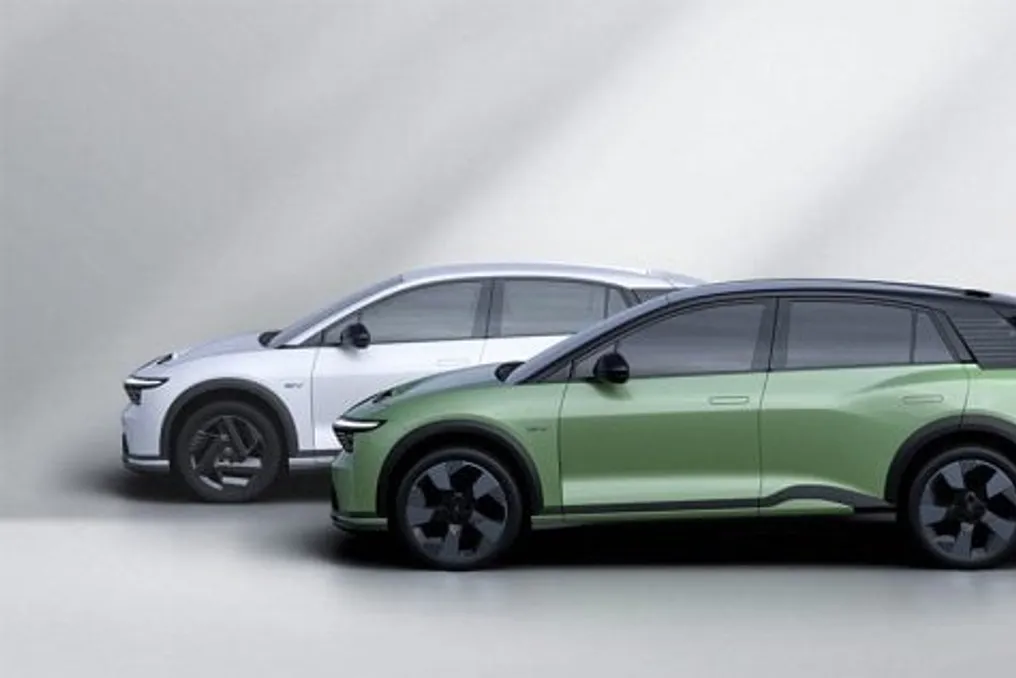
Mitsubishi has unveiled the first images of the ASX VR-e, its new all-electric compact SUV. This model is scheduled to arrive at dealerships in the last quarter of 2026, initially launching in the Australian and New Zealand markets, with no plans for commercialization in Brazil.
This vehicle represents the automaker's first electric model in Australia since the i-MiEV, which was discontinued in 2015, and is part of the electrification strategy called Momentum 2030. Four variants of the ASX VR-e will be offered: LS, Aspire, Exceed, and GSR.
The ASX VR-e is derived from the Foxtron Bria, which was displayed in Taiwan in December 2025 under the name Foxtron Model B. The development of this model was carried out by Foxtron, a subsidiary of Foxconn—the same company responsible for assembling iPhones—in collaboration with the Italian studio Pininfarina. Production will be conducted by Yulon Motor in Taiwan. Although the brands are distinct, both vehicles share almost their entire structure, differing only in emblems, bumpers, wheels, and finishes.
The SUV dimensions are 4.31 meters long, 1.88 meters wide, and 1.53 meters high, featuring a wheelbase of 2.8 meters and a ground clearance of 15.5 cm. The trunk offers a capacity of 320 liters, expandable to 1,043 liters by folding down the rear seats.
The exterior design follows the current identity of electric models, featuring a horizontally integrated LED lighting system both front and rear. The sides have recessed door handles, and the wheels, available in 18 or 20 inches, feature a more closed design to optimize aerodynamics. There is also a duct designed to direct air from the front bumper to the hood, and the roof can be configured in a color different from the body.
Internally, the ASX VR-e features a minimalist cabin, equipped with ambient lighting, a 9.2-inch instrument cluster, and a 15.6-inch multimedia center.
Mitsubishi has not yet released the prices or detailed technical specifications for the versions intended for Australia. However, data regarding the Foxtron Bria indicates that the entry-level configuration uses a single electric motor positioned on the rear axle, generating 232 hp and 35.7 kgfm, with 0 to 100 km/h acceleration in 6.8 seconds. The battery, made of lithium iron phosphate, has 57.7 kWh and guarantees a range of up to 516 km in the NEDC cycle, considered optimistic.
In the top-tier version, the Bria Pioneer, two electric motors and all-wheel drive are employed, delivering 407 hp and 71.4 kgfm. This configuration allows it to reach 0 to 100 km/h in just 3.9 seconds, according to Foxtron. The battery remains the same, but the range reduces to 466 km.
Both SUV configurations support fast DC charging of up to 134 kW, which allows the battery charge to increase from 10% to 80% in approximately 30 minutes.
In Taiwan, the Bria has an initial price equivalent to R$ 142 thousand (NT$ 899 thousand) and reaches R$ 182 thousand (NT$ 1.149 million) in the top version. In Australia, this SUV is expected to compete with competitively priced Chinese electric vehicles, which also exert pressure on the Brazilian market, such as the BYD Yuan Plus.