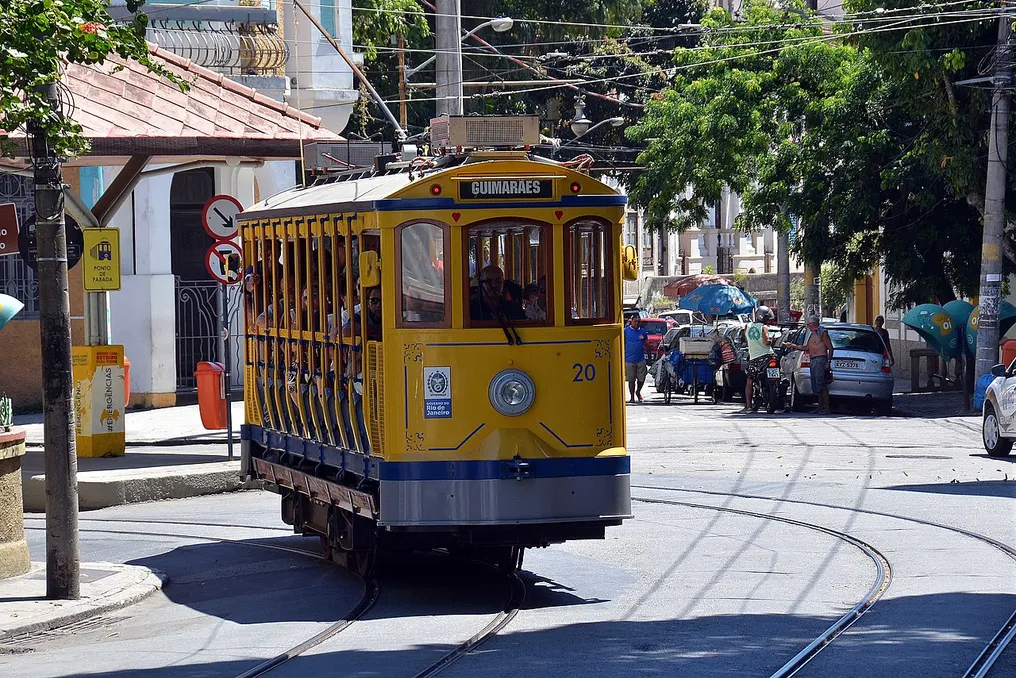
The Silvestre branch, an emblematic section of the Santa Teresa Trams, has returned to full operation in Rio de Janeiro after nearly two decades out of service. The revitalization of this segment experienced a one-year delay compared to the initial schedule, requiring the replacement of about 667 tons of rails, the restoration of 28 thousand square meters of paving, improvements to the drainage system, and the refurbishment of approximately six kilometers of overhead network.
This tram, originally inaugurated in 1896, remains one of the few trams of its era still operating globally. During the half-hour journey, which covers 5.8 km between the central area and Silvestre, passengers enjoy panoramic views of the city, passing by the Lapa Arches, the historic streets of Santa Teresa, and natural viewpoints overlooking the center of the Marvelous City.
The iconic yellow tram is a tourist symbol of the city, having been featured in international productions such as the film Rio (2011), as well as in national films like Vai Trabalhar Vagabundo (1973) and Um Bonde Chamado Saudade (1975).
The return of the Silvestre branch was achieved after the complete reconstruction of its infrastructure and the start of passenger tests, benefiting both local residents and tourists, reinforcing one of the metropolis's main tourist attractions.
The route offers a valuable experience both for the ride and the beautiful landscapes of the Carioca capital, including passing through the Lapa Arches, which now function as a viaduct over the old Carioca aqueduct. Furthermore, visitors can observe Guanabara Bay in the city center.
One of the great attractions is the opportunity to explore the Santa Teresa neighborhood. Since 1896, the tram has been part of the urban landscape, witnessing the evolution of the region from an elite refuge in early 19th-century Rio to the current cultural hub, filled with studios, art galleries, handicraft shops, bars, and colonial mansions. It is recommended to explore the neighborhood on foot, appreciating its unique architecture with narrow cobblestone streets.
The historical trajectory of the Santa Teresa Tram dates back to 1872, when permission was granted for rail lines in the hills of Santa Teresa and Paula Mattos, giving rise to the Santa Teresa Railway Company. Initially, transportation was powered by animal traction, but electricity was introduced in 1892.
With the adoption of electric traction, the Railway Company began using the then Carioca Aqueduct—the current Lapa Arches—as an access route to the Santa Teresa hill. The tram was officially inaugurated in 1896.
Over the decades, the use of the trams declined. In 1968, the service was limited to the route between Centro and Santa Teresa, being deactivated in other parts of the city. In 1983, the tram was listed as a heritage item, guaranteeing its status as a heritage asset in the areas where it still operated.
In 2011, two accidents forced the modernization of the vehicle; the most serious, a derailment, resulted in six deaths. Following this event, reforms, tests, and technical updates focused on safety and transport conservation were implemented, including the mandatory limit on seated passengers, eliminating the practice of passengers hanging from the railings.
In 2023, works were resumed to restore the original complete route, covering the renovation of the Paula Mattos and Silvestre branches, which is now operational again.
Currently, the Santa Teresa Tram makes four daily trips departing from the Carioca Station, located at number 2 of Rua Lélio Gama (Centro), at 10 am, 11 am, 2 pm, and 3 pm. The fare is R$ 20, covering round trip. Tickets are preferably sold at the Carioca Station, subject to seat availability, accepting cash or debit and credit card payments, but not PIX. Pets are allowed on the ride, provided they remain in an appropriate carrier throughout the journey, unless specific medical authorization is presented.