Amazon has announced a substantial expansion of its drone delivery service in the United States. Prime Air is projected to reach nearly 500 cities and municipalities across the country by the end of 2026, making this delivery method available to communities totaling tens of millions of consumers.
This expansion represents an increase of about six times compared to the current service coverage. Amazon reports that Prime Air already executes thousands of deliveries daily and has delivered hundreds of thousands of packages by drone just this year.
Among the new metropolitan markets planned are Chicago, Atlanta, Cleveland, Syracuse, and Boise. The company also mentioned that other locations will be incorporated into the service throughout the year.
Currently, Prime Air is active in 11 points spread across ten major metropolitan regions in the states of Arizona, Florida, Kansas, Louisiana, Michigan, Nebraska, and Texas. Operations are focused on areas adjacent to launch bases, with each unit covering an approximate area of 453 km².
For David Carbon, Vice President of Prime Air, this modality offers an even more agile alternative to the company's conventional delivery methods. He highlighted that while customers already use Amazon for fast same-day or next-day deliveries, Prime Air provides an even faster option, with deliveries made in up to 30 minutes.
According to the executive, the company has already made hundreds of thousands of drone shipments in 2026 and aims to reach consumers in nearly 500 cities and municipalities by the end of the year.
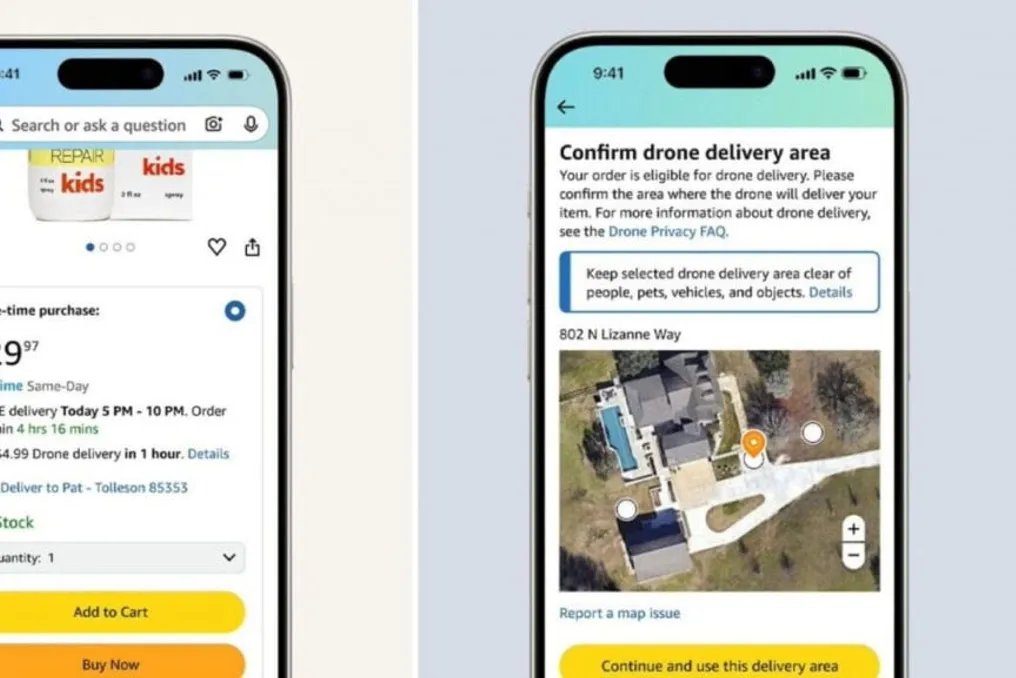
Prime Air is fully integrated into the standard Amazon shopping experience. Consumers use the same app, follow the payment process, and receive the same customer support; in eligible areas, the drone delivery option appears during the purchase.
Amazon Prime members are entitled to free ultra-fast delivery on orders of US$50 (equivalent to R$258.59) or more. For purchases under this amount, the fee is US$2.99 (R$15.46). Customers without a Prime subscription must pay US$4.99 (R$25.81) for delivery.
On the first use of the drone service, the customer must specify the package receiving location. Subsequently, they can keep the same address or select another for future orders. Upon arrival at the delivery point, the drone performs a check to ensure there are no people, animals, or vehicles present before releasing the package.
A fundamental aspect of Prime Air is the high level of aircraft autonomy. Amazon guarantees that its drones are equipped with a system called Detect-and-Avoid, which continuously monitors the airspace and the vicinity of the aircraft, allowing for real-time safety decisions.
This system operates analogously to the work of a pilot observing the aerial environment around the plane. Cameras and sensors installed on the drones are used for navigation, obstacle identification, and safe delivery execution.
Amazon also assures that the equipment does not track individuals or record their movements. There is no live video transmission to a human operator; the data collected by the cameras is processed by the drone itself to assist in safe navigation.
The devices were designed to function in real-world scenarios, including light rain and temperature variations. The drones are entirely electric and produce no exhaust emissions.
During delivery, the noise level remains below that produced by a delivery truck stopped on the street, and landing takes approximately 30 seconds. In flight, at altitude, the sound would be comparable to a window fan operating at low speed and, according to the company, is generally imperceptible inside residences.
Amazon positions Prime Air as one of the various ultra-fast delivery options offered by the company. The drone service primarily focuses on suburban areas and enables deliveries within 30 minutes for millions of products.
Meanwhile, Amazon Now provides deliveries in about 30 minutes in dozens of U.S. cities (and Brazilian cities), covering thousands of items, mainly fresh food, household goods, and immediate necessity products.
Additionally, the company maintains one or three-hour delivery options for a selection of over 90,000 products, in addition to same-day delivery, which reaches millions of items in over ten thousand U.S. cities and municipalities.
With this announced expansion, Amazon aims to transform Prime Air from a service limited to certain regions into a national scale operation, bringing aerial deliveries closer to tens of millions of consumers by the end of 2026.