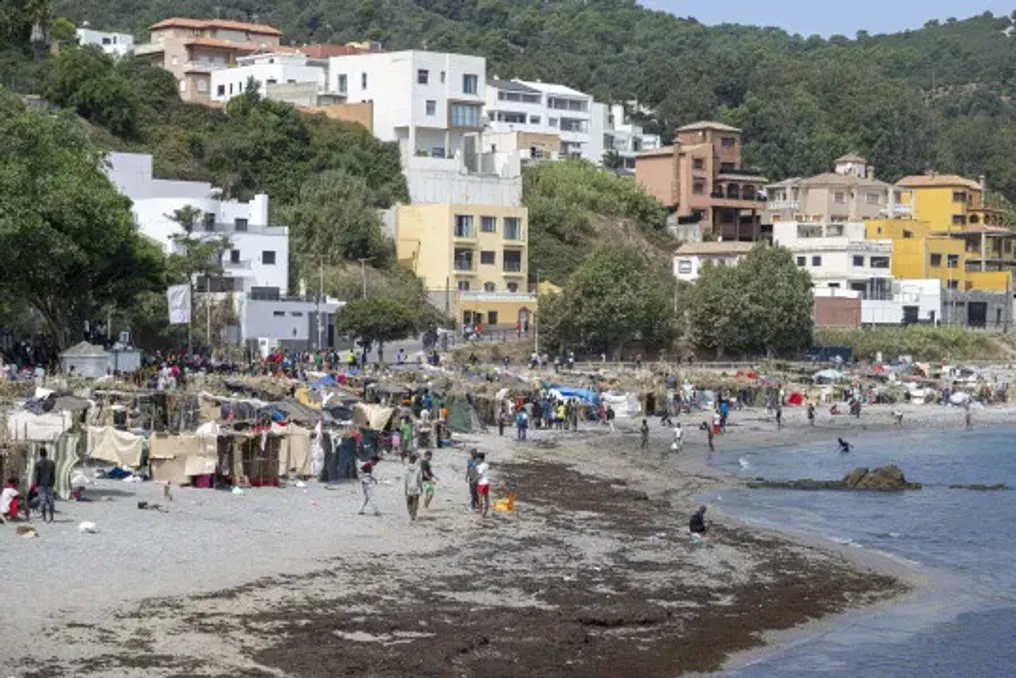
The Spanish government will allow the transfer of 500 migrant children, particularly girls who entered Ceuta at the end of July, to the mainland territory. Although most of the approximately 70,000 people who crossed the border have already returned to Morocco, Spanish legislation obligates the state to care for unaccompanied minors.
In this regard, Ceuta and the Spanish executive branch are implementing an emergency response plan for this purpose. Since this is a delicate political issue, the plan does not involve transferring custody to regional governments, as the regions governed jointly by the People's Party (conservatives) and Vox (far-right) show unwillingness or oppose accepting their share.
The strategy, developed by the Ministry of Youth in coordination with the Ceuta government, involves engaging non-governmental organizations (NGOs) and child protection agencies to take responsibility for the minors. According to Cadena SER, the girls will be urgently housed in six locations: in the existing reception center, two prepared centers, a wedding hall with a capacity of 120 people, and two residential buildings designed for 70 and 80 places, respectively.
Sources in the Ministry told the same media outlet that they are looking for an effective model that does not depend on direct placement by autonomous communities, using resources similar to those created for transferring asylum-seeking children from the Canary Islands, which are managed by organizations according to a Supreme Court ruling. The transfers are carried out in such a way that the communities cannot object, as they are not taking on guardianship.
Despite Ceuta believing that the solution to the migration crisis is the 'return of everyone who illegally entered the autonomous city at the end of July, including unaccompanied foreign minors,' the government led by Juan Jesús Vivás is ready to make an exception for these 500 migrant girls.
The People's Party (PP) has already rejected this idea, insisting on deportation, stating: 'The best place for minors is with their parents or in the protection systems of their countries.' News of this plan emerged just a few hours after the European Commission stated that under EU law, all migrants must be returned to Morocco, 'including unaccompanied minors.'
Conflicting reports are partly due to the fact that the newest European immigration pact has not yet been incorporated into Spanish legislation, which still states that the state is obliged to care for unaccompanied young migrants until they reach the age of 18. According to data from the Spanish Ministry of Inclusion and Migration last March, 21,104 people aged 16 to 23 were under state care, of which about 3,500 were under 17, and approximately 50% were from Morocco. Girls accounted for about 8% of the total number.
UNICEF (United Nations Children's Fund) had already warned about the 'unsafe and unsanitary' conditions in which hundreds of minors are in Ceuta since the large migration flow at the end of last month.