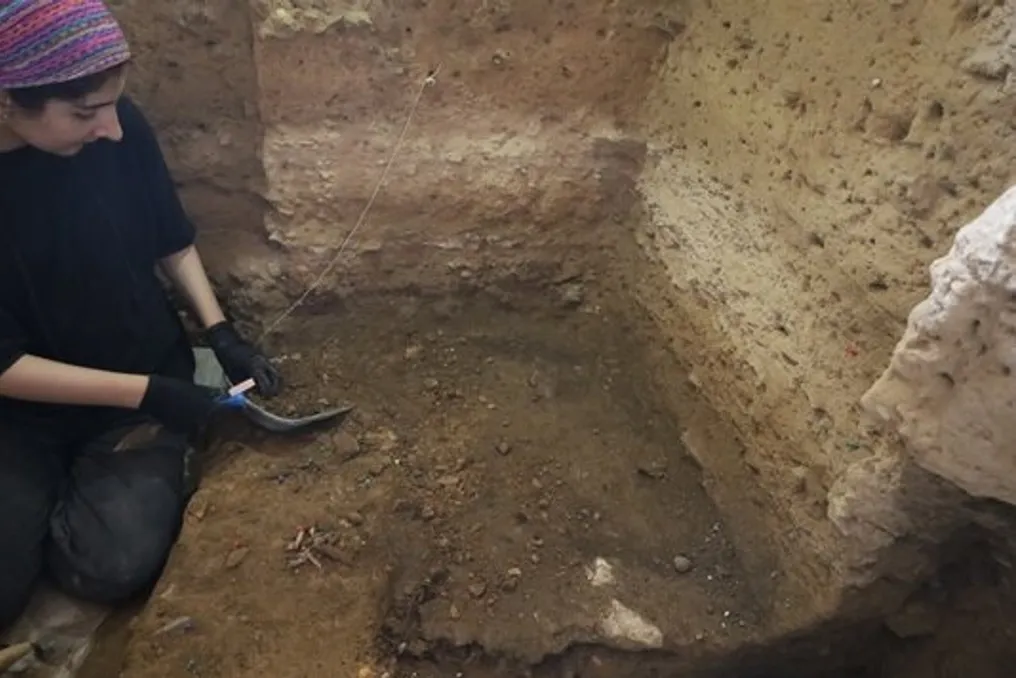
The seventh season of archaeological excavations in the Kale-Kord cave potentially could provide new data for reconstructing the evolution of stone tool manufacturing technology and the history of early human settlement on the Iranian Plateau, stated the project leader.
Milad Hashemi Sarvandi, a researcher at the Department of Archaeology of Tarbiat Modares University, noted that the findings discovered in various layers of the cave indicate the presence of separate technological sequences. This raises the probability that deeper layers represent a local technological tradition belonging to the Late Lower Paleolithic and Early Middle Paleolithic.
Hashemi Sarvandi emphasized that this interpretation remains only a research hypothesis, requiring further excavations and analysis.
According to Hashemi Sarvandi, the sequence of stone tools in the cave is preliminarily divided into three technological sections. The upper layers contain complexes of stone tools that show more similarity to Mousterian traditions known in the Zagros Mountains and are closely linked to Neanderthal populations. These complexes also demonstrate greater standardization compared to those found in deeper layers.
The middle section is characterized by a higher content of crude raw materials, and some tools and arrowheads are larger and less standardized. Technologically, these complexes occupy an intermediate position between the Mousterian traditions of the upper layers and the simpler technology found below.
Deeper layers, previously identified in areas such as Square Q18 and Trench Three, exhibit a different technological pattern, where production relies more on simple and irregular cores and less standardized artifacts.
The archaeological group hopes that continuing the work, especially deepening Trench Two, will allow them to reach these older deposits again. This will give researchers the opportunity to compare them with previously extracted complexes. Such comparisons can help clarify the development of stone tool technology in Kale-Kord and determine whether the earlier technological tradition ultimately led to more standardized technologies based on the Levallois method.
He stressed that additional work is necessary to test this hypothesis, including detailed analysis of production sequences, raw materials, artifact morphology, and their spatial distribution.
The significance of Kale-Kord extends beyond its antiquity. The cave may contribute to a better understanding of early human presence, adaptation to the environment, tool-making technologies, and behavioral changes on the Iranian Plateau. Systematic excavations and comprehensive analysis of the cave's archaeological deposits can also help fill knowledge gaps about this important period of Iranian prehistory and include Kale-Kord in the broader framework of Paleolithic studies in Iran and West Asia.