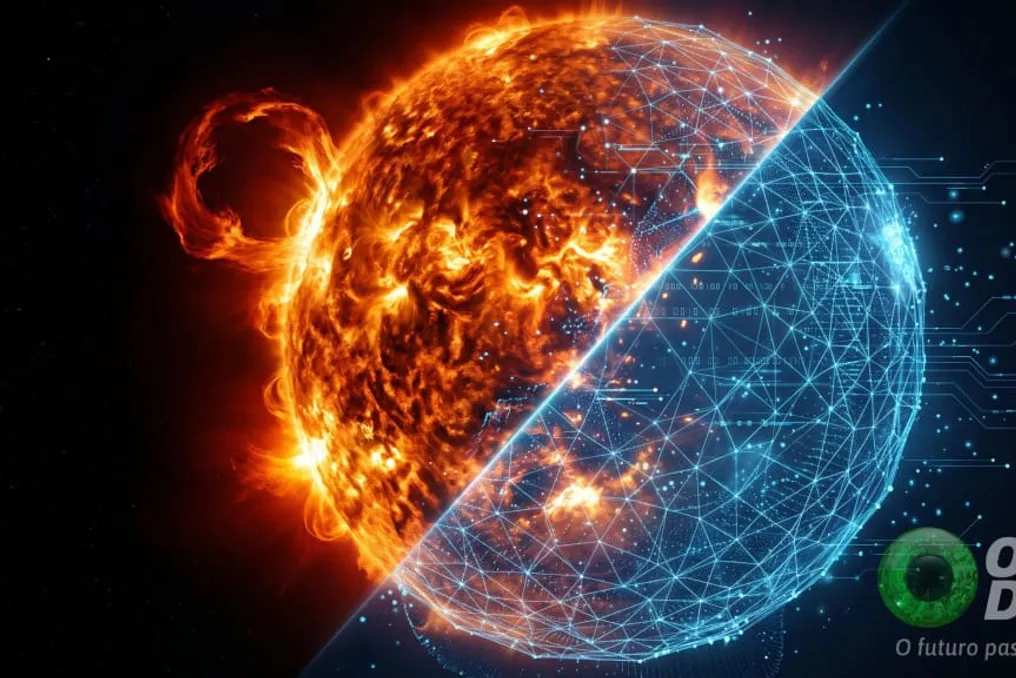
Scientists have begun using artificial intelligence (AI) to predict the occurrence of solar storms. Recent models, such as EarlyDetect, are capable of analyzing data beneath the Sun's surface to detect the appearance of active regions up to 12 hours before they become visible. The goal of this approach is to buy precious time to protect electrical grids, satellites, and GPS systems before an eruption reaches Earth.
However, the progress of these digital tools encounters a serious obstacle. Although algorithms can notice subtle changes in the data, they are only searching for numerical patterns without understanding the physical processes underlying solar eruptions. Consequently, the current task of the scientific community is to transform laboratory tests into reliable alerts for everyday use.
Despite the speed, modern AI models are limited by the very nature of the Sun. Tools like EarlyDetect study magnetic and acoustic oscillations beneath the surface to identify the appearance of sunspots, but they operate solely by mapping statistical patterns.
This limitation affects the accuracy of the warnings issued by the algorithms. Paulo Simmons, a professor and researcher at the Mackenzie Center for Radio Astronomy and Astrophysics (CRAAM), explained to Olhar Digital that digital models search for numerical correlations without grasping the behavior of the Sun.
The professor notes: 'The main limitation for machine learning algorithms in distinguishing between 'active' and 'inactive' spots is physics.' He adds that these algorithms, in a simplified sense, look for patterns in data, but without any connection to the physics that controls the appearance of spots and their potential to cause flares—specifically, the physics of magnetic fields in solar plasma.
For this reason, the detection of a sunspot does not guarantee a space storm. A region with intense magnetic activity can appear on the surface and remain stable without causing coronal mass ejections or radiation bursts. In fact, the lack of understanding of physical processes leads AI systems to generate a large number of false alarms.
Another barrier relates to the distance between laboratory tests and real-world observation. In scientific papers, algorithms often demonstrate excellent results because they analyze known and structured historical data. Nevertheless, predicting space weather requires processing information in real-time in a continuous stream from space, a scenario where the model still has shortcomings and delays.
For a digital tool to be adopted by monitoring agencies, the system must prove its usefulness in routine observational work. Simmons emphasizes that publishing academic models is just a starting point. The researcher from Mackenzie insists: 'There are many proposed tools for predicting solar activity; however, their validation must be tested in use, not just in the test cases presented in papers.'