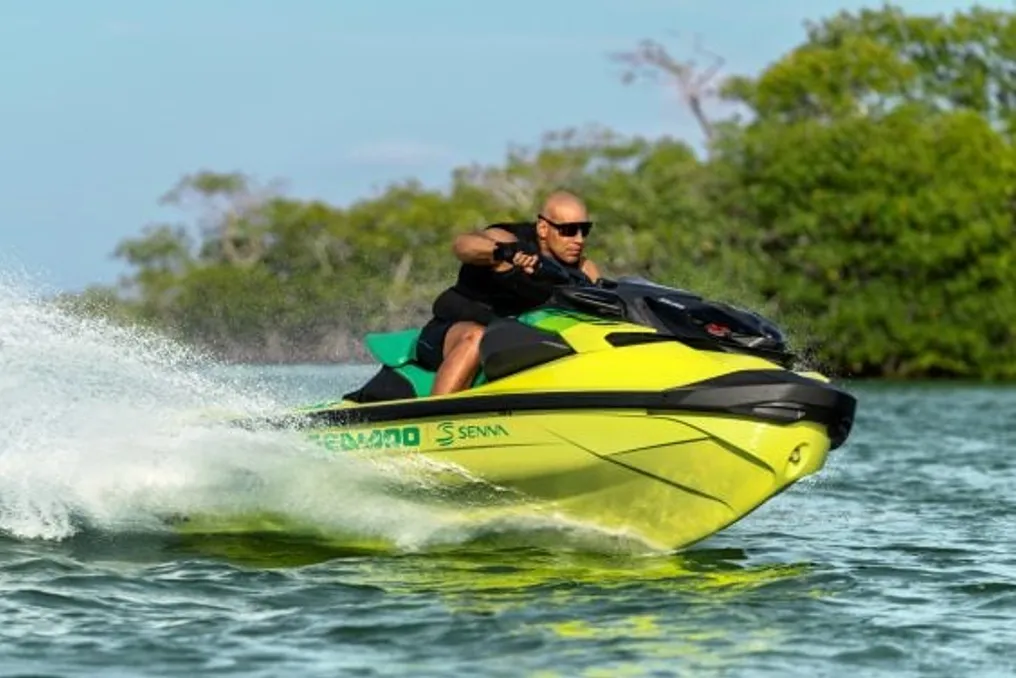
Sea-Doo, the manufacturer of jet skis from Canadian BRP, has introduced the RXP-X Senna 350 model. This limited series, restricted to 1991 units worldwide, is a tribute to Ayrton Senna. The model is equipped with the Rotax 1630 ACE engine, which is the most powerful installed in a jet ski of this brand, developing 355 horsepower, and is already available for pre-order outside the country.
The agreement with Senna Brand—a company established by the Formula 1 triumphator's family to manage his legacy—is valid for one year. In the United States, the special version starts from 145 thousand Brazilian reais ($27,799 USD), according to information from The Big Lead. BRP has not yet disclosed prices or delivery times for Brazil.
The motorcycle's design features yellow-green tones, mimicking Senna's original helmet, and the driver's signature is laser-etched onto the body. The years 88, 90, and 91 are engraved on the body, corresponding to three world titles, as well as phrases used by the family brand: 'Seek your truth' and 'Born to win'. Each of the 1991 units has a numbered designation referencing 1991, the last championship.
The configuration includes a passenger seat in the same color scheme and a protective cover with the Senna logo. Bruno Senna, the driver's nephew and ambassador for Senna Brand, stated: 'Ayrton Senna never accepted limitations. He was driven by the desire to inspire other people to go beyond what they considered possible.'
Senna showed an interest in water sports and spent free time at the house he owned in the Portogalo complex in Angra dos Reis, on the coast of Rio de Janeiro, where he rode jet skis in front of the beach. Among his gear was a Kawasaki Jet Ski X2 from the 1980s, displayed alongside other driver memorabilia at the São Paulo Boat Show in 2024.
Bruno Senna told Caras magazine in 2024 that his behavior on the water was similar to that on the tracks: 'He was competitive even in games and didn't like losing to me because I had the advantage of being lighter. So he always found a way to make his jet ski engine more powerful.'
His passion for power also extended to yachts. The 5.8-meter Pole Position boat from the shipyard Cobra, which the driver used from 1986 to 1994 in Angra dos Reis and Ilhabela, was ordered with hull and engine modifications of 225 horsepower—about three times more than required for the boat, according to current owner Danilo Iakimoff.
His hobby also came at a cost. In June 1991, a week before the Mexican Grand Prix, Senna fell off a jet ski in front of his house in Angra and sustained a head injury from a friend's car accompanying him. He suffered bruises on the back of his skull, participated in training at the Hernanos Rodriguez Autodrome with bandages, overturned during practice, but still finished third. That same season, he won his third world title, 1991, which is now displayed on the numbered badge of every Sea-Doo.
According to the Australian website Watercraft Zone, Brazil is currently the second-largest jet ski market in the world, surpassed only by the United States, which explains the commercial appeal of this tribute. Part of the revenue from Senna Brand funds the Ayrton Senna Institute, which has been involved in public education in the country for over 30 years.
Unlike cars, jet skis do not have a gearbox. The engine activates a jet pump that sucks water from under the hull and ejects it through a movable nozzle at the rear. It is the direction of this jet stream that allows the vehicle to change direction, which is not entirely intuitive for those accustomed to driving cars: without an accelerator, control is practically absent. Braking is also different, and Sea-Doo uses the iBR system, which directs the jet stream forward to slow down and move backward.
The Rotax 1630 ACE engine is a 1.6-liter three-cylinder engine with a mechanical compressor. According to the manufacturer, this unit accelerates 15% faster from 0 to 96 km/h compared to previous engines that produced 329 horsepower. The Big Lead indicates an acceleration of 3.1 seconds, measured by the North American standard of 0 to 60 mph, equivalent to 0 to 100 km/h used in Brazil.
In Brazil, operating a jet ski requires a Maritime Service driver's license in the Monohull category, and the vessel itself must be registered, like any other.