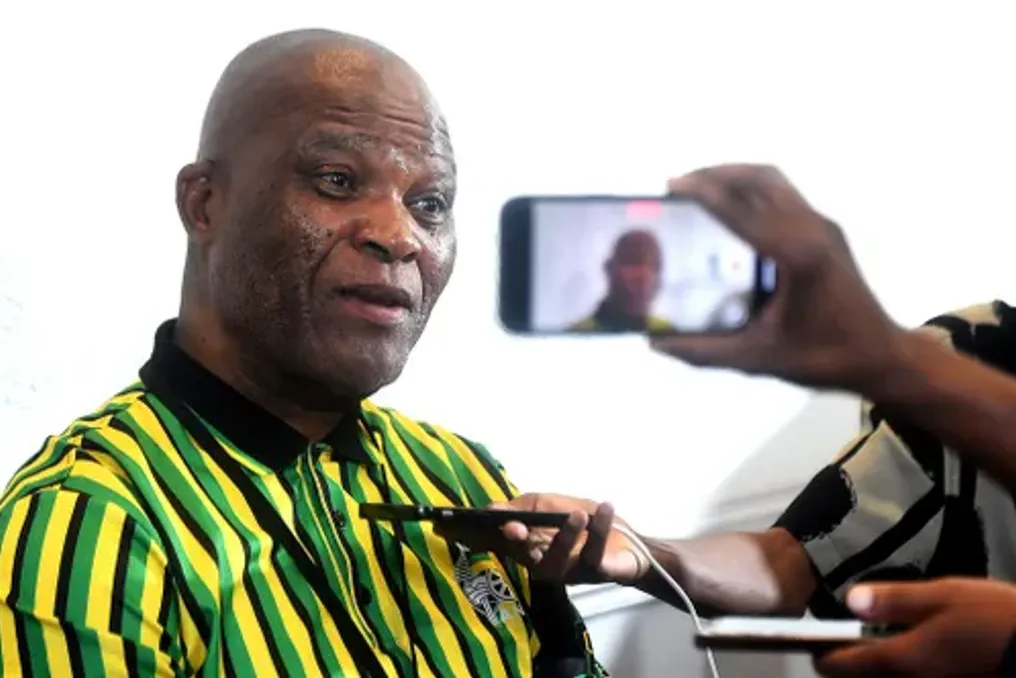
An ANC National Executive Committee member, Dickson Masemola, stated that Johannesburg's current problems were inherited from the coalition government that began operating in the metropolis in 2016 under the DA party, and insisted on the ANC's ability to fix the city's situation.
However, political experts expressed doubt about the ANC's ability to govern the city alone again, citing the party's own track record in local governance. The ANC has repeatedly blamed previous administrations for Johannesburg's current difficulties, a stance firmly rejected by the DA party.
Masemola, deputy chairperson of the party's target group for local government intervention, spoke at a press briefing on Wednesday to analyze the revision of the ANC Manifesto for the 2021 local elections and preparations for the November 4 local government elections. The party, which has long been criticized for ineffective management and administration, is under pressure to improve its results in local elections.
The ANC has not yet announced its mayoral candidates, while many of its rivals have largely finalized their lists. The ANC is expected to present its candidates after the vetting process by the National Executive Committee. The party plans to present its manifesto on August 23, outlining promises to voters ahead of the elections.
Johannesburg is expected to be one of the most closely watched contests for the ANC, with political veteran Frank Chikane highlighted as the party's main mayoral contender. The current mayor of the city is Dada Morelo. If elected, Chikane will face numerous competitors in Johannesburg, including Helen Zille of the DA, Herman Mashaba of ActionSA, Tlaleng Mofokeng of the EFF, Kenny Kunene of the Patriotic Alliance, Mlungisi Mabaso of the IFP, Lukhon Mnguni of Rise Mzansi, Nobuntu Khlazo-Webster of Build One South Africa, Shirin Ibrahim of Al Jama-ah, Ntsiki Mazwai of the Land Party, and Mo-Afrika Mandla Mokoena of the African People’s Congress.
The race for the Mayor of Johannesburg is anticipated to be one of the most intense local government races in the country. The city's problems include poor service delivery, crime, corruption, power and water outages, potholes, occupied buildings, the growth of informal settlements, non-functional traffic lights and streetlights, water losses, and poor sanitation.
Despite this, Masemola, who is the Deputy Minister of Cooperative Governance and Traditional Affairs, insisted that the ANC inherited many of these problems. He stated: 'The problems here in Johannesburg and elsewhere in the country where we have seen serious systemic constraints and difficulties are not related to the African National Congress.'
He added: 'I think the track record speaks for itself to a large extent. Humbly, with the utmost humility and respect, when we state this point. It is not about arrogance; it is about historical records, but with humility.'
Masemola pointed to the achievements of the ANC in Johannesburg under former mayor Amos Masondo, who served as executive mayor from 2000 to 2011. He also mentioned the successes of Papa Smangaliso Mkhathswi, who served as mayor of Tshwane from 2000 to 2006. Masemola noted that the situation in Durban and Ekurhuleni was exceptional during the time Obed Mlaba was mayor of that city. Mlaba served as the first mayor of Ekurhuleni after apartheid from 1996 to 2011.
Masemola urged South Africans to consider the ANC's historical experience when assessing its work in government. He emphasized that citizens should evaluate the activities of 'the great, glorious movement of this nation's people,' rather than ignoring its historical achievements. Returning to Johannesburg, Masemola stated that the city's major problems began after 2016, when the ANC lost control of the country's economic hub. Although the ANC governed Johannesburg since the end of apartheid, it lost the majority in the 2016 local elections. Following this, Mashaba, then a DA member, was elected mayor with the support of opposition parties. This marked the first time since the end of apartheid that the ANC lost control of Johannesburg, despite remaining the largest party in council.
Masemola argued that coalition politics contributed to the deterioration of governance in Johannesburg and other municipalities. He explained that since 2016, when coalition politics began manifesting in municipalities, residents have faced difficulties due to the shift in the center of power and the opening up of space for coalition politics. He noted that there was an expectation that coalition governments would improve municipal governance, but this did not happen.
'With a great sense of humility and respect for the voters of Johannesburg and all its jurisdictions, we appeal to them again and say that over the last 10 years, from 2016 to the present, we have seen how coalitions and improper management of the interaction of various, diverging ideological expressions represented by these parties in their municipalities have negatively affected governance, financial administration, and service delivery,' he stated.
In Masemola's view, the root of Johannesburg's problems lies in leadership. He asserted that 'everything rests on leadership,' and that the dynamics of coalitions created 'constant systemic problems.' He called on voters in Johannesburg, Cape Town, Buffalo City, Tshwane, and other municipalities governed by coalitions to return the ANC to power with a clear mandate. 'We want to restore this city. But we can only do this if the residents of Greater Johannesburg grant their organization, the ANC, absolute power without hesitation,' he said.
Masemola maintained that the ANC possesses the necessary policies, potential, and systems to restore Johannesburg. He stated that 'the necessary policies, including everything required to bring the city back to where it truly belongs.' He concluded that an ANC victory would allow the party to improve governance, financial administration, service provision, technical condition, and infrastructure delivery. 'We will take charge of good governance, better financial administration, better systems, including technical condition, as well as infrastructure provision,' he added.
However, independent political analyst Gudnauf Mashego rejected Masemola's explanation that Johannesburg's decline could be attributed to the DA-led administration. Mashego noted that Mashaba's tenure was perceived by many residents as a time when the city received more attention and began to recover. He stated that goals were set for municipal structures, and staff were recruited during Mashaba's term. Mashego argued that Johannesburg's decline was linked to the ANC's reaction to losing political control over the city. 'It collapsed because when the ANC lost power, it continued to refuse to be an opposition party,' he said. He disputed the claim that the ANC simply inherited the city's problems. He acknowledged that Masondo inherited a city facing significant challenges after apartheid, when the Johannesburg municipal system primarily served white communities. However, he noted that Masondo managed the transition without allowing a significant deterioration of Johannesburg's condition. Mashego added that the city began showing signs of decline under subsequent administrations, including that of former mayor Parks Tau, before Mashaba arrived. Mashego concluded that the ANC cannot credibly promise the restoration of Johannesburg without first demonstrating a successful transformation strategy in the municipalities where it currently governs.
Political analyst Solly Rashilo offered a more balanced view of the ANC's arguments. Rashilo agreed that there was 'some truth' in the ANC's argument that Johannesburg's problems predated the current administration and could not be entirely placed on the DA. Nevertheless, he stressed that inheriting problems does not absolve the incumbent government of responsibility. Rashilo stated that residents ultimately judge the current government based on measurable improvements in service delivery. He concluded that the ANC must demonstrate why governing alone will yield different results than what residents are currently experiencing.