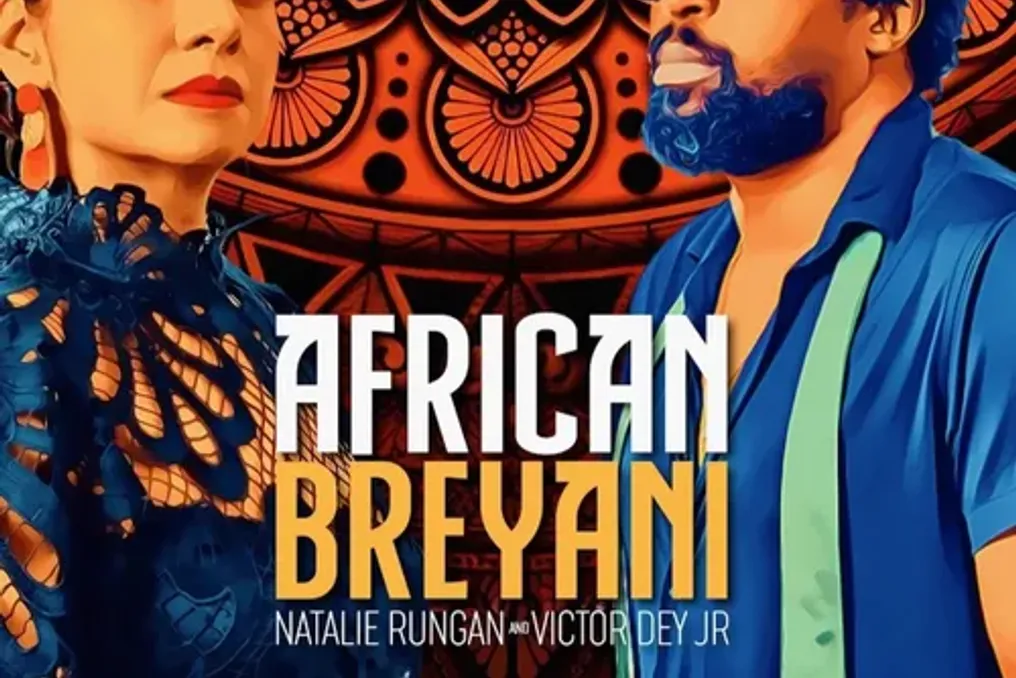
Local jazz master Natalia Rungan collaborated with Ghanaian artist Victor Dei Jr. Their joint album, titled African Breyani, demonstrates the potential of Africans when they unite with full commitment.
Unity
The first meeting with Ghanaian pianist and composer Victor Dei Jr. took place in 2018 at the National Youth Jazz Festival in Makhanda (then Grahamstown). He performed with Marcus Wyatt, and Rungan clearly remembers that concert. Dei Jr.'s music left a deep impression on her, which she described as more than mere admiration.
After this festival, she tried to contact Victor, hoping for collaboration, but the attempts were unsuccessful. Years passed until in 2024, Victor returned to South Africa with the GH Jazz Collective to perform at the same National Youth Jazz Festival. That year, Rungan was leading the National School Jazz Orchestra, and due to scheduling conflicts, they had little time to talk. Nevertheless, during a short break between rehearsals, he mentioned a song he had heard in 2018 and expressed hope for a possible collaboration.
When Victor returned home, Rungan decided to act more purposefully. She also felt more confident as a composer and lyricist, so she contacted him again. This is when the collaboration began, resulting in the album African Breyani.
For Rungan, this album marks several important moments: it is her first experience collaborating with an African artist outside of South Africa, and also the first international album of this scale that she has produced. Although the album was recorded in South Africa and Ghana, its significance extends far beyond these borders, serving as a reminder of the possibilities that open up when African musicians choose each other.
Many asked about the origin of the name. Rungan wrote the song African Breyani in 2023, commissioning her colleague Prince Bolo to produce it. While watching an Indian film, she contemplated the tension between her ethnicity and her homeland. Her heritage defines her as Indian, but Africa is her home. Reflecting on this, she started thinking about breyani.
Breyani is prepared from many spices. Some of these spices can be bitter or unpalatable, especially cardamom. However, together they create something rich, beautiful, and incredibly delicious, a dish known to most South Africans regardless of their background.
The more she reflected on this album, the clearer it became that it was created on the same principle: different musicians, different countries, different musical traditions, different stories, and different personalities. Each is unique in itself, but together they form something none of them could have created alone. That is what African Breyani is.
In childhood, Rungan rarely encountered music from the rest of Africa. She believed, as many were taught, that to become a great musician, one should look to Europe or the United States as a reference. She was never encouraged to seek exceptional musical treasures within her own continent.
The renowned Kenyan author, playwright, and scholar Ngugi wa Thiong'o powerfully writes about the decolonization of the mind, arguing that colonialism shaped not only political and economic realities but also how we see ourselves and value our cultures. Reflecting on the album, Rungan increasingly realized that one of the long-term consequences of colonialism was the formation of our self-perception and understanding of culture. This influenced how many of us value our musical heritage, causing us to look outward in search of perfection and often ignoring the wealth that already exists across Africa.
To be perfectly honest, her collaboration with Victor did not start because he was Ghanaian. It started because she recognized something in his music through the common language of jazz. However, working with Victor, Gaddiel Amoa, Frank Kissi, and Bernard Aiso allowed her to get to know a country that seemed strangely familiar to her. She discovered musical languages that resonated with South African traditions; rhythms and melodies that felt less like foreign influence and more like long-lost relatives.
More importantly, she found friends who have now become her family. Victor and she did not have to force the relationship or artificially create a creative bond; the music seemed to find them. Ideas flowed naturally, conversations were easy, and songwriting never felt forced. They certainly worked hard, but the foundation of the collaboration was already laid.
African Breyani was never just an attempt to merge South Africa and Ghana in music. It grew out of sincere friendship and a deep sense of trust and respect that arose almost effortlessly. Rungan often felt that they were uncovering music rather than trying to create it. For her, this is what makes the collaboration so significant, reminding us that the strongest musical partnerships are built not only on talent or technique but also on connection, openness, and a willingness to listen to something greater than one's own 'self.'
In many ways, this album was a journey home. But not in the narrow sense of nationality or ethnicity, but in the broad sense of discovering that Africa has always contained dialogues that we were never taught. Through this project, she understood that the distance between Durban and Accra is not as vast as she once imagined. The musical threads connecting these places are ancient, enduring, and deeply human.
The timing of the album's creation also prompted her to reflect deeply on the present moment. Recent events in South Africa have exposed painful contradictions. There is a visible threat of suspicion, fear, and division endangering relationships that should never have been broken.
It is easy to speak of unity in abstract terms, but much harder to build it. Collaboration is one way to achieve this goal. When musicians write together, travel, debate arrangements, laugh, eat, and create together, they begin to dismantle the stereotypes that divide them. They stop seeing 'foreigners' and start seeing fellow artists, compatriots, people.
Therefore, Rungan believes such projects are highly significant. They remind us that Africa is not just a collection of countries separated by borders, but a network of stories, rhythms, languages, memories, and people whose histories have always been intertwined. Her hope is that African Breyani becomes not just an album, but an invitation—an invitation for listeners to hear the beauty of their interconnected stories, and also an invitation to restore the pride, curiosity, and creative potential that comes from recognizing oneself in others.