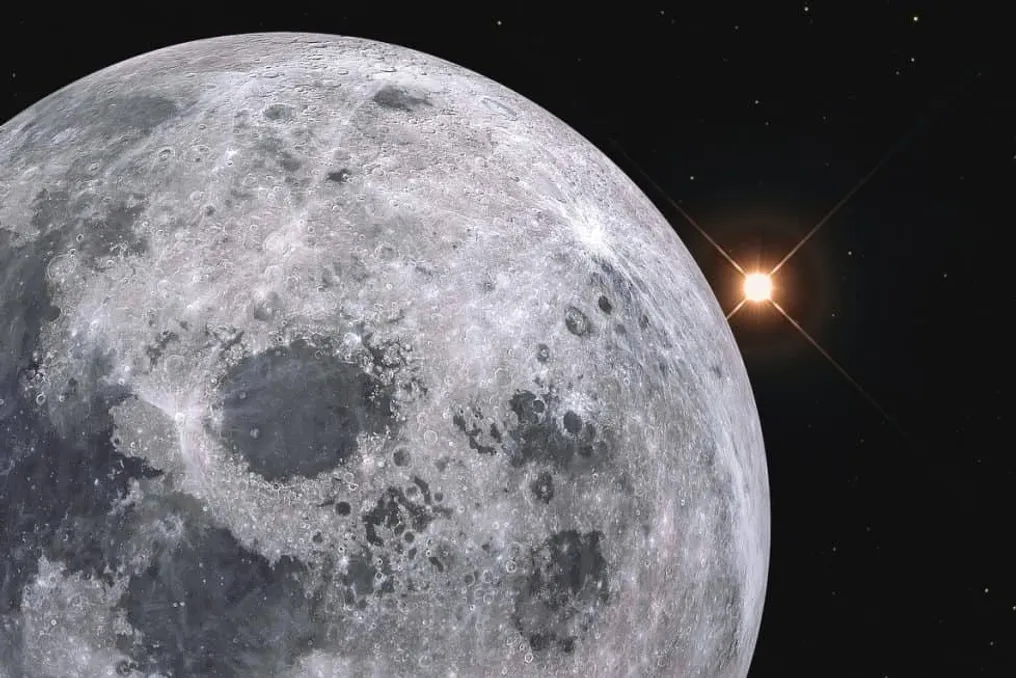
This week, the Moon will pass in front of Antares (Alpha Scorpii), causing a type of eclipse on this M-class supergiant star. Antares has approximately 883 times the radius of the Sun and is located 600 light-years from Earth.
According to information from the astronomical observation guide InTheSky.org, this event will begin on Thursday night, the 20th, at 11:55 PM (Brasília time), and will last until almost 4 AM on Friday, the 21st. Although the phenomenon is not observable from Brazil, both celestial bodies can be seen in proximity.
About the supergiant Antares:
The name Antares means 'the antagonist of Ares,' who is the god of war in Greek mythology, equivalent to Mars for the Romans. Thus, the name alludes to the reddish glow of the star, which contrasts with the brightness of Mars.
Marcelo Zurita, who holds positions such as president of the Paraíba Astronomical Association (APA), member of the Brazilian Astronomical Society (SAB), technical director of the Brazilian Meteor Observation Network (BRAMON), and columnist for Olhar Digital, commented on the subject.
Lunar occultations are only visible in a small portion of the Earth's surface. Because the Moon is much closer to our planet compared to other celestial objects, its position in the sky varies according to the exact location of the observer on Earth, an effect known as large parallax.
The position of the Moon viewed from two opposite points on the globe can vary by up to two degrees, which is equivalent to four times the diameter of the full moon. This implies that if the Moon is aligned to cover a specific object for an observer on one side of the planet, it will appear up to two degrees away from that object on the opposite side.
Based on analyses of visibility zones and geographical projections, the astronomical event can be followed in different phases and under different conditions, depending on the observer's location.
An illustrative map shows distinct areas: the disappearance of Antares can be seen in red, while its reappearance is indicated in blue. Solid lines represent locations where the occultation is likely to be visible with binoculars at a reasonable altitude. Dotted outlines signal where the event occurs above the horizon, but may not be visible due to excessive sky brightness or low Moon elevation.
More details on visibility:
The phase when the star is covered by the Moon, corresponding to its disappearance, will primarily be visible in the southern cone of the American continent. This area covers a large part of Chile, the central and southern region of Argentina, Uruguay, and the Falkland Islands, as well as sectors of Antarctica facing the South Atlantic.
The final stage of the phenomenon, when Antares emerges again behind the lunar disk, can be observed in the southern extreme of Chile and Argentina, the Falkland Islands, the South Georgia and South Sandwich Islands, on the remote Bouvet Island, and in regions of the Antarctic continent.
In other locations, the event will occur with the stars above the horizon, but direct observation may be compromised or impossible due to lighting conditions or the low elevation of the celestial bodies.
In Brazil, the phenomenon will not be visible for two main reasons: in regions such as southwestern South Africa and certain parts of the South Atlantic and Antarctic oceans, the Moon will be very low in the sky, and the atmosphere hinders and distorts the viewing of the star in this position, making observation almost unfeasible.