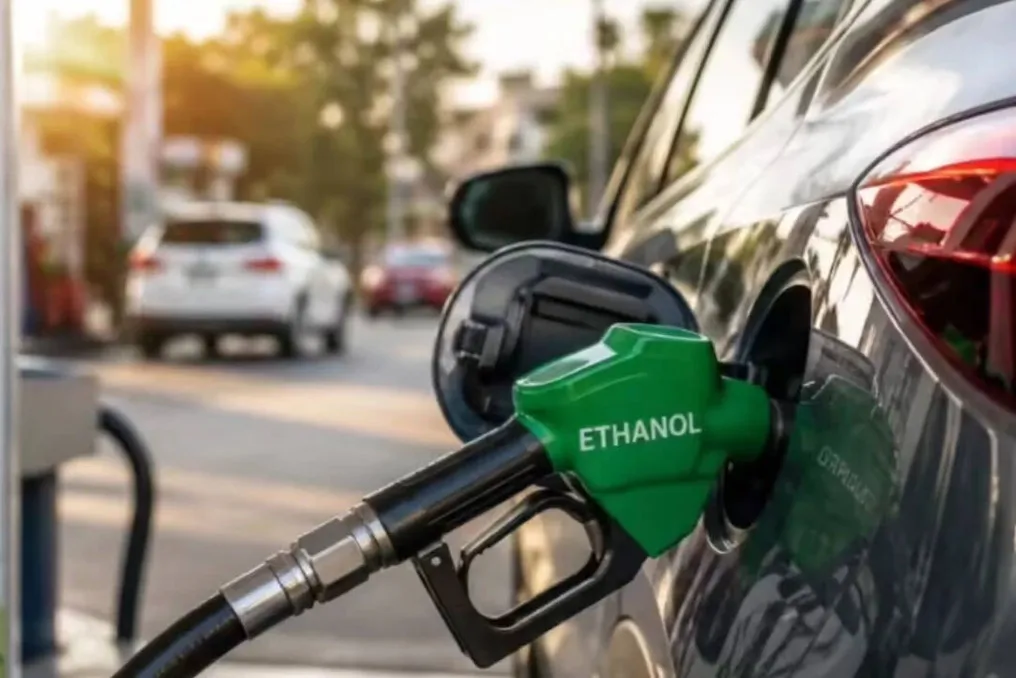
The debate surrounding E20 gasoline has reignited after the Chief Economic Advisor (CEA), Ananata Nageswaran, voiced his opinion on the necessity of providing fuel with a lower ethanol content, such as E10, for older vehicles. Meanwhile, official government representatives insist that there are currently no plans to bring back E10 at gas stations.
Nageswaran's position has strengthened the demands of vehicle owners and political leaders who have been pushing for an alternative with less ethanol since E20 became the sole available gasoline option at petrol pumps in April 2026.
What the CEA Stated
In his article, Nageswaran, along with Akash Pujari, a consultant to the Department of Economic Affairs, argued that older vehicles require protection while the industry works to ensure their compatibility with higher ethanol concentrations. The authors acknowledged the lack of convincing data regarding widespread engine damage from E20 but pointed to a specific issue concerning older cars. It is estimated that India has between 75 and 80 million old two-wheeled vehicles, some of which have rubber seals not designed for increased ethanol content.
The article noted: 'In India, approximately 75-80 million old two-wheeled vehicles... old rubber seals, not certified for ethanol, present a separate problem... modernizing these seals... will take years.' The authors urged the government to 'protect the existing fleet until the modernization program catches up.' Thus, the dispute returned to whether drivers of older cars should have the option to purchase E10, containing 10% ethanol, alongside E20, containing 20% ethanol.
Government Claims No E10 Plan Exists Yet
Despite the CEA's proposal, officials dealing with ethanol policy stated that the government is not currently discussing the reintroduction of E10 at pumps. Officials explained that bringing back a separate, lower-concentration fuel would require additional infrastructural solutions and could create complexities in pricing, storage, and distribution. They also pointed to the extensive ecosystem that has formed around the 20% ethanol blending program.
One official reported that last month the government had already stated there were no plans to bring back lower-ethanol options like E0 or E10. Another official countered that the E10 proposal could be interpreted as an admission that E20 is unsuitable for older cars, which the government does not accept. A third official emphasized: 'Furthermore, allowing the sale of E10 would mean the government agrees that E20 is not suitable for older cars, which is untrue. Studies have shown that E20 causes no mechanical problems.'
Consequently, despite the CEA's call for a lower-concentration option, there is currently no government decision to resume the sale of E10.
Why E20 Became a Subject of Debate
E20 is gasoline containing 20% ethanol and 80% petroleum. The government promotes increasing the ethanol blending level as a way to reduce crude oil imports, save foreign currency, and enhance India's energy security. India also achieved its 20% blending target ahead of schedule in 2030.
Nevertheless, the nationwide transition caused concern among some vehicle owners, especially those with older models. The most frequent complaint was reduced fuel efficiency, and some drivers also expressed concerns about fuel lines, seals, and other components. The issue gained further attention after senior executives from major automotive companies privately expressed concerns about contamination in E20 fuel. These concerns subsequently led to a broader public discussion about the compatibility of older cars with this fuel.
At the same time, the government and the automotive industry maintain that existing tests do not demonstrate widespread mechanical damage from E20. Auto manufacturers have also stated that older cars can run on E20, although fuel efficiency may suffer.
Political Tension Intensifies
The latest discussion provided the opposition with a new argument: Akhilesh Yadav, head of the Samajwadi Party, questioned the government's stance on E20 on Wednesday following reports of Nageswaran's recommendation. In a post on X, Yadav published a photograph referencing the CEA's stated remarks and asked: 'Who is right: the government or the advisor?' The photo published by Yadav read: 'E20 gasoline damages vehicles. E10 gasoline sales should be resumed for older two-wheeled vehicles.'
Yadav noted that drivers who believe their vehicles have experienced problems after using E20 remain without help, while the government continues to assert that there are no issues with the fuel. He also questioned why the government does not directly solicit feedback from vehicle owners who have reported problems. Characterizing E20 as a 'double-edged sword,' Yadav stated that it creates a 'double burden' for consumers through fuel costs and higher vehicle maintenance expenses.
Earlier, opposition leader Rahul Gandhi of Lok Sabha stated that the Congress will soon raise the issue of the central government's E20 ethanol blending program. In a social media post on X, Rahul accused the government of 'direct theft from people's pockets.' The Congressman said: 'This E20 issue is very serious. Usually, we say: 'There is something black in the dal.' But here the whole dal is black.' He added: 'Brothers and sisters, this is a matter of priorities. In any campaign, we must decide the order of issues to be addressed. The problem now is that there is so much corruption that we have a long list of issues to prioritize. But don't worry. We will raise the E20 issue on a large scale because it damages people's cars and scooters and their lives, and it is literally stealing money right out of their pockets.'
A Broader Political Question
The immediate question is not whether the government has decided to bring back E10; it has not. The question is whether it will ultimately consider providing older vehicle owners with a choice between different ethanol concentrations. The CEA's intervention has once again brought this issue to the forefront while E20 is already the standard fuel across the country. However, the government continues to advocate for the broader ethanol program based on reducing dependence on crude oil, decreasing emissions, and enhancing energy security.
For now, positions remain divided: Nageswaran's opinion calls for protecting the existing fleet of older cars, while officials state that reintroducing E10 would be difficult and is not currently under consideration.
[ ]