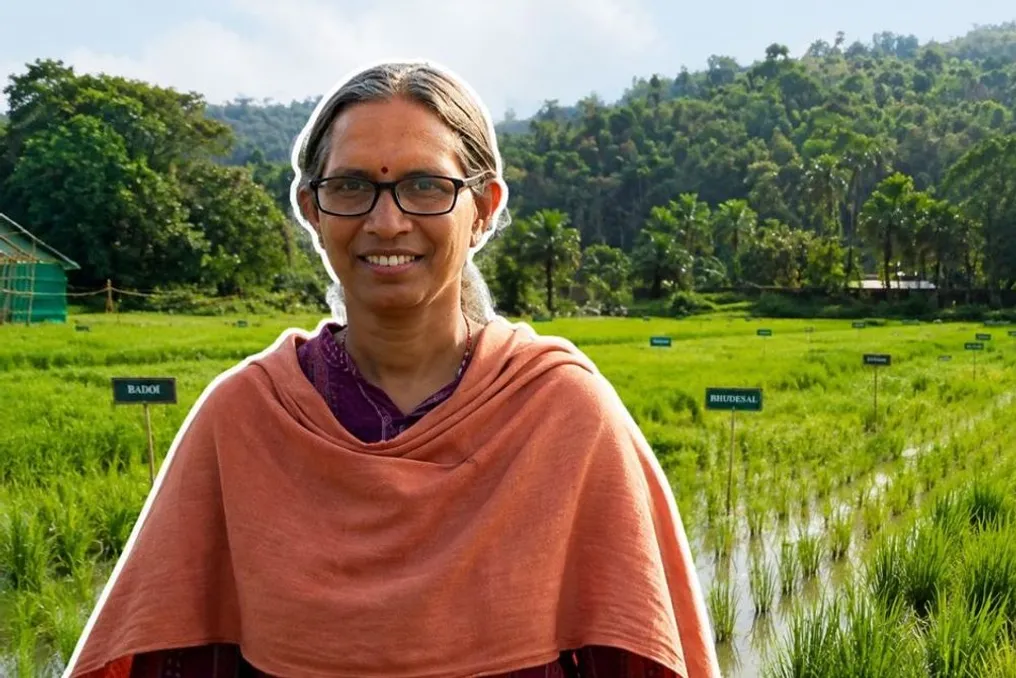
In the early 1980s, while India was still recovering from the Bhopal gas disaster, a young agricultural worker in Palakkad, Kerala, found inspiration in a thin book from Japan. Masanobu Fukuoka's manifesto 'The One-Straw Revolution,' which opposed chemical farming, became a turning point for Usha Soolapani.
She recalls that this book was a 'guiding light' for her, prompting her to engage in chemical-free agriculture and base her agrarian work on philosophy rather than just production. This philosophy defined her entire life's work: preserving India's indigenous rice varieties and creating a movement that helped revive rice cultivation traditions in six states.
Today in Thiruvananthapuram, Usha and her friend and partner Jayakumar are closely associated with the Tanal organization, which resembles an extensive family more than a formal structure. A shared commitment to ecological health and justice prevails among their friends and supporters.
From Palakkad Wetlands to India's Rice Hubs
For nearly two decades, Usha quietly observed the slow destruction of the rice cultivation ecosystem in Kerala. Farmers, who once earned more than government officials, now faced rising cultivation costs and stagnant grain prices. Wetlands were disappearing due to urbanization, and rice fields were changing hands, leading to the loss of centuries-old ecological balance. Her campaign against chemical pesticides, particularly Endosulfan, became a decisive moment in her life.
What is Endosulfan?
Endosulfan was used for aerosol spraying on cedar plantations in the Kasaragod region of Kerala between 1978 and 2000. Residents living near the plantations reported birth defects, disabilities, and various health problems, making Kasaragod one of the most notorious cases of pesticide contamination in India. The campaign against Endosulfan turned into a protracted fight for recognition and compensation. Eventually, the pesticide was banned in Kerala, and the Supreme Court later intervened to protect the well-being of the affected individuals. In January 2017, the court ordered the Kerala government to pay over 500 crore rupees in compensation to more than 5000 victims. This issue gained international significance: in 2011, the Stockholm Convention listed technical Endosulfan and its related isomers in Annex A as a persistent organic pollutant, with specific provisions for phasing out production and use.
For Usha, observing the consequences of intensive chemical agriculture revealed a link between farming, public health, and the environment. Usha, having become a leading voice in movements for food sovereignty and agroecology in India, notes: 'What I saw in Palakkad was not an isolated incident. The same story echoed across the rice centers of all of India.'
This realization prompted Usha and her colleagues from Tanal, one of Kerala's oldest environmental NGOs, to travel across the country between 2005 and 2018. They visited the lush deltas of Tamil Nadu, the reddish interior regions of Karnataka, the floodplains of West Bengal, and the tribal highlands of Chhattisgarh. In each location, they sought out farmers who were still carefully preserving ancestral seeds, often keeping them in clay pots or hiding them in the attics of their homes. What they found was more than just grain; it was memory.
At seed festivals, the air filled with the aroma of freshly cooked rice, while elders shared stories of almost lost varieties. Each gathering became an opportunity to revive this heritage—one seed and one story at a time.
From Campaign to Regional Movement
This work was part of much larger efforts. In 2003, the Save Our Rice Campaign (SOR) was launched at the regional level by the Pesticide Action Network Asia Pacific (PANAP) to counter threats to Asian rice heritage, food sovereignty, and traditional agricultural knowledge. In India, Tanal became one of the key organizations associated with this campaign, helping to shape a grassroots movement around local rice varieties and ecological farming.
Over the years, the campaign expanded beyond seed preservation. It united farmers, conservation groups, and civil society organizations around issues of food security, seed control, and the future of agriculture. More than two decades later, the broader Save Our Rice network continues to operate across Asia, running campaigns with partners in countries such as India, Sri Lanka, the Philippines, Bangladesh, China, Indonesia, Korea, Laos, Malaysia, Pakistan, Thailand, and Vietnam.
In India, one of the most notable contributions has been the creation of Rice Diversity Blocks (RDBs) and community seed banks, where traditional varieties can be grown, propagated, and passed down, rather than just stored. For Usha and her colleagues, the idea was never to preserve rice as a museum exhibit; the goal was to keep it alive in farmers' fields.
Rice is Not Just a Crop
Usha asserts: 'Rice is not just a crop. It is an ecosystem that supports people, communities, and biodiversity. When such ecosystems are transformed for infrastructure, the balance is disrupted, and lives and livelihoods are threatened.'
This conviction formed the basis of the Save Our Rice campaign in India, which brought together farmers, seed keepers, researchers, and communities to revive traditional rice varieties. Farmers, who were previously reluctant to attend seed fairs, now participate as experts, sharing their knowledge with others. Seed keepers have become specialists; some have established community seed banks and farmer-producer companies. In WhatsApp groups, farmers exchange notes on pest resistance and cooking qualities. At annual fairs, women share recipes showcasing forgotten grains. In panchayat-level seed banks, rows are decorated with bags of red, golden, and black rice.
Varieties Once Belonging to a Single Farmer
Some of the campaign's most significant discoveries were made thanks to varieties that were on the brink of extinction. In some cases, a variety was known to only one or two farmers and was grown in a small corner of a field. The campaign helped locate, document, and share these seeds. Today, farmers in different regions grow varieties that were once nearly lost. Among them are Mappilai Samba from Tamil Nadu, Mullaan Kazma, Rakta Sali from Kerala, and Rajamudi from Karnataka.
The scale of the problem becomes clearer when looking at the rice fields of Kerala. The area of rice cultivation in the state has sharply decreased compared to historical highs. Data from the Kerala government shows that rice cultivation in wetlands was about 1.8 lakh hectares in 2023–24, a sharp decline from approximately 7.6–8 lakh hectares recorded in the decades after independence. Several factors contribute to this decline, including rising cultivation costs relative to income, labor shortages, and pressure from urbanization.
In 2008, Kerala adopted the Kerala Paddy Land and Wetland Conservation Act to restrict the conversion and drainage of rice fields and wetlands and protect their agricultural and ecological value. Usha notes: 'This restored the value of the rice ecosystems in the state.'
However, pressure to weaken the law and create exceptions for infrastructure projects continues. Climate change has added another layer of uncertainty for farmers. Cyclones can arrive without warning, followed by droughts. Pest and disease models are also becoming less predictable. Meanwhile, systems designed to support farmers—from local weather monitoring and advisory services to reliable seed systems—remain fragile. Usha emphasizes: 'There are no real efforts to build resilience by involving farmers in the process.'
Her professional work reflects this belief. In Kerala, she works with agroecology-based organizations and consults on strategies for building climate-resilient agriculture. She also contributes to national advocacy as a member of the ASHA Steering Committee—Alliance for Sustainable and Integral Agriculture, Kisan Swaraj.
For Usha, sustainability cannot simply be a policy imposed on farmers; the farmers themselves must participate in building it.
Six States, One Common Approach
The campaign now spans six states, each with its own rice traditions, climate, and agricultural history. Instead of imposing a single model, SOR collaborates with local partner organizations, allowing each to develop strategies suitable for its region. They are united by a common approach to climate resilience, seed sovereignty, and food security. Usha says that this was not the initial focus of the campaign. 'Climate resilience was not the guiding principle initially. The focus was on seed sovereignty, reviving rice culture, and honoring farmers' wisdom. However, over time, the movement began to transform into a paradigm of climate resilience.'
Allauddin Ahmed, state coordinator for the campaign in West Bengal, recalls meeting Usha in 2004. 'Tanal invited me to Kumbhalangi during the International Year of Rice, where I first met Usha while discussing the alarming decline in local rice varieties and traditional agricultural heritage,' he recalls. Years later, farmers in the Sundarbans preserved and promoted about 192 indigenous rice varieties.
Women, Seeds, and Sovereignty
Gender equality is another crucial part of Usha's work. She believes that modern agriculture often reduced women to laborers instead of recognizing them as decision-makers. Women rarely own land or seeds, and market prices are often set without their participation. 'It is interesting that women play an important role in the transition to organic and natural farming, which can lead to food sovereignty,' she notes. Annual events, such as the Nel Thiruvizha rice festival in Tamil Nadu, reflect this approach. These gatherings are not just about agriculture; they are spaces where farmers exchange seeds, share experiences, and celebrate the food heritage that industrial agriculture often marginalized.
Engaging Youth in the Movement
To interest the younger generation in restoring the rice ecosystem, new ideas were needed. Seed festivals and food fairs, scholarships, introductory trips, cultural programs, and social media helped spread this message beyond traditional activist circles. In South India, the campaign also reached out to food vloggers, organic retail entrepreneurs, film stars, nutritionists, and doctors to raise awareness about traditional rice varieties. 'That was also a campaign strategy,' Usha says with a quiet smile. The idea was simple: if young people could discover these forgotten varieties through food, culture, and popular media, they might also take an interest in the farmers and ecosystems that preserve them.
When the Farmer's Home Becomes a Rice Museum
The revival has also created unusual places for preserving this diversity. In the Mandya district of Karnataka, farmer and seed keeper Syed Ghani Khan converted part of his home into Kirigavalu Rice Diversity Center. It now houses over 1300 traditional rice varieties, making it one of the largest private rice collections in India. His work is also closely linked to the broader farmer-led rice revival movement. The idea of taking rice preservation beyond the fields has appeared elsewhere. In West Bengal, a proposed rice museum was designed at the Agrarian Training Centre in Phulia, which is intended to showcase hundreds of varieties, including traditional and regionally specific ones. In Kerala, the Aluva State Seed Farm positions itself as a museum of traditional rice varieties while simultaneously conserving and propagating rare strains displaced by high-yielding hybrids. The Kaziranga Orchid and Biodiversity Park in Assam has also presented a heritage rice collection. Together, these spaces reflect a broader shift: traditional rice is becoming...
3.