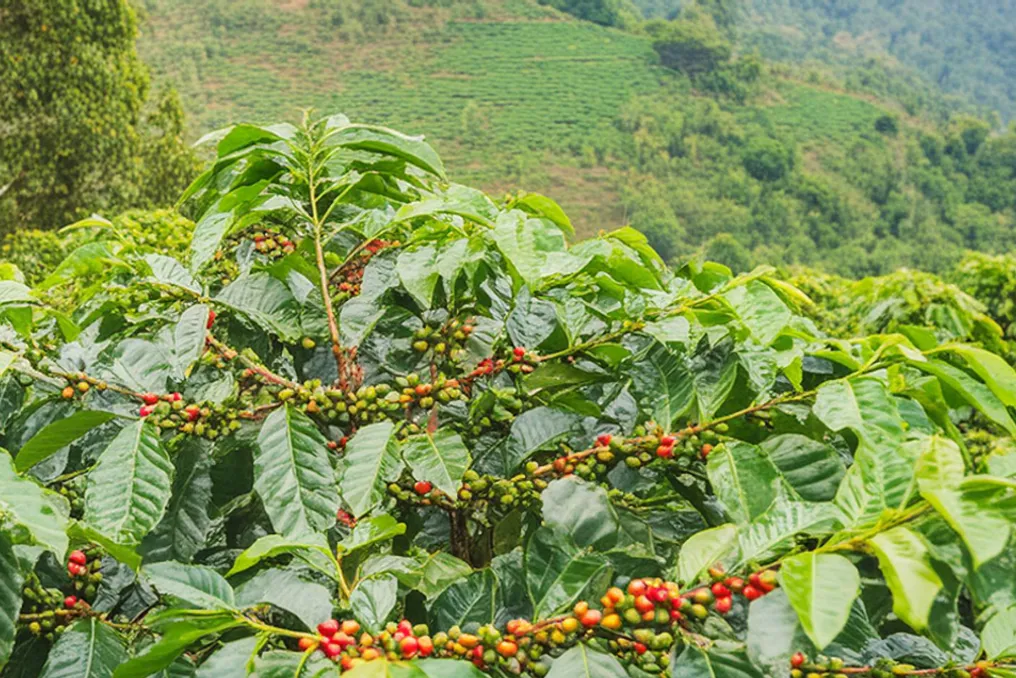
Despite the rush to start the workday and enjoy the first cup of coffee, a special silence reigns within the coffee plantation in the Western Ghats. The call of the Malabar parakeet can be heard from above, the drongo moves through the branches, and sunbirds flit between flowers while insects hide in the undergrowth. A giant squirrel may cross the canopy above the rows of coffee trees.
It is important to note that coffee is not originally suited for cultivation in open fields; it is an understory plant naturally adapted to growing beneath taller trees. For many generations, coffee has been cultivated in shaded landscapes where the harvest coexisted with fruit trees, native species, and other vegetation.
However, as coffee production intensifies in many parts of the world, some farms have switched to more open, sun-grown systems. Shade trees were removed to increase the amount of sunlight reaching the crop. This decision can have a much greater impact than just changing the light level on the coffee bush.
Farm above the coffee
For scientists studying coffee landscapes, the tree canopy is not just a layer of vegetation. It has the potential to transform a plantation into a functioning agroforest. Research conducted by the Smithsonian Institution's Migratory Bird Center (SMBC), which has studied shade-grown coffee for decades, demonstrates that such farms can serve as habitats for birds, mammals, insects, and other wildlife. Furthermore, trees help protect the soil, support pollination and natural pest control, sequester carbon, and regulate local microclimates.
The Smithsonian Institution notes that coffee was traditionally grown in the shade. Nevertheless, the widespread shift to sun-grown plantations has led to the loss of tropical forest habitats used by migratory birds and other wildlife. Therefore, researchers posed a central question: is it possible for a coffee farm to remain productive while also serving as a habitat?
This work led to the development of Bird Friendly standards, which set requirements for shading, tree height, and species diversity. This certification, developed by the Smithsonian Institution, is the only coffee certification that requires coffee to be both organic and shade-grown. The core principle is based on canopy structure: what volume of foliage is present, how tall are the trees, are there different levels of vegetation, and is the farm shaded by diverse species or predominantly one?
These details determine whether a coffee plantation will be merely a crop with trees on top, or if it will be a landscape capable of supporting life at multiple levels.
When coffee meets a biodiversity hotspot
Nowhere is this relationship illustrated as clearly as in the Western Ghats of India. Here, coffee plantations are located within and around one of the country's most vital biodiversity landscapes. In areas like Kodagu, plantations are often situated between forest fragments, protected areas, villages, and other agricultural lands, making them more than just isolated farms.
Their canopies can support birds such as Malabar parakeets, hornbills, drongos, and sunbirds. These tree-covered landscapes can also be used by forest and endangered species, including the Nilgiri wood pigeon and the Alexandrine parrot. Civets, giant squirrels, hedgehogs, and wild cats may also move through plantations located near forests.
This does not mean that a coffee plantation can replace a natural forest, but in a landscape where forests are separated by farms, roads, and settlements, the difference between bare agricultural land and land with a continuous canopy can matter. Coffee plantations can become part of the landscape through which wildlife moves.
What happens when diversity is removed?
A 2017 study by scientists from Zurich and India examined 25 agroforestry plots of *Coffea canephora*, or Robusta, in Kodagu. The farms ranged from diverse multi-species systems to plantations dominated by *Grevillea robusta*, widely known as the silver oak. The results refuted the assumption that simplifying the canopy automatically leads to better farm outcomes.
As plantations became increasingly monocultural regarding a single shade tree species, species diversity dropped sharply. However, the consequences extended beyond biodiversity: reduced species diversity was linked to poorer coffee quality and smaller bean size, as well as increased attacks by coffee berry borers.
These findings were consistent across a wide gradient of rainfall and when using traditional, organic, and irrigated management systems. The study pointed to an important possibility: a diverse canopy is not necessarily a trade-off against farm productivity; in some cases, it can support it. Trees and other vegetation can provide habitat for pollinators, support organisms involved in natural pest control, cycle nutrients, and protect farms from climatic extremes. Researchers acknowledged the economic reality, however, that drives farmers toward intensification.
Not all coffee is the same
A 2018 study published in the journal Nature examined another significant shift occurring in tropical Asia: the growing dominance of Robusta coffee. Scientists compared the value of preserving Arabica versus Robusta in the Western Ghats. They found that Arabica farms had higher diversity of habitat-specialized species and functional groups and were more profitable within the study. Nevertheless, Robusta farms could support similar, and in some cases even higher, populations of habitat-specialized species. One reason was the presence of a dense canopy and forest at the landscape level.
The broader conclusion was not that one coffee species is always better than another, but that the surrounding landscape and farming methods can be as important as the crop itself.
The question of native trees
Here, the discussion about shading becomes more complex. A coffee plantation covered by a single fast-growing commercial tree is not ecologically identical to an agroforest containing a diverse mix of native species. A diverse canopy creates more types of food, nesting sites, and shelter. It can support various levels of life—from insects in fallen leaves to birds moving through upper branches.
Removing this complexity may allow a farm to continue producing coffee, but it may cease to support the same ecological connections.
But there are limits
There are limitations to what coffee landscapes can do. Human-wildlife interaction can lead to closer contact between elephants, wild boars, and other animals with people, causing friction and sometimes conflict. Plantations cannot replace protected forests or pristine natural habitats, but they can influence what happens between these forests.
The next cup
The future of coffee is often discussed in terms of yield, price, and climate change. However, there is another part of the story visible from inside a plantation in Kodagu. Above every coffee bush lies a decision about the landscape. Are trees viewed as competitors to the crop, or are they seen as part of a system that helps maintain the farm's function? Decades of Smithsonian Institution research, alongside studies in the Western Ghats of India, suggest that the answer to this question may affect the lives of birds, insects, and mammals—and potentially the health and productivity of the coffee farm itself. Thus, the next time you take a sip of coffee, there may be more than just beans in your cup. There may be a forest above them.