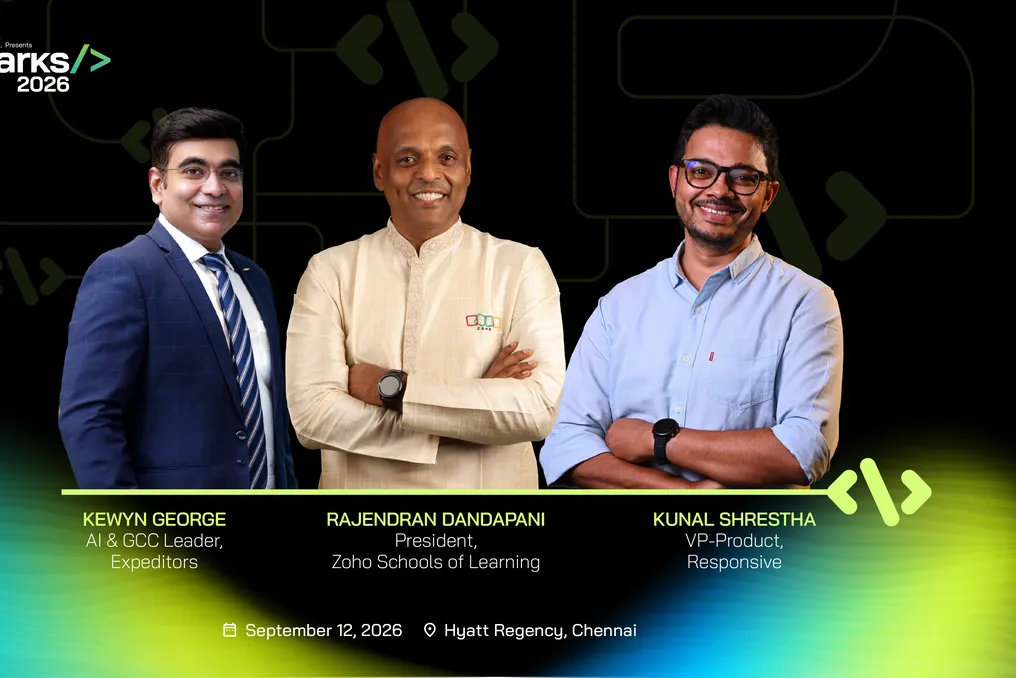
Following its successful execution in Hyderabad in August, the DevSparks 2026 event will take place in Chennai on September 12th. The second summit in this city will gather developers, technology leaders, startups, and enterprises to exchange knowledge and discuss technologies shaping the next stage of development.
The event will be held at the Hyatt Regency Hotel in Chennai, with an expected attendance of over 500 developers. The Chennai exhibition will focus on how specialists trained in artificial intelligence can apply their knowledge within the city's evolving deep technology ecosystem.
More than 20 speakers will conduct technical seminars and workshops covering topics such as AI for the physical world, creating AI for manufacturing, Edge AI, AI in automation, semiconductors, robotics, and building India's own AI stack.
Among the speakers at the event are Rajendran Dandapani, President of Zoho Schools of Learning; Kunal Shrestha, Vice President of Product at Responsive; and Kevin George, Head of AI-GCC at Expeditors. Dandapani will share ideas on software scaling and rethinking talent development, while Shrestha will review a practical guide to developing products based on enterprise AI, which is crucial for an audience predominantly composed of developers.
Kevin George will leverage his experience leading corporate AI and GCC initiatives to teach future creators how to transform and implement innovations in large technology organizations. The broader DevSparks Chennai program will also explore the integration of AI into industry use cases, including manufacturing, as well as Edge AI and the Internet of Things (IoT), where intelligence moves closer to devices and networks.
Chennai has established itself as a key hub for transitioning deep technology startups from concepts to tangible infrastructure. This ecosystem is not limited to one industry, encompassing sectors such as aerospace, electric vehicles, and quantum cybersecurity.
A vital supporting factor is the IIT Madras Incubation Cell. As of April 2026, this cell has crossed a significant milestone, boasting over 500 deep technology startups. Among the most prominent companies are Agnikul Cosmos, The ePlane Company, Ather Energy, and QNu Labs.
Support does not come only from IIT Madras. The Tamil Nadu government is also actively promoting the scaling of deep technologies. Former Chief Minister M.K. Stalin introduced the state's first Policy for Supporting Indian Deep Tech Startups (2025–26). This five-year initiative aims to attract ₹100 billion to support 100 science and intellectually intensive startups, thereby bridging the gap between the laboratory and the market in areas like AI, semiconductors, and aerospace.
The city has a long history of technological innovation and was once a center for major corporate software and SaaS companies, including Zoho, Freshworks, Chargebee, and Kissflow. The city's technological base developed in parallel with a robust industrial economy.
Known as the 'Detroit of India,' Chennai boasts a high concentration of automotive, electronics, and engineering enterprises. Major global manufacturers such as Hyundai, Daimler, and Foxconn have established significant manufacturing capacities in the Chennai region, forming a vast talent pool in embedded systems, industrial automation, electronics, and advanced manufacturing.
Furthermore, the city is developing a substantial presence in corporate technology and Global Capability Centers (GCCs), bringing together engineers working on global products and platforms across the automotive, financial, medical, and corporate sectors. The growing GCC ecosystem is attracting global AI teams to the region, strengthening Chennai's role in India's AI/ML ecosystem.
This has resulted in a unique technological identity: an engineering-oriented ecosystem where software interacts with the physical economy. Strengths in SaaS and corporate technology are now complemented by advancements in AI, hardware, mobility, manufacturing, and deep technologies. As AI moves from the cloud to factories, vehicles, devices, and daily business, Chennai's combination of software and industrial competencies is becoming increasingly relevant. DevSparks Chennai will unite these areas, providing developers with an in-depth look at the technologies defining how India creates, implements, and scales the next generation of software.