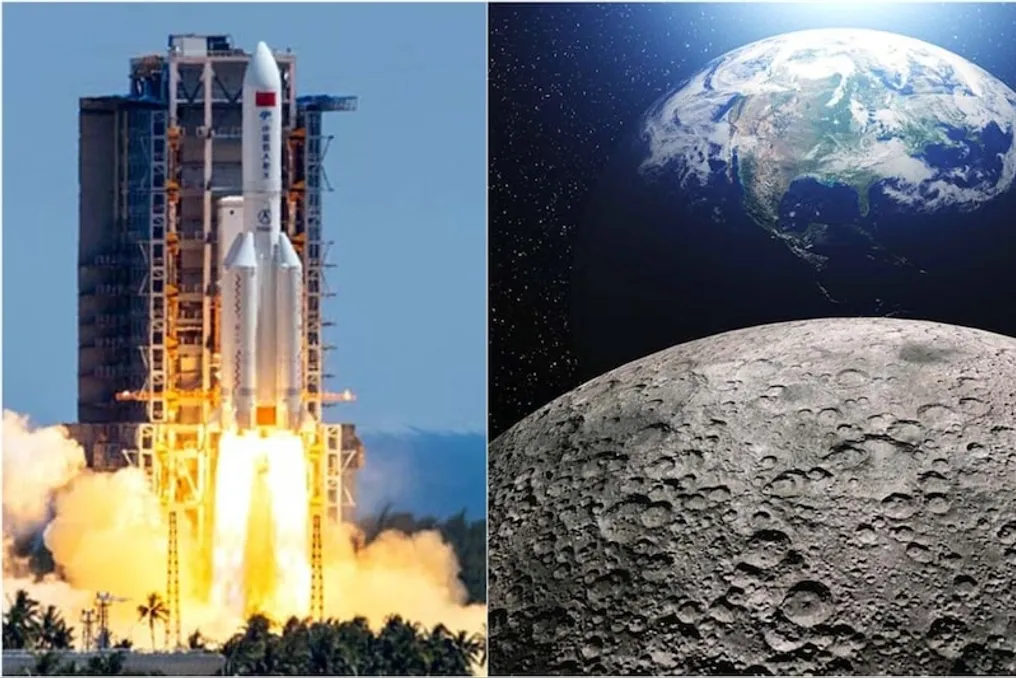
China is preparing to launch its new lunar mission, Chang'e-7, on August 24, 2026. This mission will be directed towards the Moon's South Pole, where scientists will search for water ice and other substances.
The mission is planned to be sent using the Long March-5 rocket from the Wenchang Spaceport in Henan Province. Chang'e-7 is the fourth stage of China's lunar program.
The mission includes several spacecraft: an orbiter, a lander, a rover, and a small hopper probe. All these components will explore different areas of the Moon's South Pole. Special attention is paid to the hopper probe, which will attempt to penetrate craters where sunlight does not reach. Scientists hope to discover water ice there.
There are many deep craters located at the Moon's South Pole, in some of which sunlight almost never reaches. In such cold places, water can remain in the form of ice for a long time. This is why China is interested in searching for water in this region. The mission will also collect data on the lunar soil, surface, and atmosphere to understand where and in what quantity water and other compounds are located.
The hopper probe is a key part of Chang'e-7. Unlike a wheeled rover, it can move by small jumps rather than just across the ground. This will allow it to explore places that are difficult for a conventional rover to reach.
The rover will move across the lunar surface, studying the soil and regolith. The lander will land on the surface to conduct research using scientific instruments. The orbiter will orbit the Moon, collecting images and other necessary information from above.
The discovery of water on the Moon could have enormous significance for future missions. Water can be used for drinking, and there is potential for producing oxygen and rocket fuel. Therefore, the search for water ice at the Moon's South Pole is important for many countries.
Thanks to Chang'e-7, China will gain more detailed information about this part of the Moon, which will serve as a basis for its further lunar projects. Furthermore, China is working on plans to create an International Research Station near the Moon's South Pole in the future.
Chang'e-7 will be launched using the heavy Chinese Long March-5 rocket, designed for large space missions. The spacecraft related to the rocket and the mission have already arrived at the Wenchang Spaceport and are undergoing pre-launch preparations. All attention is focused on the planned launch on August 24, after which scientists will receive new information about the soil and water ice at the Moon's South Pole, if the mission is successful.