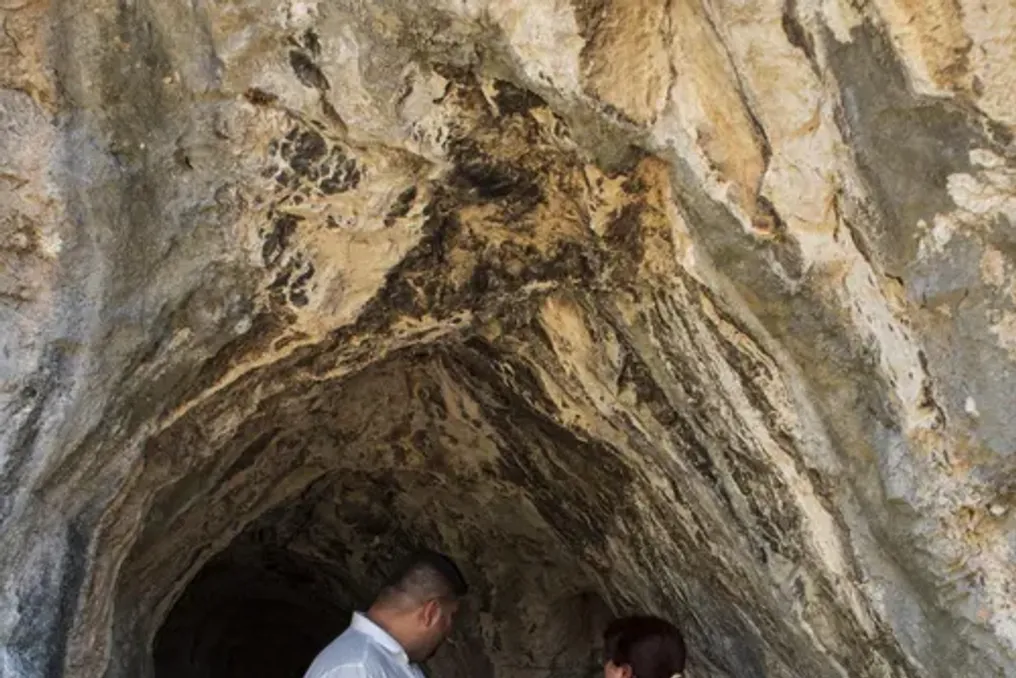
In Turkey, on a hill overlooking olive slopes outside Izmir, there is a cave that local residents have called for generations the place where Homer composed the 'Odyssey'. This cave is located in the Homer Valley in Bornova.
Turkish researcher Altan Altın, who wrote a book on the subject, explains that locals have always referred to this place as the 'Homer Valley', and travelers from all over the world come to see the cave where Homer is believed to have created his poems.
In reality, no one knows exactly where Homer wrote his epic works, and many myths surround the idea of his cave. Today, the discussion has become more active thanks to Christopher Nolan's blockbuster 'The Odyssey'.
The poet was long associated with the Izmir region on the Aegean coast of Turkey, which throughout most of its history was known as ancient Smyrna. In the second century BC, the Greek chronicler and geographer Pausanias wrote: 'The Smyrnians have the Meander River, with its beautiful water, and at its sources there is a grotto where, it is said, Homer composed his poems.'
These words fueled a centuries-old debate that continues to this day regarding Homer's life and the place where he is thought to have been born in 8 BC. The city historian and author Altan Altın presents the caves of Homer in Bornova, Izmir, after a thorough study of Homer's connection to Izmir.
Visiting the cave, filled with stones, is not easy. Visitors have left Greek inscriptions on the walls inside, although it is unclear how old these writings are. Although other places, particularly the Greek island of Chios, have also claimed Homer's origin, ancient Smyrna and its surroundings—where Bornova is located—are closely linked to the poet.
Altın asserts: 'For me, there is no doubt that Homer is from Bornova. In any case, he is from Ionia, which includes Smyrna and Chios. He is from these lands.' Ionia is the name of an ancient Greek region on the Aegean coast of Turkey.
To support his theory, Altın pointed to a 3rd-century BC frieze depicting the deification of Homer, which, according to him, reproduces the Bornova cave with striking accuracy. He noted: 'This bas-relief was already known, but no one ever noticed the identical details to those found in Homer's cave. This is the first time such a detailed geographical description has appeared.'
Archaeological findings in the area also point to a connection with Homer. Archaeologist Mehmet Akif Erdem stated: 'Excavation discoveries, especially coins depicting Homer, show us that the inhabitants of ancient Smyrna considered the poet one of their own.'
He added that since the 'Iliad' and the 'Odyssey' were written in Ionic and Aeolic (ancient Greek) dialects, it suggests that ancient Smyrna and Bornova could have been among Homer's native lands.
Beyond academic debates about his origins, Homer is present everywhere in Bornova. At the Yesilova Höyük complex, a Neolithic site considered the oldest known prehistoric settlement in Izmir, there is a bust of Homer inscribed with: 'I composed the epics 'Iliad' and 'Odyssey' on this land. I lived in Bornova.'
The city, which already hosts a book fair dedicated to Homer and has a statue of the Trojan War hero Hector in its local park, plans to restore the cave and open it to visitors to capitalize on the growing interest in the ancient poet. Bornova Mayor Ömer Eski stated: 'Preserving Homer's heritage is a duty we owe to humanity. He is one of the founding fathers of literature.' He emphasized: 'The stories he tells are about this land. The question is not whether we should claim Homer or not. His story is ours too.'
However, not everyone shares his view. In 2024, municipal officials of Recep Tayyip Erdoğan's ruling party, AKP, proposed renaming the Homer Valley in honor of a Turkish wrestler, stating that the place should not have a Greek name. The mayor objected: 'Erasing Homer's name would be one of the worst things we could do to Bornova,' noting that his goal is to 'introduce the whole world to Homer as a man from Bornova' and make the city a tourist attraction.
Mustafa Köjigit, owner of the Gargantua bookstore in Izmir, reported that the success of Nolan's film revived interest in Homer and increased sales of the 'Odyssey'. Teacher Safak Tosun, near one of the city's cinemas showing the film, said: 'I knew Homer was from these lands, but I didn't know he was specifically from Izmir. We are incredibly happy.' He added: 'I feel proud, honored, and deeply privileged to be his compatriot.'
For researcher Altın, there are clues in Homer's work that, in his opinion, indicate the poet originated from this region. He observed: 'When you immerse yourself in the 'Iliad', you truly understand that Homer was an Anatolian. You find anecdotes and cultural references completely unknown elsewhere.'
He believes that Homer's origin should not cause rivalry between Turkey and Greece. Altın jokes: 'Homer is 2800 years old, and the Turkish-Greek border is only a hundred years old. Homer is Greek. Homer is Anatolian. None of us is older than him, not even our countries.'