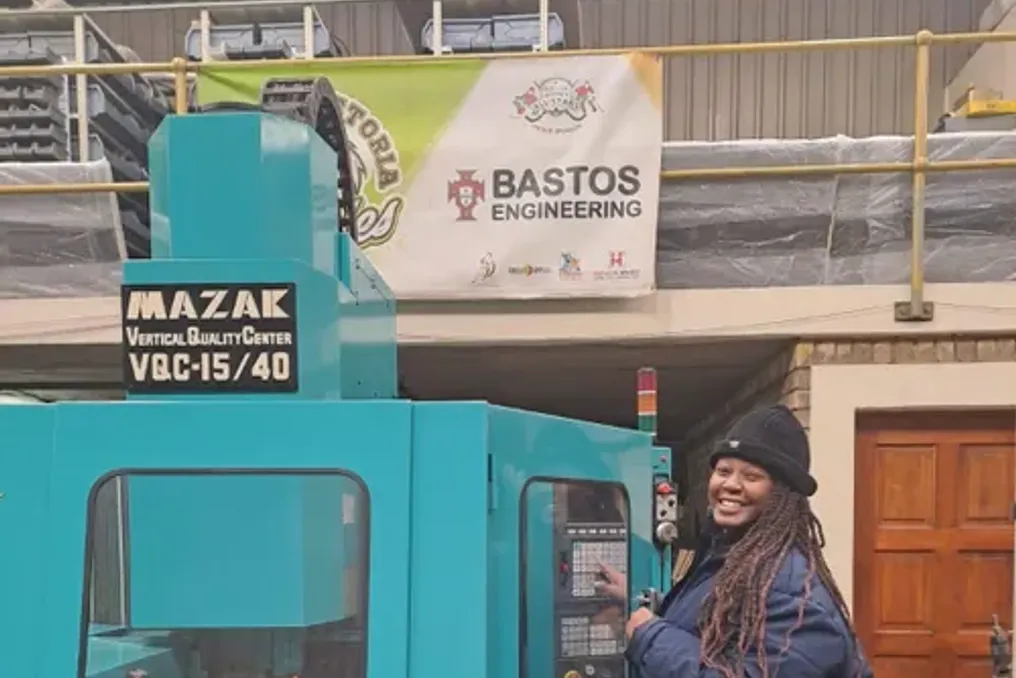
Seventy years ago, on August 9, 1956, over 20,000 women marched to the Union buildings in Pretoria to protest the expansion of pass laws for women under apartheid. This event gave rise to the phrase: 'If you beat a woman, you beat a rock.' Seven decades later, South Africa is observing Women's Month 2026 under the slogan 'Building sustainable economies for all.' The author argues that this phrase is today not just a tribute, but a call to action: it is impossible to build a sustainable economy using only half of the workforce. This situation persists in the toolmaking industry.
Toolmaking, which many perceive as unglamorous, is fundamental. Any metal panel cast by injection molding, or a high-precision part in South African manufacturing—whether for cars, airplanes, or supermarket goods—first passes through the hands of a toolmaker. The Chinese side has termed this sector the 'Mother Industry' because everything else depends on it. However, like much of South Africa's technical economy, it faces a demographic problem that cannot be postponed.
The situation is made more acute by current economic indicators. According to the Labour Force Survey from Stats SA, published this week, the unemployment rate in South Africa reached 33.6% in the second quarter of 2026, higher than the 32.7% figure and signifying job losses for 345,000 people. Women are in a more difficult position: their unemployment rate stands at 37.5%, significantly exceeding the national average, with 4.4 million women out of work. Furthermore, during the same quarter, the manufacturing industry shed 15,000 jobs, yet industry members still report a shortage of skilled toolmakers. This is not a contradiction, but a mismatch: the problem is not a lack of jobs, but an insufficient number of trained specialists, the vast majority of whom are men.
Another alarming fact is that women constitute only 16% of registered engineering professionals in South Africa. The reason lies not in a lack of necessary qualifications, but in what happens after graduation: who receives mentorship, who is nominated for leadership positions, and who is never invited into a work culture created without considering their needs. As one industry leader noted, the problem has never been a shortage of talented women in engineering, but rather the unwillingness of people to support them after they enter the workplace.
Examples of successful development confirm that support works. Charmaine Lebogan Mtimunye completed the Toolmaking Apprenticeship program, continued her internship at Ford Motor Company, worked as a CNC machine programmer at Silverton Components, and three weeks ago polished plastic injection moulds for cars at Lanulfi Moulds and People in Vicenza, Italy. In 2024, she was recognized as the best graduate of PtSA TDM Powered National Overall Top Achiever and the best graduate of Gauteng.
She shares her experience: 'My technical foundation was laid through the PtSA Toolmaking Apprenticeship and strengthened by practical training at Ford.' She emphasizes her passion for engineering excellence, continuous learning, and contributing to innovation and quality in the manufacturing and automotive sectors.
Successes are visible outside the workshop as well. Lozien Jarvis began her career as an administrative clerk. In 2018, facing the threat of dismissal, she decided to start her own company, receiving rejections from numerous banks until she was supported by the Industrial Development Corporation (IDC). Today, her company, Equal ELM Trading, produces engine protection systems for diesel engines and provides high-precision CNC machining services.
Jarvis, now the company director, thanks PtSA for invaluable partnership in her entrepreneurial journey, noting support in networking, market access, and quality standardization. She adds that being a woman in the manufacturing and engineering sector creates unique challenges, but also strengthens her resolve to lead with integrity, innovation, and excellence.
There is also Benita Sigavuki, who grew up in Limpopo raising livestock and had no idea what toolmaking was. In October 2021, she applied for a four-year PtSA apprenticeship program in Gauteng—a program she describes as very challenging and full of mistakes. Nevertheless, she successfully completed it, received several awards, and is now a junior toolmaker at Tente Castors South Africa, awaiting certification.
One of her mentors told her: 'A mistake is an unintentional inaccuracy, but how you rise after it defines who you are.' She took this to heart and says: 'I am proud of the woman I have become. The world of toolmaking still needs young and ready people, and I am proud to be part of the toolmaking community in South Africa.'
These examples demonstrate that different paths lead to one lesson: when this industry, or any other, intentionally opens doors for women, they walk through them and succeed. These are not just isolated stories. In the automotive sector—the main beneficiary of toolmaking—women make up almost a third of the approximately 317,000 workers in organized retail and after-sales, and nearly 40% of new master registrations last year. In one apprenticeship cohort, 60% of participants were women. This is not a coincidence; it is the result of the industry viewing female talent as a strategic asset, not just a pleasant addition.
PtSA, as the representative body for the toolmaking, press, and special processing sector, conducts training and apprenticeship programs because industry members constantly report that the shortage of skilled toolmakers is one of the main obstacles to their business. Every young woman who is not attracted, mentored, trained, or funded in this field represents an unresolved skills deficit. This is not charity or quotas—it is strategy. South African manufacturing is under pressure from global trade changes and the aging workforce of craftsmen; structural deficits cannot be eliminated if resources are drawn from only half the pool.
In light of this, the author appeals to educational institutions, sponsors, and the government during Women's Month to establish real targets for women in apprenticeships. People like Mtimunye must be presented to schoolchildren during career days so that toolmaking is perceived as a conscious choice. Support must be provided to people like Jarvis by offering funding and market access so that the rejection of one bank does not end the journey. Furthermore, rural girls like Sigavuki need patient mentors in the workplace who turn mistakes into professional skills. And most importantly—results must be measured, because only what is measured gets budgeted.
The South African toolmaking sector has played a key role in shaping the country's industrial base. The future depends on whether we build this base by engaging all our talent or only a part of it. The women who stood silently at the Union buildings in 1956 did not ask permission to participate in the future of South Africa. Seventy years later, our industry should not need that. Action must be taken, stone by stone.