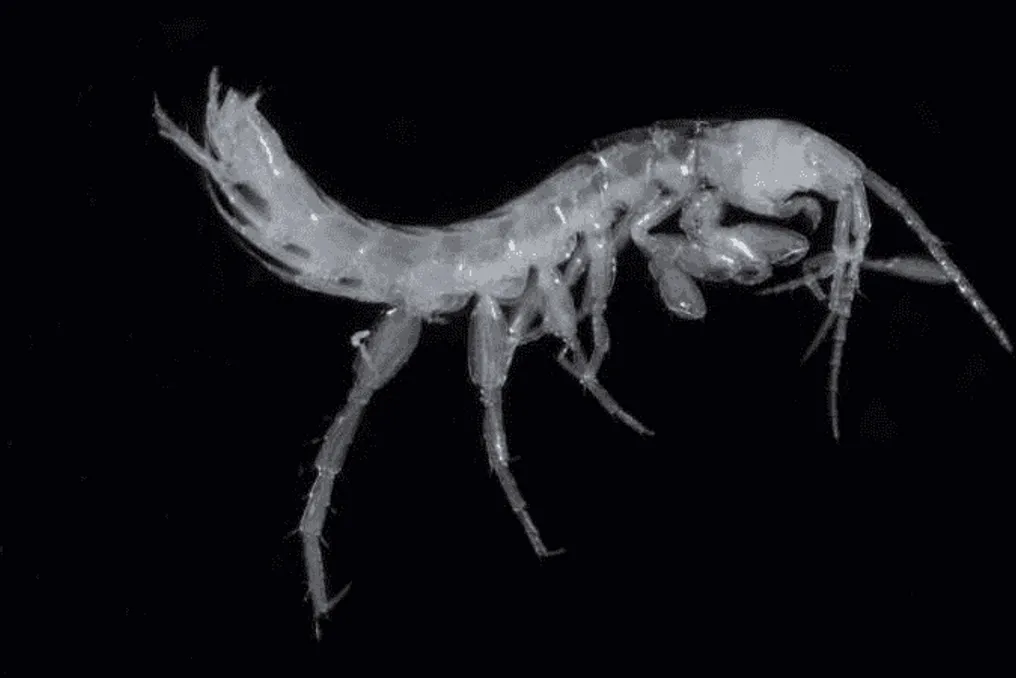
Two new species of small, shrimp-like crustaceans have been identified in underground water environments in Japan. These animals belong to the genus Bogidiella and were found in subterranean aquatic ecosystems on the Ryukyu Islands, a subtropical archipelago located in the southeast of the country.
Adapted to life in darkness, these organisms exhibit notable characteristics, such as the absence of pigmentation and eyes, along with elongated appendages, according to Phys.org.
Details of the New Species
The two species have been named Bogidiella isajii and Bogidiella painushima. The first was discovered in an underwater cave connected to the sea on Minamidaito Island. The second was identified in freshwater flowing through a cave on Ishigaki Island. Both locations are linked to groundwater systems, which have the potential to harbor highly specialized life forms.
The animals are part of the family Bogidiellidae, a group of amphipods capable of surviving in little-explored areas, such as underground streams and small connections between different water systems. These environments can contain fresh, brackish, or seawater-influenced water, creating varied conditions for subterranean existence.
The species B. isajii received this name in honor of Yoshitaka Isajii, who was responsible for its discovery. The specimens measure between 3.8 and 4.3 millimeters, comparable in size to a sesame seed. A prominent feature of this species is the lack of one of the pleopod branches, structures located on the posterior part of the body.
Additionally, the species lacks certain hardened structures on the first two pairs of uropods, appendages located near the caudal extremity. Another relevant trait lies in the telson, a structure at the tip of the body; in the collected specimens, this part is wider than long and has a distinct shape from those observed in other species of the same genus.
Meanwhile, the species B. painushima is slightly smaller, with individuals measuring between 1.4 and 3.2 millimeters. Its name derives from 'Painu-shima,' an Okinawan expression meaning 'southern island.' Despite sharing similarities with other members of the genus, this species shows differences in the head, antennae, telson, and gnathopods, which are used for feeding and cleaning.
Researchers also collected samples to determine the genetic sequences of the two species. The intention is to use this information in future investigations into the evolution of the animals and the diversity present in subterranean aquatic environments. The team believes that further research may reveal other unknown species in these locations.
According to scientists, groundwater is crucial for human activities, such as water supply and agriculture, but preserving these ecosystems presents a major challenge. Therefore, increasing knowledge about the biodiversity found in these systems can help develop protection strategies and prevent the degradation of natural areas caused by human action.