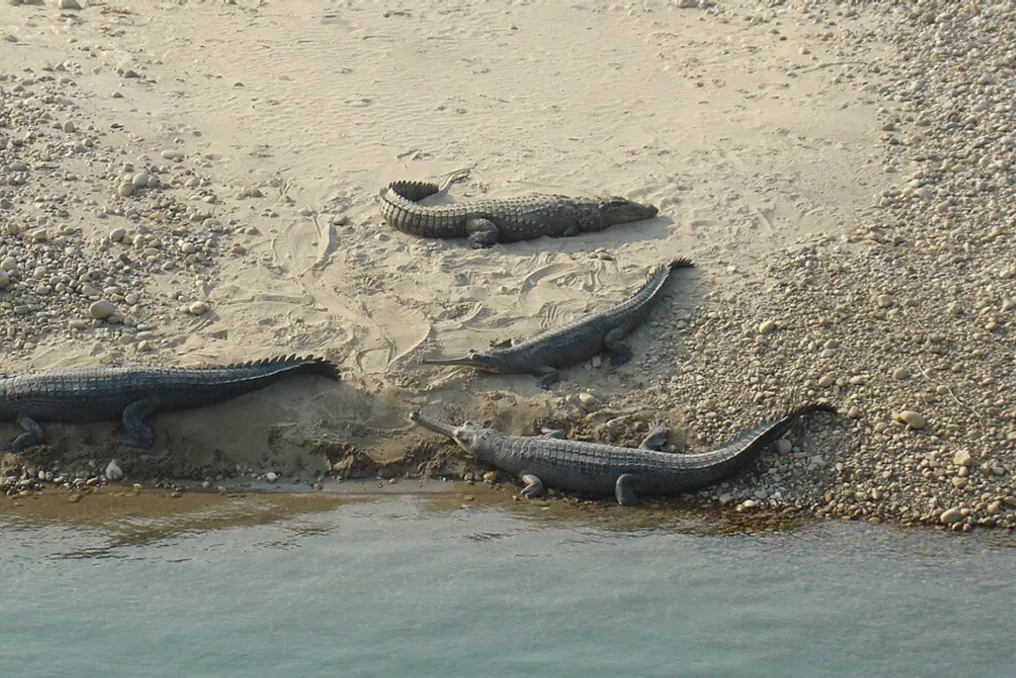
On the sandy shoals of the Gandak River in Bihar, a long-snouted reptile lies motionless, its jaw pointed downstream. Several meters away, fishermen untangle nets, while children walk along the bank to school. Once, the sight of the gharial caused panic here, but today, in some parts of the Gandak basin, people stop to protect it.
For years, in villages scattered across the Gandak floodplain, any crocodile attack was attributed to gharials. Few distinguished between the critically endangered gharial and the mugger crocodile, another species known for attacking humans. This confusion brought one of the world's rarest reptiles to the brink of extinction.
Dr. Samir K Sinha, chief ecologist at Wildlife Trust of India (WTI), told The Better India about the Gandak Gharial Restoration Project: 'The gharial is not a problem animal. The gharial has never attacked humans.' Unlike mugger crocodiles, gharials feed on fish. Their long, narrow snouts are adapted for catching fish, not large prey. They are naturally shy and highly sensitive to disturbance, so they tend to avoid people.
However, fear had already shaped the public perception along the Gandak. Dr. Sinha noted: 'The general psyche views mugger attacks as gharial attacks. It took a long time for people to understand that the gharial and the mugger are different animals.' This misunderstanding was dangerous because the Gandak river basin contains one of the few remaining gharial populations in the world, as well as the second largest after Chambal.
Classified as Endangered on the IUCN Red List, the gharial has experienced one of the sharpest declines among South Asian reptiles. Once widespread across the Ganges, Brahmaputra, Indus, Irrawaddy, and Mahanadi river systems, this species is now restricted to scattered areas in India, Nepal, and Bangladesh. It has already disappeared from rivers in Bhutan, Myanmar, and Pakistan. According to government data provided by Wildlife Trust Of India, wild gharial nests in India had dwindled to single digits by the early 1970s.
A River Created for Gharials
The Gandak is not an easy river to live on. It is fast-flowing and constantly changes its course, eroding banks, flooding settlements, and reshaping its geography every monsoon. But the same qualities that make the river difficult for humans are ideal for gharials. High sandy shoals along the river bends create nesting sites where females lay clutches of 40–50 eggs annually. The eggs incubate naturally under warm sand for several months before the hatched young break out of their shells and crawl toward the water.
Even in this case, survival remains uncertain. Floods can destroy entire nests overnight. Erosion consumes breeding grounds. Jackals, stray dogs, and birds predate the young before they reach the river. Only a small number survives long enough to become adults.
Dr. Sinha explained: 'Their survival heavily depends on the river remaining undisturbed.' The construction of dams and spillways, artificial embankments, destructive fishing methods, sand mining, and livestock movement have continuously reduced suitable habitats across the gharial's range. The Gandak has also faced growing anthropogenic pressure over decades.
Nevertheless, the river still offered hope. Around 2014–2015, conservation efforts in the Gandak were revitalized through the collaboration of the Bihar Forest Department, Wildlife Trust of India (WTI), and the World Wildlife Fund (WWF). At that time, awareness of the river's biodiversity was limited, and disturbance at nesting sites was common, with antisocial activities often going unpunished.
Then came a breakthrough. Dr. Sinha recalled: 'In 2015, some gharials were released. Then, in 2016, we realized that reproduction was occurring naturally in the Gandak River.' This discovery changed the project. Conservation teams identified six nesting sites along the sandy banks of the river. Annual population monitoring in 2016 later documented over 250 gharials of various age groups in the river system, confirming Gandak as one of the most vital remaining habitats for this species globally.
But identifying the nests was only the beginning. Conservation...
There are no formal classes along the Gandak educating people about gharials. Most informational campaigns were conducted on boats. Dr. Sinha said: 'There is no such training center. We sit on boats and calmly talk to local residents. They must feel their involvement in the process because they live here. They are the best informants.'
This approach proved effective. Instead of viewing villagers as outsiders in conservation matters, the project made them participants. Fishermen began finding and observing nests. Local residents started reporting poaching attempts and identifying vulnerable nesting spots before floods hit.
During the nationwide COVID-19 lockdown in 2020, community observers helped save 94 gharial eggs from being washed away by bank erosion. Over time, information campaigns, posters in local languages, and constant conversations slowly replaced fear with familiarity. Local media also played a crucial role in changing public opinion. Dr. Sinha noted: 'When people read about these incidents in their own language, they better understand the importance of the situation.'
In villages where gharials were once considered a threat, residents now intervene to protect the young. One resident told The Better India that previously, children used to destroy eggs or harm gharial hatchlings out of fear. The resident stated: 'We teach children not to harm them. Saving the gharial is our responsibility.'
Another recalled: 'Children used to throw stones at the hatchling until it died. When we learned about this, we rushed there. But by then, the gharial hatchling was dead. After that, we taught the children that killing gharials is wrong.'
For conservation specialists, such changes in attitude are extremely important. Because rivers survive when the people living near them start caring about what is disappearing from them.
Women Who Saw the Future
One of the most important keys in the history of Gandak's restoration was not satellite mapping or field equipment. It came from women speaking Bodhpuri on the riverbanks. In 2016, Dr. Sinha heard local women discussing 'Sugawa'—their term for a female gharial, identifiable by differences in snout shape. Curiosity prompted him to ask what they meant. One woman mentioned noticing a female gharial nearby. Dr. Sinha recalled: 'That very night gave us hope. Four or five days later, we found six nests in that area.'
This observation became the first convincing sign that reproduction was taking place in the river. Although women are often less visible in frontline conservation work due to social and logistical barriers, Dr. Sinha believes they are among the most perceptive observers of river ecology. He said: 'Women are very good observers. They play a very important role in gharial conservation.'
Today, conservation specialists estimate that nearly 80 percent of the Gandak River's length supports the presence of gharials. However, the species remains fragile. Floods and erosion continue to threaten nests every year. Dr. Sinha reported: 'Last year, eighty percent of the embryos died due to floods and erosion.'
Currently, a conservation and incubation center is being developed following a memorandum signed in 2022 to improve juvenile survival and strengthen long-term recovery.
A Fifty-Year Fight Against Extinction
The modern history of crocodile conservation in India began in 1975, when populations of gharials, muggers, and saltwater crocodiles collapsed across the country. With support from the United Nations Development Programme (UNDP) and the Food and Agriculture Organization (FAO), India launched the Crocodile Conservation Project to save the remaining wild populations. The strategy included collecting wild eggs, hatching them in protected centers, and releasing juveniles once they were large enough to survive in the rivers. Programs started in Odisha and Uttar Pradesh and subsequently spread to many states.
This initiative eventually led to the creation of 20 crocodile breeding and rehabilitation centers and 11 crocodile sanctuaries, including the Chambal National Sanctuary. By 2025, the restoration efforts became one of India's most successful wildlife conservation stories. According to WTI, almost 80 percent of the global gharial population, numbering over 3000 individuals, is currently in India.
Nevertheless, conservation specialists warn that restoration cannot depend solely on breeding centers or protected areas. Gharials travel vast distances in search of pristine river systems. One gharial released in the Rapti River in Nepal was later found more than 850 kilometers downstream in the Hooghly River in West Bengal in 2020. Thus, protecting one breeding population protects the entire river network.
And gharials are not the only species benefiting from this protection. Dr. Sinha noted: 'Protecting the habitat of crocodiles automatically ensures that other key river animals, including the Ganges dolphin, the extinct otter, northern river turtles, and various birds and fish, will also find safe refuge.'
Saving a Species by Changing History
The Gandak restoration project was never solely about increasing numbers. It was also about dismantling the fear deeply rooted in the collective memory. In many villages today, elders explain to children that the long-snouted reptile basking on the sandy shoal does not eat people. Fishermen, who once viewed gharials with suspicion, now report sightings to conservation teams. Local communities help monitor nests during the breeding season. A species once pushed to the brink of extinction is surviving because the people living closest to the river decided it deserves a future there.