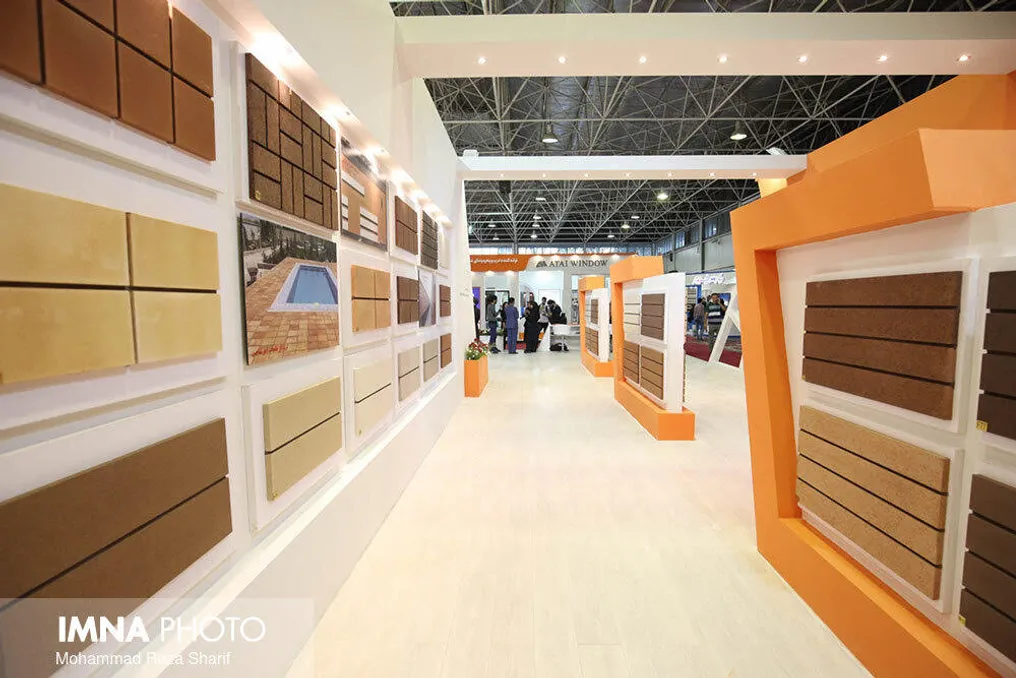
The 26th International Exhibition of the Construction Industry took place in Tehran, featuring the participation of over 600 domestic and foreign companies. The event was held at the permanent site of the Tehran International Exhibition Center.
According to IRINA, the exhibition, which covered various sectors including equipment, building materials, doors and windows, elevators, mechanical and electrical installations, as well as smart systems and architectural solutions, ran from August 18 to 21 across 20 exhibition halls and open spaces of the Center. The Iranian Chamber of Commerce organized the event.
Call for Private Sector Participation in Shaping Construction Industry Decisions: Minister
The Minister of Transport and Urban Development emphasized the significant role of the private sector in stimulating the construction industry. She stated that the government should not replace the private sector and the population in the construction sphere, but instead should remove obstacles, simplify processes, and support existing opportunities for construction development and increasing housing affordability for the public.
Farzane Sadeghi, speaking at the opening ceremony of the 26th Construction Industry Exhibition on Tuesday, reported that her ministry has conducted extensive consultations in recent months with representatives of the private sector across all segments related to construction, investment, development, contracts, mass housing construction, and the entire associated chain.
The Minister stressed that the private sector must not only fulfill tasks but also participate in policy formation and decision-making. Sadeghi continued, noting that one of the key outcomes of meetings with activists and industry elites was the creation of a dedicated group to eliminate production barriers with maximum private sector involvement. This group is formed under the Supreme Housing Council and, under the guidance of the First Vice President, reviews issues in the construction sector, particularly concerning housing.
The Minister specified that the findings of these reviews will be presented at the first meeting of the Supreme Housing Council. She acknowledged that the country's special conditions, sanctions, and military actions have exacerbated some problems, but administrative inefficiency is not linked to war or sanctions, and the ministry is making every effort to reduce this inefficiency. Issues such as insurance, taxes, customs duties, projects, the process of issuing construction permits, technical regulations, rules of the Supreme Council for Urban Planning and Architecture, and provisions of the Deputy for Housing Construction and National Building Codes were examined.
Correcting Norms and Facilitating Construction
Sadeghi also mentioned that issues related to the National Engineering Organization and projects that could shorten the time for issuing construction permits—a problem that had long concerned the private sector and investors wishing to enter the housing sector—were reviewed. She added that several issues related to cooperatives, mass construction, contractors, and supervisory bodies were resolved through current meetings and cooperation with the National Engineering Organization and the Deputy for Housing Construction, and some guidelines were revised and communicated.
The Minister noted that other problems, due to their intersectoral nature and falling outside the ministry's jurisdiction, required coordination with other structures, and such coordination was carried out. Speaking about the country's energy consumption situation and the need to reform construction processes, Sadeghi stated that one of the most important tasks is the industrialization of construction. She emphasized: 'We have always talked about increasing production and the number of construction sites, but we talked less about reducing costs. If we can reduce construction costs without compromising quality, production will also increase.'
She recalled that industrialization attracts attention due to greater speed, lower cost, higher technical complexity, and better quality. The Minister further stressed that the issue is not just about construction costs—it is also necessary to reduce the operational and maintenance costs of buildings. This issue is being addressed through cooperation with the private sector and the National Engineering Organization nationwide.
Sadeghi also mentioned measures taken with the assistance of the Parliamentary Civil Committee to promote professional leasing. She stated that when discussing housing construction and applicants, full ownership should not be the only consideration. Given the differences in solvency and needs between provinces and cities, satisfying everyone's housing needs is not possible solely through ownership. She noted that governments have been involved in supporting housing construction for years, and the level of access for real applicants—including the first four income deciles and young couples—to housing has been studied. Therefore, leasing and professional leasing can solve a significant part of the demand for quality housing.
The Minister added that part of this relates to social support rentals, while another part relates to facilitating construction by mass developers, developers, and investors to build housing suitable for the capabilities of different social strata, including the middle class. Sadeghi continued that numerous meetings have been held with mass developers, contractors, and developers to simplify processes within the ministry's competence. The utilization of potential in aging urban areas and urban regeneration using the private sector for developing professional leasing is also being implemented.
She named the regulation of the rental market as another important issue, noting that during periods of inflationary spikes—which may be caused by factors outside the housing and construction sectors—appropriate regulation must be carried out through the development of professional leasing, and in this area, the private sector and municipalities can provide significant assistance.
The Minister of Transport and Urban Development, referencing the President's emphasis on the role of the private sector, stated that the government's approach is not to replace the private sector. In housing and construction matters, the government should not intervene to build instead of people and the private sector. Sadeghi added that the government must recognize and support potential, as well as remove obstacles, and the issues raised ultimately boil down to removing barriers, providing support, and simplifying processes.
Iran Possesses High Potential in Technical and Engineering Services
Addressing the presence of representatives from various countries at the 26th Construction Industry Exhibition, she stated that the region where they live is in urgent need of Iran's strong capabilities in infrastructure, materials, equipment, and, most importantly, technical and engineering services. A member of the 14th government cabinet noted that the 26th Construction Industry Exhibition is not just a platform for demonstrating capabilities but a platform for dialogue aimed at maximizing interaction between countries.
As the Minister of Transport and Urban Development participating in joint economic committees with neighboring countries, she highlighted Iran's potential in technical and engineering services during these meetings and accompanied private sector activists during recent trips. The Minister expressed gratitude to private sector activists, engineers, and Iranian contractors, stating that Iran's engineering and construction capabilities are so impressive that even if a bridge is damaged, Iran's rich engineering knowledge can restore it within a few hours.
Meanwhile, Mohammad Ali Dehghan Dehnavi, head of the Iranian Trade Promotion Organization, stated in his message to the exhibition that the Tehran Construction Industry Exhibition contributes to the development of the construction industry in Iran and the region, leading to the development of construction projects and related equipment. He noted that the 26th Tehran International Construction Industry Exhibition is a suitable opportunity for industry activists to familiarize themselves with the latest technologies, modern construction methods, new building materials, equipment for 'smart' construction, mechanical and electrical systems, and specialized engineering services.
Dehghan Dehnavi's message indicated that this exhibition is one of the largest in the Middle East and the largest in the country in this field, hosting both domestic and foreign visitors annually. Domestic companies have the opportunity to participate, and companies from various parts of the world are present. The Head of the Trade Promotion Organization added that the exhibition helps raise the level of the construction industry in Iran and the region and will contribute to the development of construction projects and corresponding equipment. Companies can showcase their products in new markets and explore cooperation potential with foreign firms.
Dehghan Dehnavi added that the Iranian construction industry market has high potential for presence due to domestic demand and will expand the market for knowledge-based companies. The goal of the exhibition is to present the latest achievements, modern technologies, products, and services related to the construction industry, and it will host manufacturing companies, builders, engineers, architects, consulting engineering firms, and activists in the fields of installations, building materials, and construction equipment. Another part of the message stated that significant efforts have been made over the past decades to develop the export of construction products and materials in the country. Iran, possessing rich raw material reserves, cheap energy, inexpensive labor, and high-quality manufactured products, has achieved a significant competitive advantage in global markets. Neighboring countries, such as Iraq, Turkey, and Afghanistan, are major importers of Iranian building materials, accounting for several million dollars of Iranian exports; this is particularly attractive due to geographical proximity, low transportation costs, and favorable customs tariffs in these markets. Furthermore, in the field of steel structures, Iran, thanks to the production of high-quality and competitive steel, can export at least one million tons per year, which can bring significant foreign currency revenue into the country.
Dehghan Dehnavi continued that the export of construction materials, given its enormous potential, could become one of the main sources of foreign currency inflow and a key driver of Iran's economic growth, but this path is not without challenges. Structural barriers and external difficulties continue to impede its growth. To turn this opportunity into a great success, effective cooperation between the government, trade institutions, and exporters is necessary. Moreover, compliance with domestic and international legal requirements is crucial for moving along this path.