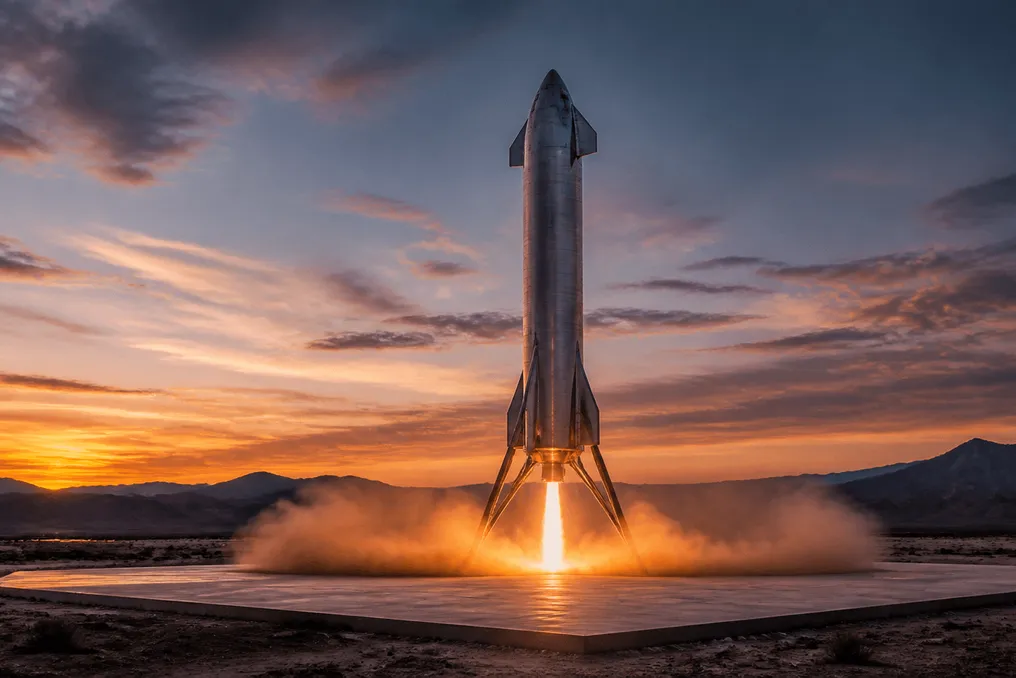
According to CCTV, on August 19, the Zhuque-3 Y-2 rocket launched from the Dunfeng Commercial Aerospace Innovation Pilot Zone and successfully landed at the Zhuque-3 landing site in Minqin County, Gansu Province. This flight marks the first controlled return of a booster's first stage in China and the first ground return of an orbital-class first stage.
This flight is an important test that transitions Zhuque-3 from the technology verification stage of return to the engineering reusability verification stage. The mission also confirmed the correctness of the design and the reliability of the Zhuque-3 reusable launch system product, confirming the first stage's ability to return and its engineering maturity amid the acceleration of China's commercial space towards reusable rocket engineering validation.
The Zhuque-3 rocket (model ZQ-3) is a large, low-cost, reusable liquid-propellant booster developed by LandSpace for missions involving the creation of large satellite constellations. It features a two-stage sequential configuration with 4.5-meter diameter sections, a 5.2-meter fairing, a total length of 66.1 meters, a liftoff mass of approximately 570 tons, and a liftoff thrust of 7,542 kilonewtons. Stainless steel is used as the primary structural material.
The first stage is equipped with nine TQ-12A engines running on liquid oxygen and methane, as well as RCS systems, stabilizing fins, and landing gear necessary for return. This enables autonomous return after orbital missions and a soft landing at the site for subsequent use.
The first orbital flight of Zhuque-3 took place in December 2025. In mission Y-1, the second stage reached the planned orbit, and the first stage executed most key maneuvers during return; however, an anomaly occurred during the landing ignition, and a soft landing at the landing site did not occur. Nevertheless, this flight allowed for the collection of real data to optimize the return plan.
Based on the data from mission Y-1 and accumulated engineering experience, targeted improvements were made to key stages of the reusable flight in mission Y-2. The engine system for landing ignition was simplified, reducing the number of such engines and increasing reliability. Furthermore, an onboard autonomous safety control system with a function for predicting a safe landing point and an optimized return management strategy was added, improving safety and autonomy. The heat shield and atmospheric entry load protection design was also optimized for extreme conditions.
Mission Y-2 also utilized a self-developed LandSpace 'stacked compression' release device without pyrotechnic elements, which further confirmed the effectiveness of this scheme in a real flight to support the creation of large satellite constellations, rapid batch deployment, and increased launch efficiency. This mission lays a solid foundation for subsequent inspection of returned vehicles, maintenance, reuse flights, and commercial application.
LandSpace has stated its intention to continue iterating on reusable technologies and engineering validation to strengthen China's low-cost, high-frequency, and highly reliable space transportation, providing new capacity for creating large satellite constellations and scalable commercial launches.