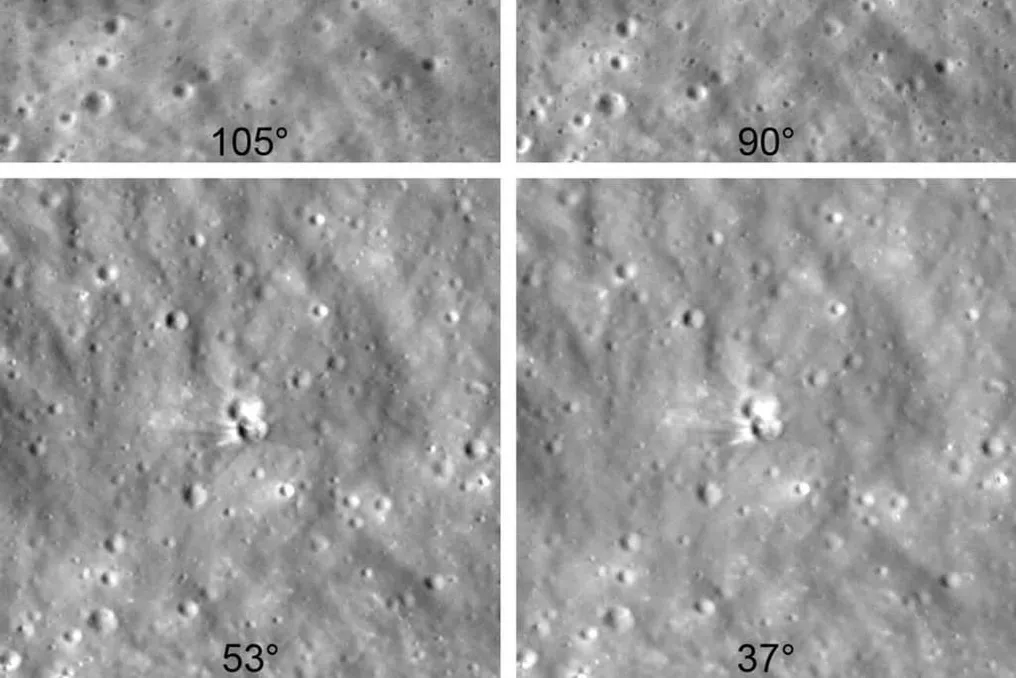
NASA obtained detailed records of a crater formed on the Moon after the impact of an upper stage of the Falcon 9 rocket, manufactured by SpaceX. The images were collected by the Lunar Reconnaissance Orbiter (LRO) between August 11 and 12, six days after the object hit the lunar surface.
The impact event occurred on August 5, when the Falcon 9 upper stage, which had been launched in January 2025 to transport the Firefly Aerospace's Blue Ghost 1 mission to the Moon, collided near the Einstein crater.
To photograph the site, NASA engineers had to tilt the LRO to focus its cameras on the impact area during each pass. The probe was at an altitude of approximately 97 kilometers and moving at about 1.6 km/s. The LRO completes a full orbit around the Moon every two hours, passing from pole to pole, which required waiting until the impact site was in the correct position to be recorded, taking six days.
Capturing the image demanded extreme precision; according to NASA, if the camera had registered the target ten seconds earlier or later, it would have shifted from the center of the image by about 16 kilometers.
More information about the crater formation
The darkest areas within the crater are composed of dust and rocks that have been exposed to the lunar surface for long periods. This material has undergone changes due to the influence of solar wind, galactic cosmic rays, and micrometeorite collisions. The Falcon 9 impact excavated this material from a depth of approximately 46 centimeters beneath the surface.
In contrast, the lighter bands, located near the edge of the crater, are made of more recent material that was buried in deeper layers and was ejected during the collision.
The exact location of the crater was established through a collaboration involving independent astronomers and professional specialists. Initial calculations of the Falcon 9 stage's trajectory were made by independent astronomers using public data. Subsequently, NASA's Center for Near Earth Object Studies (CNEOS) refined this trajectory and used the incident to test impact prediction methods.
CNEOS, located at the Jet Propulsion Laboratory (JPL) in California (USA), transmitted the predicted impact location to South Korea. The latter used the Danuri probe, also known as the Korea Pathfinder Lunar Orbiter, to search for the crater. Danuri's high-resolution LUTI camera managed to record the site a few hours later, and the predicted position had an error margin of approximately one kilometer.
After locating the crater, the Danuri mission team provided the coordinates to the researchers responsible for the LRO. This information helped NASA refine the probe's observation sequence. Comparing pre-impact images with the new records allowed NASA to update the crater's central position to 19.4759° North latitude and 266.7138° East longitude, at an altitude of 511 meters.
This event provides scientists with a unique opportunity to investigate how a large artificial object alters the lunar surface. Simultaneously, the data obtained aids in testing methodologies that can be used to identify future impacts and better understand the dynamics of material ejection during lunar collisions.