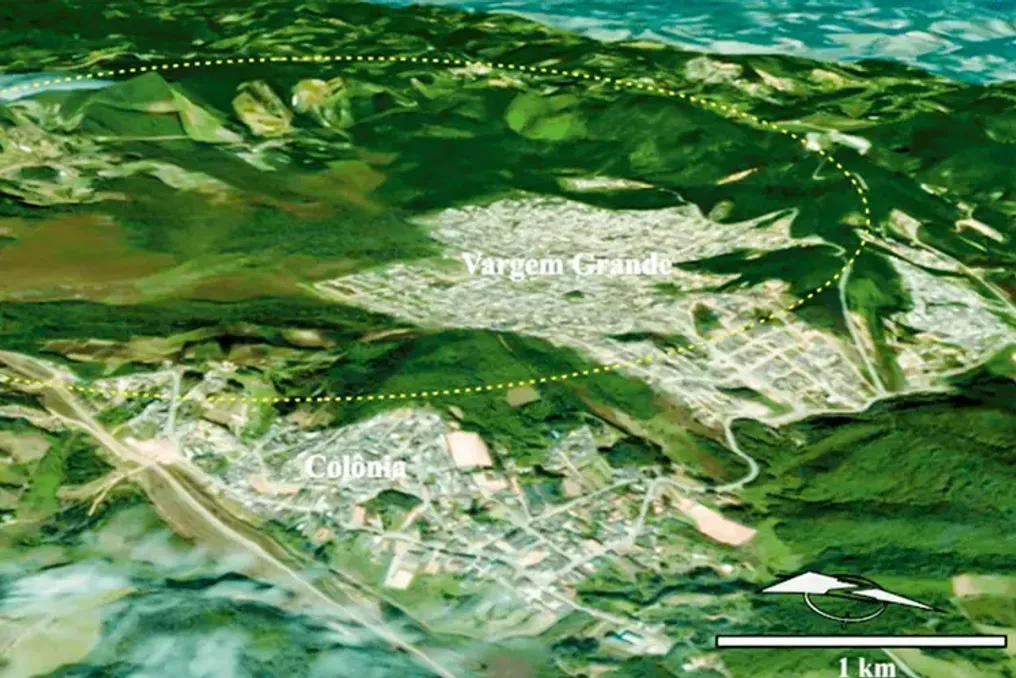
Researchers have discovered that the enigmatic crater located in the extreme south of São Paulo appeared in the early 1960s. Satellite imagery revealed an unusual landscape in the Pareleiros area. It was a circular depression with a diameter of about 3.6 kilometers and a depth of approximately 300 meters, covering almost the entire Vargam Grande area.
The Colonia Crater, as it became known, turned into the main object of geological rarity in the state capital and was included in the Condepaat registry (Council for the Protection of Historical, Archaeological, Artistic, and Tourist Heritage) in 2003. Despite this, specialists long doubted the source of this impact. Hypotheses existed that the cause could be a celestial body, such as a comet or meteorite, or it could have been a volcanic crater.
However, a recent article published in the journal Earth and Planetary Science confirmed that the crater is the result of a celestial body collision millions of years ago—it was an asteroid. Researchers from the University of São Paulo (USP) and the Institute of Environmental Studies (IPA) reached this conclusion based on a mineral found in samples extracted from the crater. Zircon grains are capable of preserving traces of extreme pressure and temperature events.
The study showed that the deformations found in the mineral correspond to the impact of an asteroid. Furthermore, it was established that the zircon itself does not have extraterrestrial origin but was already present in the rocks before the impact.
This is the first case in Brazil where the presence of zircon resulting from an asteroid impact has been registered. In 2013, geologist Victor Velasquez Fernandes from the USP School of Arts, Sciences, and Humanities began studying the features of the crater. His early work helped structure its official inclusion in the international crater registry. At that time, he had already discovered signs proving that the crater was formed by the fall of an extraterrestrial body.
Initially, the researchers' reference point, the Colonia area adjacent to Vargam Grande, later gave the structure its name—Colonia Crater. This site, one of the few inhabited structures resulting from an asteroid impact in the world, has between 40 and 60 thousand residents.
Since the initial impact, the date of which the authors have not determined, the crater has been filled with sediments and plant remains. Nevertheless, this habitation led to the destruction of macroscopic evidence related to this phenomenon. Therefore, researchers decided to resort to microscopic analysis, examining the internal scars and other impact-induced deformations in selected zircon samples.
Six zircon grains were selected out of a total of 40 based on their degree of preservation and level of deformation for detailed microscopic characterization. These deformations indicated shock waves, confirming that they originated from an asteroid impact, not tectonic activity or metamorphism, as they exceed the type of deformation created by endogenous pressure. The next steps in the research involve applying other methods, such as dating, to gain a clearer understanding of how and when the collision occurred.