Brazilian open television is preparing for a major historical change with TV 3.0, the operation of which is scheduled to begin in 2027. This project seeks to integrate the traditional experience of broadcasting with the resources currently available on the internet and digital platforms.
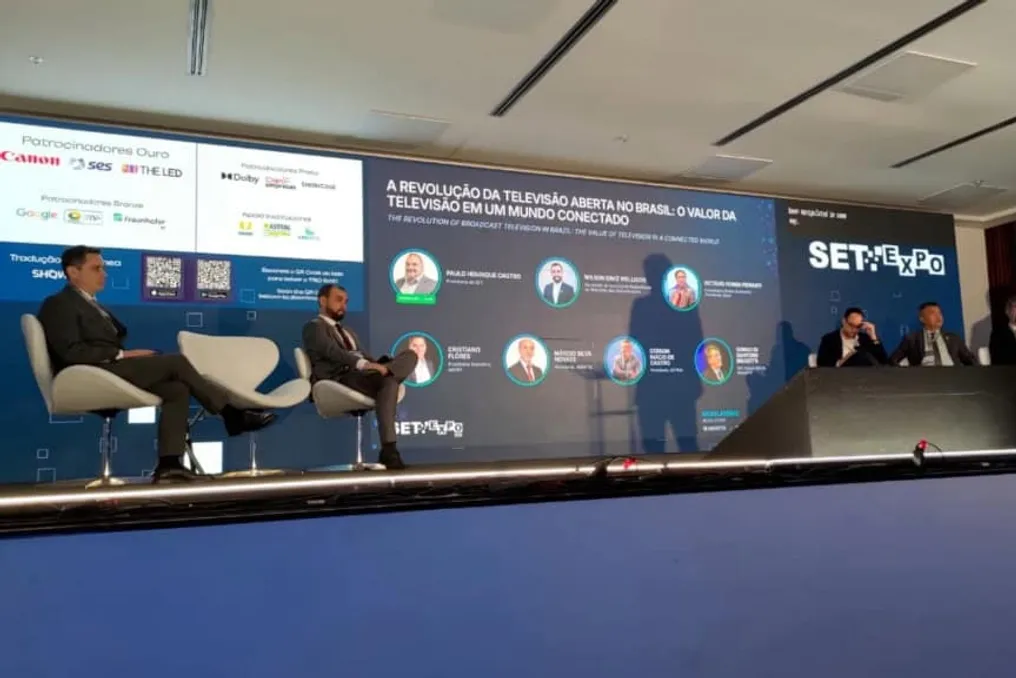
This topic was debated during the panel titled 'The Revolution of Open Television in Brazil: The Value of Television in a Connected World,' held at SET Expo 2026 in São Paulo on the 18th.
The event featured the participation of several important figures, including Wilson Diniz, Secretary of Broadcasting Services; Otávio Penna Pieranti, Board Director of Anatel; Cristiano Flores, Executive President of ABERT; Samir Nobre, representing Márcio Novaes, President of ABRATEL; Gerson Inácio de Castro, President of ASTRAL; and Sérgio Santoro, from the SBTVD Forum.
The central topics addressed included progress in the implementation of TV 3.0, regulatory changes in the sector, how open television is distributed on digital platforms, and the sociocultural role of Brazilian broadcasting.
The Experience Phase and Infrastructure
According to Wilson Diniz, TV 3.0 is already undergoing testing phases, and its transmission module has been established using ATSC 3.0 technology. More than ten thousand converters have already been commercialized, and several broadcasters are organizing to start operations in cities such as Brasília, Rio de Janeiro, São Paulo, Curitiba, Salvador, and Recife. Furthermore, there are subsidized credit lines totaling R$ 7 billion underway to expedite the adoption of this new technology, with operation projected to begin in early 2027.
However, the transformation goes beyond just improving signal quality. A significant challenge pointed out is the need to reformulate the linear television model, making it closer to concepts of on-demand TV, satellite, and multi-platform connectivity.
Regulatory Changes and Access Challenges
Diniz also mentioned recent regulatory modifications, citing Law 14.812, which raised the limit on licenses per group, and Law 15.182, responsible for broad deregulation of the sector and the annulment of about four to five thousand processes.
How the public accesses content was also identified as a major obstacle. Otávio Penna Pieranti, from Anatel, emphasized that daily television viewership in Brazil exceeds five hours. He observed that TV manufacturers created barriers to accessing open channels, benefiting services distributed via the internet through commercial agreements. In this context, TV 3.0 emerges as a chance to restore some of the importance of broadcasting within connected televisions themselves.
Pieranti also warned about the negative consequences of the lack of local broadcasters, as regions without these operations lose not only information but also job opportunities and spaces for cultural debate. The Anatel representative guaranteed that regulation will not delay the implementation of TV 3.0.
The Social and Economic Role of Television
For Cristiano Flores, Executive President of ABERT, the debate must encompass the interconnection between television, the internet, and access to information. Presenting data, Flores reported that Brazilians spend an average of nine hours daily connected to the internet, while the country faces low rates of digital literacy. Given this scenario, he argued that open television plays a crucial role in combating industrially generated disinformation.
Flores outlined three essential pillars for the future of the sector: ensuring freedom of expression and strengthening journalism, including protection against artificial intelligence; establishing clear and impartial rules for distribution on digital platforms and connected televisions; and promoting the full development of TV 3.0. The President of ABERT also requested that Brazilian communication be recognized as a 'Strategic National Industry.'
Another point raised was the dispersion of digital policies across more than six government secretariats, which, according to Flores, prevents the creation of a centralized State policy for the segment.
Samir Nobre, representative of ABRATEL, commented that open television has undergone several transformations over the past decades, such as the advent of pay-TV, streaming platforms, and social media. During this process, the broadcasters themselves expanded their activities beyond conventional transmission, utilizing digital platforms like Globoplay, Record Play, and SBT Play.
The analysis conducted at the panel indicated that open television maintains its participation in political and social debate, even when content consumption migrates to other digital channels. As an example of its relevance, Nobre cited free electoral advertising and questioned the audience about support for its end.
Cultural Heritage and Technology
The status of Brazilian television as cultural heritage was another topic discussed. Gerson Castro, President of ASTRAL, argued that open television should not be seen merely as a producer and distributor of content, but also as a cultural shaper for various generations. From this perspective, Castro advocated that TV 3.0 be considered a national cultural heritage.
The representative also drew attention to university televisions, which possess unique historical archives and require public funding policies to ensure their preservation and continuity. Artificial intelligence also entered the conversation, with Castro warning about the use of this technology in creating bumpers and other materials, which could lead to the decharacterization of broadcaster identities.
Technically, Sérgio Santoro presented the work of the SBTVD Forum, which will complete 20 years in 2026. The development of TV 3.0 began with a call for proposals in 2019 and, according to Santoro, received international recognition for its conducting methodology. At SET Expo, the SBTVD Forum signed a Memorandum of Understanding (MoU) with ATC and TTA from Korea, focused on standard convergence, aiming to increase the global scale of technologies and thus reduce the cost of reception equipment, although these benefits are expected in the medium term.
Santoro also pointed out a distinction between operating environments: while Brazilian broadcasting is strictly regulated, digital platforms operate under a different set of rules. The discussions revealed that the arrival of TV 3.0 is not merely a technical update of the signal, but rather a broad debate on how channels will be located on smart TVs, how Brazilian content will be distributed on digital platforms, and what the role of open television will be in an ecosystem where streaming, the internet, and broadcasting are increasingly integrated. With the first operations planned for 2027 and broadcasters preparing in several Brazilian capitals, the next phase of open television will depend as much on technological implementation as on defining rules for this new connected landscape.