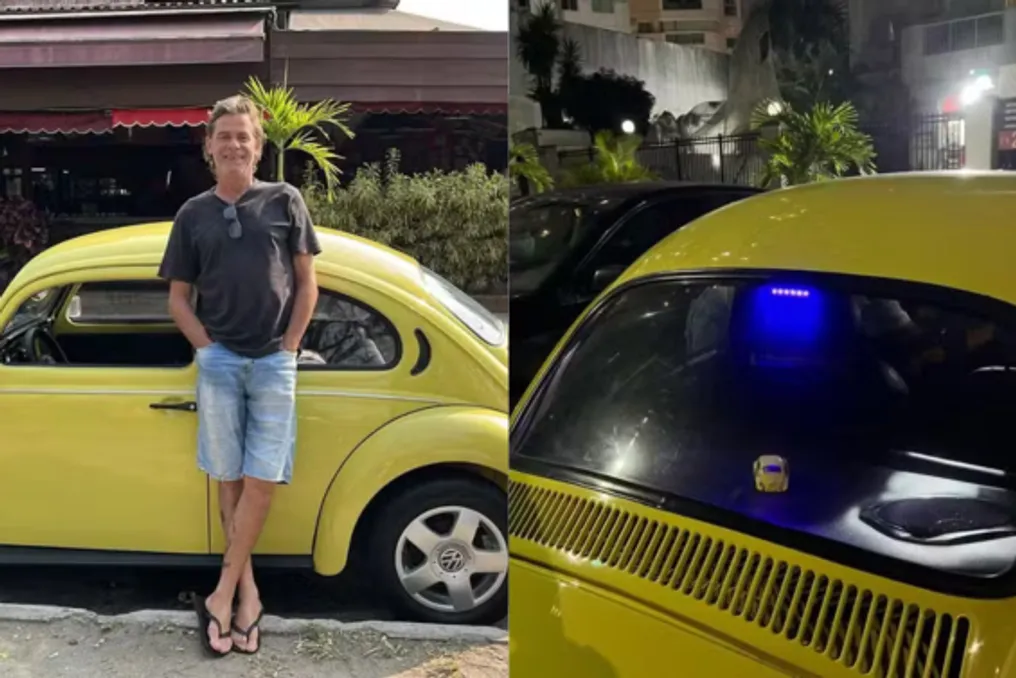
The idea of the 'Thank You Light,' created by actor Marcos Winter to foster cordiality while driving, has evolved from a manual adaptation made on a 1977 Beetle to a legislative suggestion currently under review in the Chamber of Deputies. Bill 2729/2026 aims to modify the Brazilian Traffic Code (CTB) to allow for the optional use of a courtesy light signal.
Although many drivers already use their horn or headlights to express thanks or apologize, this practice is not standardized and is not regulated by the CTB, which can result in fines for the driver even if their intention is positive. Therefore, the introduction of a new complementary light on vehicles was suggested to eliminate ambiguities and create clear legal guidance.
Origin of the Idea
The concept arose twenty years ago when Marcos Winter installed a blue LED controlled by a button on the dashboard of his yellow Volkswagen Beetle. The purpose was to address a gap in road communication by offering a specific indicator to say thank you, apologize, or show cooperation, preventing the incorrect use of the horn, hazard lights, or high beams.
In collaboration with Thiago Paschoa, the model includes a secondary lighting system integrated into the car, activated by a specific button or voice command. To ensure safety, the installation must follow a triangular arrangement relative to the original headlights and taillights, guaranteeing that there is no interference with brake lights, turn signals, or emergency signals.
Details of the Legislative Proposal
Federal deputy Amom Mandel presented Bill 2729/2026, which stipulates that this device will be strictly optional, educational, and without priority status. This courtesy light does not grant right of way nor does it alter general circulation rules.
The proposal received conceptual support from the Brazilian Association of Traffic Medicine (Abramet) and the National Association of Automotive Manufacturers (Anfavea). Abramet argues that the measure aligns with traffic psychology by implementing the concept of 'nudge' (behavioral stimulus), encouraging courtesy to reduce incidents of stress and hostility between drivers.
Although the equipment has generated media attention and is undergoing patent application with the National Institute of Industrial Property (INPI), it is not yet authorized for use in Brazilian vehicles. If the project is approved by Congress, the National Traffic Council (Contran) will be responsible for defining the color, intensity, operating time, and approval procedures. The project also provides for the future possibility of collecting anonymized statistical data to support studies on human behavior in traffic.