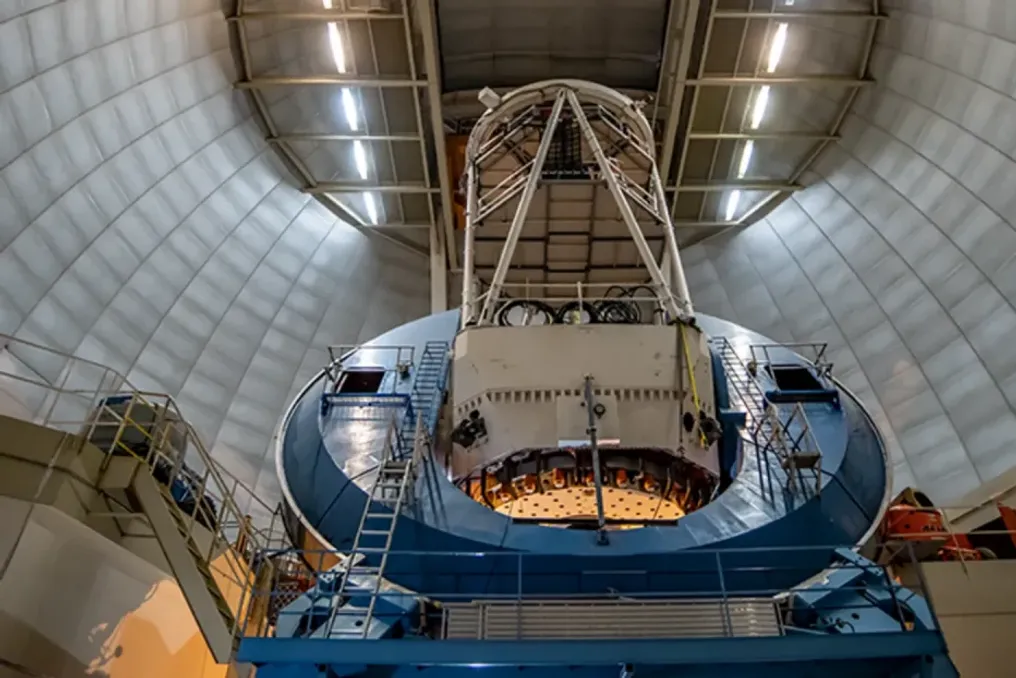
For decades, the standard cosmological model treated dark energy as a constant value responsible for the accelerating expansion of the Universe. However, results published in 2025 using the Dark Energy Spectroscopic Instrument (DESI) have revealed an intriguing possibility: this mysterious component may not be constant and could change over time.
The second series of DESI data (DR2), based on observations from the first three years, showed consistency with the standard cosmological model ($ ext{\Lambda CDM}$), which assumes the constancy of dark energy. At the same time, these results pointed towards a preference for the hypothesis of its evolution throughout the history of the Universe.
In a study published on March 19 last year, the DESI collaboration combined DR2 data with observations of the cosmic microwave background and three sets of Type Ia supernovae. Depending on the sample used, the analysis showed a preference in the range of 2.8 to 4.2 sigma for a model that allows for the evolution of dark energy.
It is important to note that this result does not mean that DESI has discovered a new form of energy, as the statistical significance is still below the 5-sigma threshold typically associated with a scientific discovery. Furthermore, the analysis itself depends on the combination of different datasets and the mathematical description of dark energy's behavior.
It is in this area that subsequent works have begun to re-evaluate the interpretation of the obtained data. One of the latest doubts arose on July 31 from a study conducted by Jin-Young Kim from Stanford University and the investment firm Two Sigma, as well as David F. Mota and Andrius Tamosiusnas from the University of Oslo, Norway.
The team applied a statistical approach developed for re-analyzing the same data as it becomes available. Bruno Quint, an astrophysics doctor from the University of São Paulo (USP) and operations specialist at the Vera C. Rubin Observatory, noted that such re-evaluations highlight fundamental questions about the very nature of dark energy. He stated in an interview with Olhar Digital: 'The honest answer begins with acknowledging: we do not know what it is. Dark energy is a name we gave to what causes the Universe's expansion to accelerate, without defining its nature.'
This uncertainty helps explain why different analyses may reach different conclusions when trying to determine whether dark energy is truly constant. In a new study, scientists noticed that the evidence is concentrated almost exclusively in the LRG2 range, which corresponds to a specific distance and epoch in the history of the Universe determined by redshift.
When this range is excluded from the analysis, the result shifts slightly towards the $ ext{\Lambda CDM}$ model. Moreover, when considering the possibility of an excess in any of the seven analyzed regions, the signal fails to maintain statistical correction.
Based on these results, the authors classify this signal as fragile, concentrated in one region, and dependent on the test specification, rather than considering it reliable evidence for dynamic dark energy.
A few days earlier, on July 26, another group reached a similar conclusion using a different method. The study employed a statistical technique known as Gaussian process, which allows reconstructing the history of the Universe's expansion based on data without requiring a prior assumption about the specific formula for dark energy's behavior.
The combination of DESI DR2 data with information on the cosmic microwave background, supernovae, and 'cosmic chronometers' still showed some preference for evolving dark energy. However, this preference weakened when researchers tested various models and data combinations. In some analyses, the difference from the standard model was close to 1 sigma, which is considered a weak level for substantiating scientific proof.
Another re-evaluation led to an even more provocative conclusion. In a paper by Dilin Duan Ing, David Yallup, and Will Hendley, all from the University of Cambridge, UK, they analyzed the results using a Bayesian approach that penalizes more complex models. When using DESI data and the Planck satellite, the indication of possible dark energy change lost strength. When the researchers used a revised version of the supernova data, this evidence disappeared. According to the authors, part of the previous signal might have been caused by the way this data was calibrated.
Despite this, not all recent studies weaken this hypothesis. An analysis published on July 1 showed that the preference for dynamic dark energy persists when considering various extensions of the cosmological model. In the most optimistic estimates, DESI's preference for the dynamic model reached 99.995% confidence—about one in twenty thousand chance of randomness. Nevertheless, as Quint explains, astronomy requires even greater rigor. 'This is below near-complete certainty that astronomers usually require to announce a discovery.'
Another work, available for review on the arXiv repository on August 7, presented a possible additional explanation for part of the discrepancy. Nils Schöneberg from Ludwig Maximilian University of Munich and Max Planck Institute for Physics; Rodrigo Calderon from Ludwig Maximilian University of Munich; and Julien Lesgourgues from Technical University of Munich and Max Planck Institute for Physics, all from Germany, argue that solutions to the Hubble tension problem related to early Universe physics could significantly reduce the evidence attributed to dynamic dark energy.
Thus, the situation is far from a final conclusion. DESI data continues to show an interesting anomalous effect compared to the simplest model of the Universe, but independent studies indicate that the strength of this evidence depends on how the data are combined, calibrated, and analyzed.
At present, the most important question is not whether dark energy has 'disappeared' or is 'weakening.' It is crucial to find out whether the observed signal represents a real characteristic of cosmic expansion or a combination of statistical, systematic effects, and model selection. New data will be decisive in clarifying this issue. Observatories such as Euclid, Nancy Grace Roman, and Vera C. Rubin will be able to provide new observations of the Universe's expansion and help verify whether different datasets point to the same conclusion. 'Testing this possibility—comparing different effects and observing their consistency—is precisely what the Rubin Observatory was built for,' concludes Quint.